Skip to content

Elementary Mathematics 2024 (I)

Set A

Questions 61–80 of 100

61Algebra • Expressions • Inequalities
Moderate

Consider the following for the next ten (10) items that follow :

Each item contains a Question followed by two Statements. Answer each item using the following instructions :

Choose option

(a)
If the Question can be answered by one of the Statements alone, but not by the other.
(b)
If the Question can be answered by either Statement alone.
(c)
If the Question can be answered by using both the Statements together, but cannot be answered by using either Statement alone.
(d)
If the Question cannot be answered even by using both Statements together.

Let , , and be positive integers.

Question : Which one of , , , is closest to the product ?

I
II
is not the smallest.
Options
Show answer & solution

Option C

If the Question can be answered by using both the Statements together, but cannot be answered by using either Statement alone.

Approach

Each factor is at most the product, so the closest to the product is the largest of the four numbers. Then see which statements fix the largest.

Step-by-step solution

  1. 1
    for each factor , so is smallest for the largest

    Why: Each number is a positive integer, so the product is at least as large as every factor. The closest factor is therefore the largest one.

  2. 2
    Statement I: , but is unknown. The largest is or

    Why: Nothing compares with , so I alone is not enough.

  3. 3
    Statement II: nothing about the order of , , follows from it alone

    Why: II says only that some other number is smaller than . This gives no largest number.

  4. 4
    I and II together: only can be smaller than , so and is the largest

    Why: From I, and are larger than . II says some number is smaller than , so it must be . The order is then fully known.

Common mistakes

Option A

Took statement I alone as enough because is the largest of . Missed that could be larger.

Option B

No route reaches 'either alone': statement II gives no order at all.

Option D

Thought the two statements do not settle where stands. But 'c is not the smallest' with forces to be the smallest.
Ideal time: about 1.5 min
62Arithmetic • Number System • Prime Numbers
Moderate

Same directions as Q61

Let , where and are prime numbers and is an even number.

Question : What is the value of ?

I
II
One of the numbers is .
Options
Show answer & solution

Option D

If the Question cannot be answered even by using both Statements together.

Approach

Two primes whose product is even must include . Write the asked value in terms of the other prime and see what each statement fixes.

Step-by-step solution

  1. 1
    is even and , are prime, so one of them is

    Why: The only even prime is . A product of odd primes is odd.

  2. 2

    Why: Group the terms to see how the value depends on and .

  3. 3
    Statement I: forces , so the value is . This still depends on

    Why: If were an odd prime then would be a larger odd prime and would be odd. So . But is any prime larger than .

  4. 4
    Statement II repeats what the first line shows

    Why: It is already known that one of the numbers is , so II adds nothing.

  5. 5
    I and II together: still and is any odd prime, for example gives and gives

    Why: A single number is needed for the value, but two different values occur.

Common mistakes

Option A

Decided that I alone gives and stopped there, without noticing that is still free.

Option B

No route reaches 'either alone' for this question.

Option C

Took the smallest odd prime after finding , so the value looked fixed. can be any odd prime.

Skills used

Ideal time: about 1.5 min
63Arithmetic • Number System • Divisibility
Moderate

Same directions as Q61

Question : If is a positive integer, then what is the remainder when is divided by ?

I
is even.
II
is even.
Options
Show answer & solution

Option A

If the Question can be answered by one of the Statements alone, but not by the other.

Approach

A number is one less than the divisor , so write using . See which statement fixes the remainder.

Step-by-step solution

  1. 1
    after division by , so leaves the same remainder as

    Why: Here . Powers of a number one less than the divisor alternate between and , which is the remainder and the remainder .

  2. 2
    Statement I: even. Then is divisible by , hence by , so the remainder is

    Why: The factor divides for any . Here the base is and the other term is .

  3. 3
    Statement II: even gives no information about . If is even the remainder is ; if is odd it is

    Why: The remainder depends on whether is odd or even. being even does not decide it. For example : leaves after division by , while leaves .

Common mistakes

Option B

Thought that an even also settles the remainder. It does not: for the remainder is when and when .

Option C

Believed that must be known as well, as if the remainder depended on the actual value of . It depends only on whether is even.

Option D

Believed that the remainder cannot be found without the value of . The remainder is for every when is even.

Skills used

Ideal time: about 1.5 min
64Algebra • Surds
Moderate

Same directions as Q61

Question : Is positive?

I
II
Options
Show answer & solution

Option C

If the Question can be answered by using both the Statements together, but cannot be answered by using either Statement alone.

Approach

Find the sign of from I, then find how the sign of follows from II. Check whether either statement alone settles the sign of .

Step-by-step solution

  1. 1
    Statement I: , since the cube root of a negative number is negative

    Why: An odd root keeps the sign. But is not given, so the sign of is not known from I alone.

  2. 2
    Statement II: has the same sign as . So if , but if then , which is not positive

    Why: The cube root keeps the sign. But II alone does not say whether is zero.

  3. 3
    I and II together: , so and

    Why: I rules out and fixes the sign, and II links to it.

Common mistakes

Option A

Took II alone as enough because and always have the same sign. Missed that gives , which is not positive.

Option B

No route reaches 'either alone' for this question.

Option D

Thought the cube root of the decimal could not be worked out, so the sign could not be found. Only the sign is needed, and it comes from the minus sign.

Skills used

Ideal time: about 1 min
65Algebra • Expressions • Algebraic Identities
Moderate

Same directions as Q61

Let , and be the sides of a triangle ABC.

Question : Is the triangle equilateral?

I
II
Options
Show answer & solution

Option B

If the Question can be answered by either Statement alone.

Approach

A triangle is equilateral when the three sides are equal. Rewrite each condition as a sum of squares equal to .

Step-by-step solution

  1. 1
    Statement I:

    Why: A sum of squares of real numbers is only when each one is .

  2. 2
    So and I alone shows the triangle is equilateral

    Why: All three sides are equal.

  3. 3
    Statement II:

    Why: Expand the right side to check it matches the left. Again a sum of squares.

  4. 4
    So and II alone also shows the triangle is equilateral

    Why: Each square is .

Common mistakes

Option A

Could not see II as a sum of squares and treated it as unusable. Then only I answers the question.

Option C

Believed both conditions must be used together. Each one gives without the other.

Option D

No route reaches 'neither' because both reduce to .

Skills used

Ideal time: about 1.5 min
66Mensuration • Plane Figures • Quadrilateral
Moderate

Same directions as Q61

Area of a rectangle with length and breadth is P and area of a parallelogram (which is strictly not a rectangle) with adjacent sides of length and is Q.

Question : Is ?

I
II
The angle between the two adjacent sides of the parallelogram is .
Options
Show answer & solution

Option B

If the Question can be answered by either Statement alone.

Approach

Compare the two areas directly: the parallelogram area is and the angle is not .

Step-by-step solution

  1. 1
    and where is the angle between the sides

    Why: The height of the parallelogram on side is . The rectangle has .

  2. 2
    The parallelogram is not a rectangle, so and

    Why: The sine of an angle between and is only at .

  3. 3
    Hence always, and is true whatever , and are

    Why: The question already has a definite answer, 'yes'. So each statement alone is enough, since neither is needed to settle it.

Common mistakes

Option A

No route reaches 'one but not the other', since the answer does not depend on either statement.

Option C

Thought both the ratio and the angle are needed to compare with . The factor already decides it.

Option D

Missed that the words 'strictly not a rectangle' mean the angle is not , and wanted more data.

Skills used

Ideal time: about 1.5 min
67Geometry • Quadrilateral
Easy

Same directions as Q61

A circle touches all the four sides AB, BC, CD, DA of a quadrilateral ABCD.

Question : What is the perimeter of the quadrilateral?

I
AB + DC = cm
II
AD + BC = cm
Options
Show answer & solution

Option B

If the Question can be answered by either Statement alone.

Approach

A circle touching all four sides makes the sums of opposite sides equal, so the perimeter is twice either sum.

Step-by-step solution

  1. 1
    Circle touches all four sides, so

    Why: This is the property of a quadrilateral with an inscribed circle.

  2. 2
    Perimeter

    Why: Both sums are equal, so the perimeter is twice either one.

  3. 3
    Statement I gives cm; statement II gives cm

    Why: Each statement supplies one of the two equal sums.

Common mistakes

Option A

No route reaches 'one but not the other' because the two sums are always equal.

Option C

Did not use the equal-sum property and thought both sums were needed, then added them to get .

Option D

No route reaches 'neither' once the equal-sum property is used.

Skills used

Ideal time: about 50 s
68Geometry • Quadrilateral • Parallelogram
Moderate

Same directions as Q61

Question : What is the ratio of the lengths of diagonals of a rhombus?

I
One diagonal of the rhombus is equal to its side.
II
The longer diagonal of the rhombus is equal to times its side.
Options
Show answer & solution

Option B

If the Question can be answered by either Statement alone.

Approach

In a rhombus the diagonals cut each other at right angles into halves. Use each statement to find the half-diagonals in terms of the side .

Step-by-step solution

  1. 1
    Statement I: a diagonal equals the side , so two sides and that diagonal form an equilateral triangle. The half of the other diagonal is its altitude

    Why: The altitude of an equilateral triangle is times the side.

  2. 2
    So the diagonals are and , with ratio

    Why: The other diagonal is twice the altitude.

  3. 3
    Statement II: longer diagonal , so its half is . The half of the other diagonal is

    Why: The half-diagonals and the side form a right triangle with the side as hypotenuse.

  4. 4
    So the shorter diagonal is and the ratio is again

    Why: The same ratio from the other statement.

Common mistakes

Option A

Took II to give only the longer diagonal against the side, not the ratio of the two diagonals. The right triangle with the side as hypotenuse gives the other half-diagonal.

Option C

No route reaches 'both together only' since each statement alone fixes the ratio.

Option D

No route reaches 'neither' because each statement fixes the ratio.

Skills used

Ideal time: about 1.5 min
69Geometry • Circle • Chords
Moderate

Same directions as Q61

The chord of a circle of radius R touches at a point on the circumference of a concentric circle of radius . The length of the chord is units.

Question : What are the values of and R?

I
is an integer.
II
R is an integer.
Options
Show answer & solution

Option D

If the Question cannot be answered even by using both Statements together.

Approach

The chord touches the inner circle, so the radius to the touching point is perpendicular to the chord and cuts it in half. Then see how many pairs the statements allow.

Step-by-step solution

  1. 1
    Half the chord is , so

    Why: The radius of the inner circle is perpendicular to the chord at its midpoint. The half-chord, and form a right triangle with hypotenuse .

  2. 2
    I: integer gives for many , for example and

    Why: Many integer values of are possible, so is not fixed.

  3. 3
    II: integer allows many values of

    Why: Many integer values of above are possible.

  4. 4
    Both: has the integer solutions

    Why: Both factors have the same parity because their sum is . The pairs of factors are .

Common mistakes

Option A

Thought that an integer alone fixes , reading the -- triangle. Other values like -- fit as well.

Option B

Thought that an integer alone fixes , reading the -- triangle.

Option C

Used both integers and settled on and . Other Pythagorean triples with the leg also fit.

Skills used

Ideal time: about 1.5 min
70Geometry • Quadrilateral • Parallelogram
Easy

Same directions as Q61

P, Q, R, S are the mid-points of sides AB, BC, CD, DA respectively of a quadrilateral ABCD.

Question : What is the difference in the area of the quadrilateral ABCD and the area of the quadrilateral PQRS?

I
Area of the quadrilateral ABCD is square unit.
II
Area of the quadrilateral PQRS is square unit.
Options
Show answer & solution

Option B

If the Question can be answered by either Statement alone.

Approach

The midpoint quadrilateral of any quadrilateral has half its area, so the difference is half the area of either way.

Step-by-step solution

  1. 1
    In triangle , and ; in triangle , and . So is a parallelogram

    Why: The line joining two midpoints is parallel to the third side and half as long.

  2. 2
    Corner : . Corner : . Together . Corners and take another in the same way, using the diagonal

    Why: Triangle is similar to with ratio , so its area is one quarter. The four corner triangles together take half of .

  3. 3
    , so

    Why: The inner quadrilateral is half the outer one, so the difference equals the inner area.

  4. 4
    I: gives . II: gives , so

    Why: Either statement gives the same number.

Common mistakes

Option A

No route reaches 'one but not the other', since both statements give the same fact.

Option C

Thought both areas must be given to take a difference. Each area fixes the other, because the ratio is always .

Option D

No route reaches 'neither' once the half-area result is known.

Skills used

Ideal time: about 1 min
71Mensuration • Plane Figures • Circle
Easy

Consider the following for the next two (02) items that follow :

In a pie-diagram (with radius cm), the central angles of the sectors are in the ratio . (Take )

If P is the area of the smallest sector and Q is the area of the largest sector, then what is P + Q equal to?

Options
Show answer & solution

Option D

square cm

Approach

Turn the ratio into fractions of the full circle, find the smallest and largest sectors, and add their areas.

Step-by-step solution

  1. 1
    , so the angles are

    Why: A ratio only gives parts, so write each part with a common factor . The angles of the sectors add up to .

  2. 2
    Smallest sector of the circle, largest sector of the circle

    Why: The area of a sector is the same fraction of the circle as its angle is of . Here the smallest part is and the largest is .

  3. 3

    Why: Both sectors come from the same circle, so add the fractions first and then multiply by the circle area with .

Common mistakes

Option A

No clear route reaches , which is about .

Option B

No clear route reaches , which is about .

Option C

No clear route reaches , which is about .

Skills used

Ideal time: about 1 min
72Mensuration • Plane Figures • Circle
Easy

Same directions as Q71

If is the perimeter of the smallest sector, then what is the value of ?

Options
Show answer & solution

Option B

cm

Approach

The perimeter of a sector is its arc plus the two radii; find the arc of the smallest sector and then multiply by .

Step-by-step solution

  1. 1
    Smallest sector has fraction , so its angle is

    Why: From the ratio the angles add up to parts of each.

  2. 2
    Arc cm

    Why: Arc length is the same fraction of the circumference as the angle is of .

  3. 3
    , so cm

    Why: The boundary of a sector has the arc and also the two straight radii. Each radius is cm.

Common mistakes

Option A

No clear route reaches .

Option C

No clear route reaches .

Option D

No clear route reaches .

Skills used

Ideal time: about 1 min
73Arithmetic • Time, Speed and Distance • Trains
Moderate

Consider the following for the next three (03) items that follow :

Two trains A and B started from stations P and Q respectively towards each other. Train A started at p.m. at a speed of km/hr and train B started at a.m. (next day) at a speed of km/hr. The distance between the two stations P and Q is km.

How far from station Q will the two trains meet?

Options
Show answer & solution

Option C

km

Approach

Train A runs alone from p.m. until a.m., then the trains close the remaining gap together; find where B has gone by then.

Step-by-step solution

  1. 1
    A's head start km (from p.m. to a.m. is hours)

    Why: Only A is moving until B starts, so the distance A covers alone is speed times time.

  2. 2
    Gap left at a.m. km

    Why: This is the distance the two trains still have to cover between them.

  3. 3
    Time to meet hours

    Why: They move towards each other, so their speeds add. The gap divided by the combined speed gives the time.

  4. 4
    Distance from Q km

    Why: The question asks for the distance from Q, and B starts at Q, so use B's speed and this time.

Shortcut

After a.m. the trains share the gap km in the ratio of their speeds , so B covers of , which is km.

Common mistakes

Option A

km is the distance A covers after a.m. This is the distance from the meeting point to A's position at a.m., not from Q.

Option B

No clear route reaches .

Option D

No clear route reaches .

Skills used

Ideal time: about 1.5 min
74Arithmetic • Time, Speed and Distance • Trains
Moderate

Same directions as Q73

At what time will the two trains meet?

Options
Show answer & solution

Option B

a.m.

Approach

Add the meeting time found after a.m. to a.m. itself.

Step-by-step solution

  1. 1
    A covers km alone, so the gap left at a.m. is km

    Why: Train A runs for hours alone, from p.m. to a.m.

  2. 2
    Time after a.m. hours hours

    Why: The trains move towards each other, so the closing speed is km/hr.

  3. 3
    hour minutes, so the time is a.m.

    Why: Change the fraction of an hour into minutes by multiplying by , then add to the start time.

Common mistakes

Option A

No clear route reaches a.m.

Option C

No clear route reaches a.m.

Option D

No clear route reaches a.m.

Skills used

Ideal time: about 1.5 min
75Arithmetic • Time, Speed and Distance • Trains
Easy

Same directions as Q73

If the lengths of the two trains A and B are m and m respectively, then what is the time taken by them to cross each other?

Options
Show answer & solution

Option A

seconds

Approach

Two trains moving towards each other cross when together they cover both lengths; divide that distance by the sum of the speeds.

Step-by-step solution

  1. 1
    Distance to cover m

    Why: To cross, the back of each train must pass the front of the other, so both lengths are used.

  2. 2
    Closing speed km/hr m/s

    Why: The trains move towards each other, so the speeds add. Change to m/s because the length is in metres and the answer is in seconds.

  3. 3
    Time s

    Why: Divide the distance by the closing speed.

Common mistakes

Option B

No clear route reaches seconds.

Option C

No clear route reaches seconds.

Option D

No clear route reaches seconds.

Skills used

Ideal time: about 1 min
76Mensuration • Plane Figures • Quadrilateral
Hard

Consider the following for the next three (03) items that follow :

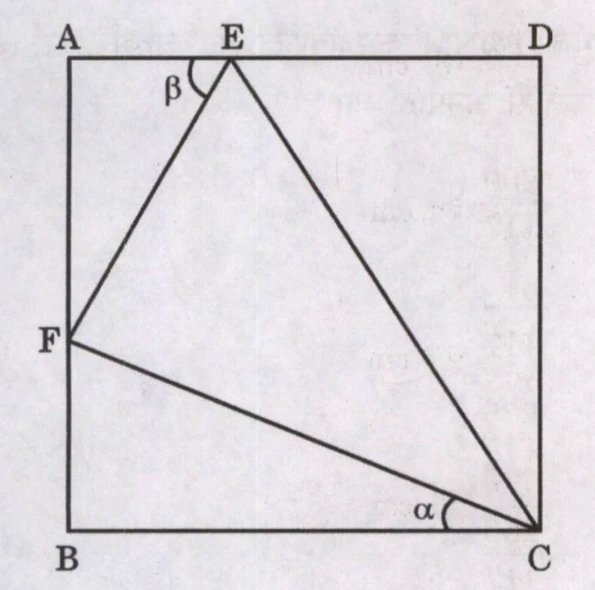
A triangle CEF is drawn inside a square ABCD as shown in the figure given below. Given : CF = cm, EF = cm and CE = cm.

Square ABCD drawn with A at the top-left corner, D at the top-right, B at the bottom-left and C at the bottom-right. E is a point on the top side AD, roughly midway between A and D. F is a point on the left side AB, below its midpoint. Segments EF, EC and FC are drawn, forming triangle CEF inside the square. The angle at E between the top side ED/EA and the segment EF is marked β (the arc sits between EA and EF). The angle at C between the bottom side CB and the segment CF is marked α (the arc sits between CB and CF).

What is the area of the square?

Options
Show answer & solution

Option C

square cm

Approach

Show that the angle at F is a right angle, use similar triangles to place F on the side, and then use Pythagoras in triangle FBC to find the side of the square.

Step-by-step solution

  1. 1
    , so

    Why: The sides , , satisfy Pythagoras, so by the converse the angle between and is a right angle.

  2. 2
    , so and

    Why: The angles on the straight line at add to , and takes . In triangle , , so . Both triangles have a right angle and an angle .

  3. 3
    , so with side : and

    Why: Corresponding sides of similar triangles are in the same ratio. matches , and and together make the side .

  4. 4

    Why: Triangle has a right angle at and . The area of the square is .

Common mistakes

Option A

No clear route reaches , which is exactly half of the correct area.

Option B

No clear route reaches .

Option D

No clear route reaches .

Skills used

Ideal time: about 2.5 min
77Trigonometry • Triangle
Moderate

Same directions as Q76

What is equal to?

Options
Show answer & solution

Option D

Approach

Show that angle equals , use similar triangles to find , and then read both tangents from right triangles.

Step-by-step solution

  1. 1
    , so . Then and, in triangle , , so

    Why: The sides of triangle obey Pythagoras, so the angle at is a right angle by the converse. The angles on line at add to .

  2. 2
    (right angles, and ), so

    Why: Two angles are equal, so the triangles are similar and corresponding sides have the same ratio. matches .

  3. 3
    With side : , so

    Why: and together make the side .

  4. 4
    and , so

    Why: In right triangle , is at and is at . Opposite over adjacent gives each value.

Common mistakes

Option A

No clear route reaches .

Option B

No clear route reaches .

Option C

No clear route reaches .

Skills used

Ideal time: about 1.5 min
78Mensuration • Plane Figures • Triangle
Hard

Same directions as Q76

What is the area of triangle CDE?

Options
Show answer & solution

Option A

square cm

Approach

Find the side of the square and the lengths and , then use half base times height in the right triangle .

Step-by-step solution

  1. 1
    As in the similar triangles and (ratio ): , ,

    Why: because . This makes the triangles similar with matching and matching , in the ratio .

  2. 2

    Why: Triangle has a right angle at and .

  3. 3
    and

    Why: is a side of the square, so is what is left after removing .

  4. 4
    Area square cm

    Why: and meet at the right angle , so they serve as base and height.

Common mistakes

Option B

No clear route reaches , which equals .

Option C

Using instead of in the triangle formula halves the area to .

Option D

No clear route reaches , which equals .

Skills used

Ideal time: about 2 min
79Mensuration • Plane Figures • Circle
Moderate

Consider the following for the next two (02) items that follow :

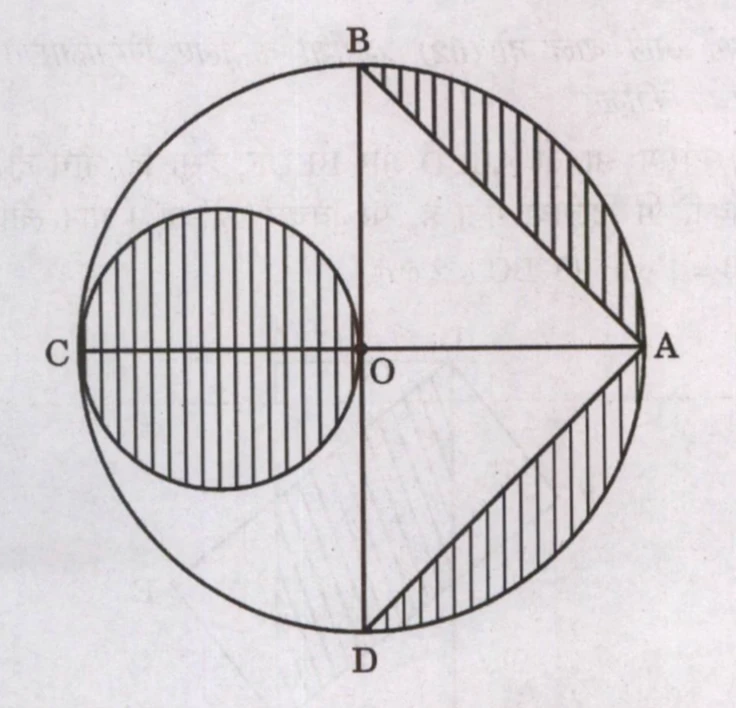
ABCD is a circle with centre O and taking OC as a diameter, a circle is drawn as shown in the figure given below. Let OB = cm. (Use )

A large circle with centre O and two perpendicular diameters: the horizontal diameter CA with C on the left and A on the right, and the vertical diameter BD with B at the top and D at the bottom. A smaller circle is drawn on OC as diameter, so it lies inside the left half of the large circle, touching it internally at C and passing through O; the whole of this smaller circle is shaded. The chords BA and DA are drawn. The two circular segments cut off by these chords -- the region between chord BA and the arc BA, and the region between chord DA and the arc DA -- are also shaded.

What is the area of the shaded region?

Options
Show answer & solution

Option D

square cm

Approach

The shaded part is the small circle plus two circular segments of the big circle; find each part and add.

Step-by-step solution

  1. 1
    Small circle: radius , area square cm

    Why: The small circle has as its diameter, so its radius is half of .

  2. 2
    Segment quarter circle triangle square cm

    Why: and are perpendicular radii, so the sector is a quarter of the big circle. The segment is the sector less the triangle with the two radii as legs.

  3. 3
    The segment is the same, square cm. Shaded area square cm

    Why: The three shaded pieces do not overlap, so their areas add.

Common mistakes

Option A

This is only the small circle, , with both segments left out.

Option B

No clear route reaches .

Option C

This is the small circle plus one segment, , with the second segment left out.

Skills used

Ideal time: about 1.5 min
80Mensuration • Plane Figures • Circle
Moderate

Same directions as Q79

What is the ratio of the area of the shaded region to the area of the non-shaded region?

Options
Show answer & solution

Option A

Approach

Find the shaded area (the small circle plus two segments) and the whole big circle, subtract to get the non-shaded area, and form the ratio.

Step-by-step solution

  1. 1
    Big circle area ; small circle (radius ) area

    Why: is the big radius, and is the diameter of the small circle.

  2. 2
    One segment

    Why: , so the sector is a quarter circle. The segment is the sector less the right triangle on the two radii.

  3. 3
    Shaded and non-shaded

    Why: The three shaded pieces do not overlap. The non-shaded part is the rest of the big circle.

  4. 4

    Why: Multiply both by , then divide both by .

Common mistakes

Option B

No clear route reaches .

Option C

No clear route reaches .

Option D

No clear route reaches .

Skills used

Ideal time: about 1.5 min