Skip to content

Elementary Mathematics 2024 (I)

Set A

Questions 81–100 of 100

81Geometry • Triangle • Similarity
Moderate

Consider the following for the next two (02) items that follow :

Let two parallel line segments PQ = cm and RS = cm be perpendicular to a horizontal line AB, as shown in the figure given below. The point of intersection of PS and QR is M and MN is perpendicular to QS.
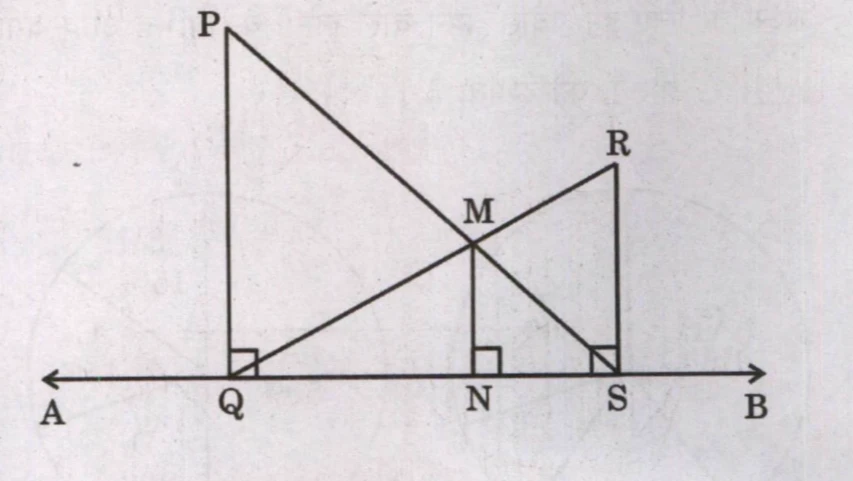
A horizontal line with arrowheads at both ends, labelled A at the left end and B at the right end. Three points Q, N and S lie on it in that order from left to right. A vertical segment QP of length 5 cm rises from Q (P at the top) with a right-angle mark at Q, and a shorter vertical segment SR of length 3 cm rises from S (R at the top) with a right-angle mark at S. The segments PS and QR are drawn and cross at the point M. From M a vertical segment MN drops to the point N on the horizontal line, with a right-angle mark at N. Q is to the left of N, and N is to the left of S.

What is the length of MN?

Options
Show answer & solution

Option D

cm

Approach

, and are all perpendicular to , so they are parallel; use two pairs of similar triangles and add the ratios along .

Step-by-step solution

  1. 1
    , so

    Why: , and the triangles share the angle at , so they are similar. Their sides are in the same ratio.

  2. 2
    , so

    Why: , and the triangles share the angle at , so they are similar.

  3. 3
    , so and cm

    Why: lies between and , so . Adding the two ratios removes the unknown length .

Shortcut

For two upright poles of lengths and the crossing point is at height .

Common mistakes

Option A

is the ratio , which is a fraction of , not a length in cm.

Option B

is the ratio , which is a fraction of , not a length in cm.

Option C

No clear route reaches .

Skills used
Ideal time: about 1.5 min
82Mensuration • Plane Figures • Quadrilateral
Hard

Same directions as Q81

What is the ratio of the area of the quadrilateral PQNM to the area of the quadrilateral RSNM?

Options
Show answer & solution

Option C

Approach

Find and the split of by similar triangles, and then treat each quadrilateral as a trapezium with as one parallel side.

Step-by-step solution

  1. 1
    and give and . Adding, , so

    Why: , and are all perpendicular to , so they are parallel. The two ratios add to .

  2. 2
    Let . Then and

    Why: The same two ratios now give the parts of .

  3. 3
    : parallel sides and , gap . Area

    Why: and are parallel, and is the distance between them.

  4. 4
    : parallel sides and , gap . Area

    Why: Same reasoning with and as the parallel sides.

  5. 5
    Ratio

    Why: The unknown cancels, so is not needed.

Common mistakes

Option A

No clear route reaches .

Option B

No clear route reaches .

Option D

No clear route reaches .

Skills used

Ideal time: about 2 min
83Statistics • Data Interpretation • Pie Chart
Moderate

Consider the following for the next three (03) items that follow :

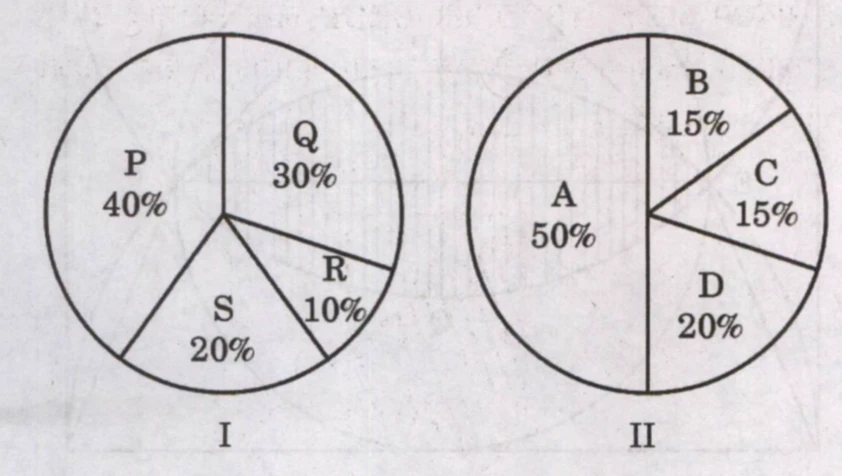
The following Pie-Chart-I shows the people migrating to Delhi from different Indian States (P, Q and R are three different States and S is the combined group of other States) and Pie-Chart-II indicates the different age groups A, B, C and D of these migrating people for each State.

Two pie charts side by side. The left chart, labelled I below it, has four sectors labelled with their percentages: P 40%, Q 30%, S 20% and R 10%. The right chart, labelled II below it, has four sectors: A 50%, B 15%, C 15% and D 20%.

If the people coming from a particular State belonging to S are and in number, then what is the total number of migrating people belonging to the age group B?

Options
Show answer & solution

Option A

lac

Approach

Use the given figures to find the size of group S, then the whole total, then read the share of age group B.

Step-by-step solution

  1. 1
    of group S , so group S

    Why: A State's share is taken out of its own group S. So is percent of the people in S.

  2. 2
    S is of all migrants, so the total

    Why: Pie chart I shows S as percent of the whole. The whole is the group divided by its share.

  3. 3
    Age group B of lac

    Why: Pie chart II gives the age shares for every State. So B is percent of the total.

Common mistakes

Option B

No clear route reaches lac.

Option C

No clear route reaches lac.

Option D

No clear route reaches lac.

Skills used

Ideal time: about 1.5 min
84Statistics • Data Interpretation • Pie Chart
Moderate

Same directions as Q83

What is the maximum of differences between the number of people coming from different groups P, Q, R and S?

Options
Show answer & solution

Option C

lac

Approach

Find the total number of migrants, read each group's share, and take the largest minus the smallest.

Step-by-step solution

  1. 1
    Total

    Why: This item gives no total. Using the figures of the item that says is of group S: S is , and S is of the whole, so the whole is .

  2. 2
    Largest group is P with ; smallest is R with

    Why: Read the percentages from pie chart I: P , Q , S , R .

  3. 3
    Largest difference of lac

    Why: The biggest gap between any two numbers is the largest minus the smallest.

Common mistakes

Option A

lac is of the total. It is the gap between P and S, or between Q and R, and not the largest gap.

Option B

No clear route reaches lac.

Option D

No clear route reaches lac.

Skills used

Ideal time: about 1.5 min
85Statistics • Data Interpretation • Pie Chart
Moderate

Same directions as Q83

What is the difference between number of people coming from R having age group A and those coming from Q having age group D?

Options
Show answer & solution

Option B

Approach

Find each group of people, apply its age share, and subtract.

Step-by-step solution

  1. 1
    Total

    Why: This item gives no total. Using the figures of the item that says is of group S: S is and is of the whole, so the whole is .

  2. 2
    R is of ; age group A is of it, so

    Why: Pie chart I gives R's share and pie chart II gives the share of age group A, the same for every State.

  3. 3
    Q is of ; age group D is of it, so

    Why: Same steps for Q, now with the share of age group D.

  4. 4

    Why: Subtract the smaller number from the larger.

Common mistakes

Option A

No clear route reaches .

Option C

No clear route reaches .

Option D

No clear route reaches .

Skills used

Ideal time: about 1.5 min
86Mensuration • Plane Figures • Quadrilateral
Hard

Consider the following for the next two (02) items that follow :

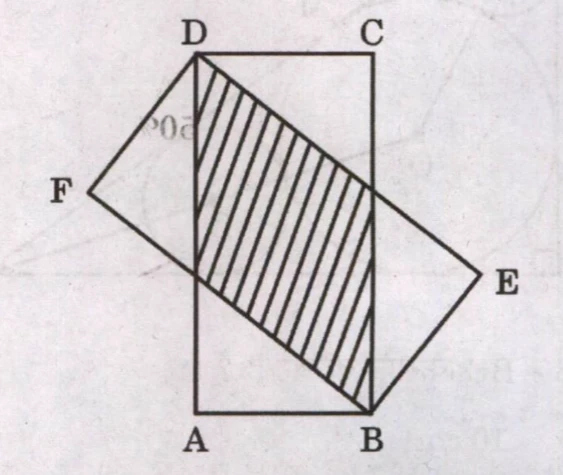
Consider two identical rectangles ABCD and BEDF as shown in the figure given below. Let AB = cm and BC = cm.

An upright rectangle ABCD with A at the bottom-left, B at the bottom-right, C at the top-right and D at the top-left. A second, congruent rectangle BEDF is drawn tilted, sharing the two opposite vertices B and D with the first rectangle; its other two vertices are F on the left, outside the first rectangle, and E on the right, outside the first rectangle. The two rectangles therefore share the common diagonal BD. The overlapping region of the two rectangles, a hatched parallelogram running from D at the top down to B at the bottom, is shaded. A faint "50°" appears near D inside the tilted rectangle, but it is printed laterally reversed -- it is show-through from the back of the sheet, not a label belonging to this figure, and carries no information for the item.

What is the area of the overlapping region?

Options
Show answer & solution

Option B

square cm

Approach

Put the rectangles on coordinates, find the shape of the common region, and compute its area numerically as well as by a formula.

Step-by-step solution

  1. 1
    , , , ; the tilted rectangle shares the diagonal

    Why: The two rectangles are identical and share , so the common region is symmetric about .

  2. 2
    The common region has corners and , one more corner on and one on . Its opposite sides are parallel and the two sides meeting at and at are equal, so it is a rhombus. Let its side be

    Why: Two identical rectangles sharing a diagonal overlap in a rhombus.

  3. 3
    The corner on is at distance from , so at distance from . Its distance to is also :

    Why: Pythagoras in the right triangle formed by , and that corner.

  4. 4
    , so . The rhombus has base along and height , so area square cm

    Why: The area of a parallelogram is base times the perpendicular distance, and the distance from to line is .

Common mistakes

Option A

No common slip leads to this value; it does not sit on a natural wrong path.

Option C

No common slip leads to this value; it does not sit on a natural wrong path.

Option D

This is , the part of one rectangle that is not shared. It answers the next item, not this one.

Skills used

Ideal time: about 2.5 min
87Mensuration • Plane Figures • Quadrilateral
Hard

Same directions as Q86

What is the area of the non-overlapping region?

Options
Show answer & solution

Option C

square cm

Approach

Find the area of the overlap, then take it out of each of the two rectangles and add what is left.

Step-by-step solution

  1. 1
    Overlap is a parallelogram whose two heights are both , so its sides are equal: . With , , so

    Why: The gap between and is , and the gap between the long sides of the tilted rectangle is its width, also . Equal heights on both pairs of sides mean equal sides. Triangle has a right angle at .

  2. 2
    Overlap area

    Why: A parallelogram has area base times height.

  3. 3
    Part of each rectangle outside the overlap

    Why: Each rectangle has area , and the overlap lies inside both.

  4. 4
    Non-overlapping region square cm

    Why: The figure has two such parts, one from each rectangle.

Common mistakes

Option A

is only the part of one rectangle outside the overlap.

Option B

is the area of the whole figure, , with the overlap still included.

Option D

is the overlap itself.

Skills used

Ideal time: about 2 min
88Geometry • Triangle • Pythagoras Theorem
Hard

Consider the following for the next three (03) items that follow :

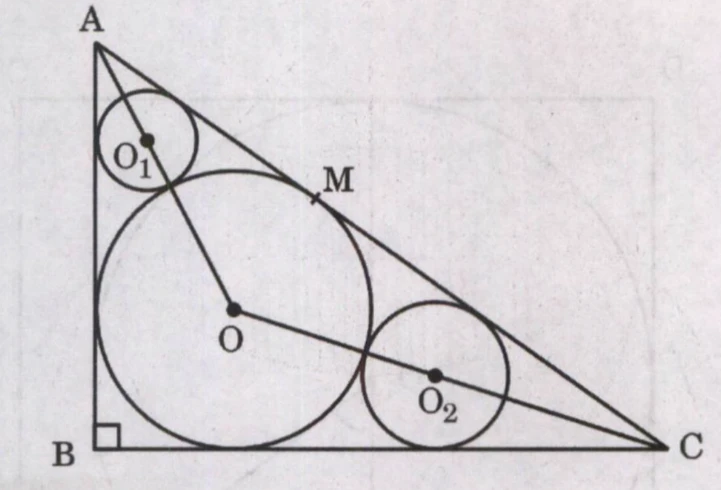
ABC is a right-angled triangle with . The centre of the incircle of the given triangle is at O, whose radius is cm. Two more circles with centres at and touch this circle and the two sides as shown in the figure given below. Further, MA : MC = .

Right-angled triangle ABC with the right angle at B, marked by a small square. A is at the top, B at the bottom-left and C at the bottom-right, so AB is the vertical side and BC the horizontal side and AC the hypotenuse sloping down from A to C. The incircle, centre O, touches all three sides. A smaller circle with centre O₁ sits in the corner at A, touching the two sides AB and AC and touching the incircle externally. Another small circle with centre O₂ sits in the corner at C, touching the sides BC and AC and touching the incircle externally. M is the point marked on the hypotenuse AC where the incircle touches it. The straight line through A, O₁, O and O₂ towards C is drawn (the line of centres), passing through the centres of all three circles.

What is AB + BC equal to?

Options
Show answer & solution

Option D

cm

Approach

Write the sides of the triangle with the tangent lengths from the vertices to the incircle, and use Pythagoras to find the common factor .

Step-by-step solution

  1. 1
    , , so

    Why: The ratio gives only parts, so introduce a common factor .

  2. 2
    Tangent length from is ; from it is ; from it is . So and

    Why: Two tangents from one point to a circle are equal. At the right angle and the radius make the tangent from equal to . The tangent from equals , and from equals .

  3. 3
    , so

    Why: Triangle is right-angled at , so . The length must be positive.

  4. 4
    , , , so cm

    Why: Put back into the sides. This is a -- triangle.

Common mistakes

Option A

is the length of the hypotenuse , not of .

Option B

No clear route reaches .

Option C

No clear route reaches .

Skills used
Ideal time: about 2 min
89Geometry • Circle • Touching Circles
Very hard

Same directions as Q88

What is the radius of the circle with centre at ?

Options
Show answer & solution

Option D

Approach

Find the sides of the triangle from the tangent lengths, then put the centres , , on the bisector of angle and solve for the small radius.

Step-by-step solution

  1. 1
    , ; , (tangents from , and ), and gives , so and

    Why: The ratio needs a common factor . Tangents from one point are equal, and the tangent from is the radius . Triangle is right-angled at .

  2. 2
    and

    Why: is perpendicular to at the point of contact, and bisects angle because the incircle touches both and .

  3. 3
    With radius for the small circle,

    Why: lies on the same bisector, a distance from side .

  4. 4
    and , so

    Why: The two circles touch externally, so their centres are the sum of the radii apart. , , are on one line.

  5. 5
    cm

    Why: Multiply top and bottom by to remove the root from the denominator.

Common mistakes

Option A

No clear route reaches , which is about .

Option B

is about , bigger than the incircle radius . A circle squeezed into the corner must be smaller.

Option C

is about , bigger than the incircle radius . A circle squeezed into the corner must be smaller.

Skills used

Ideal time: about 3 min
90Geometry • Circle • Touching Circles
Very hard

Same directions as Q88

What is the radius of the circle with centre at ?

Options
Show answer & solution

Option C

Approach

Find the sides of the triangle from the tangent lengths, then put the centres , , on the bisector of angle and solve for the small radius.

Step-by-step solution

  1. 1
    , ; , , and gives and

    Why: The ratio needs a common factor . Tangents from one point are equal, and the tangent from is the radius . Triangle is right-angled at .

  2. 2
    and

    Why: is perpendicular to , and bisects angle since the incircle touches and .

  3. 3
    With radius , and , so

    Why: is on the bisector and is from side . The circles touch externally, so the centres are apart.

  4. 4
    cm

    Why: Multiply top and bottom by . Then , with the middle term doubled.

Common mistakes

Option A

No clear route reaches , which is about .

Option B

is about , bigger than the incircle radius . A circle squeezed into the corner must be smaller.

Option D

was expanded as without doubling the middle term, which gives .

Skills used

Ideal time: about 3 min
91Mensuration • Plane Figures • Triangle
Hard

Consider the following for the next three (03) items that follow :

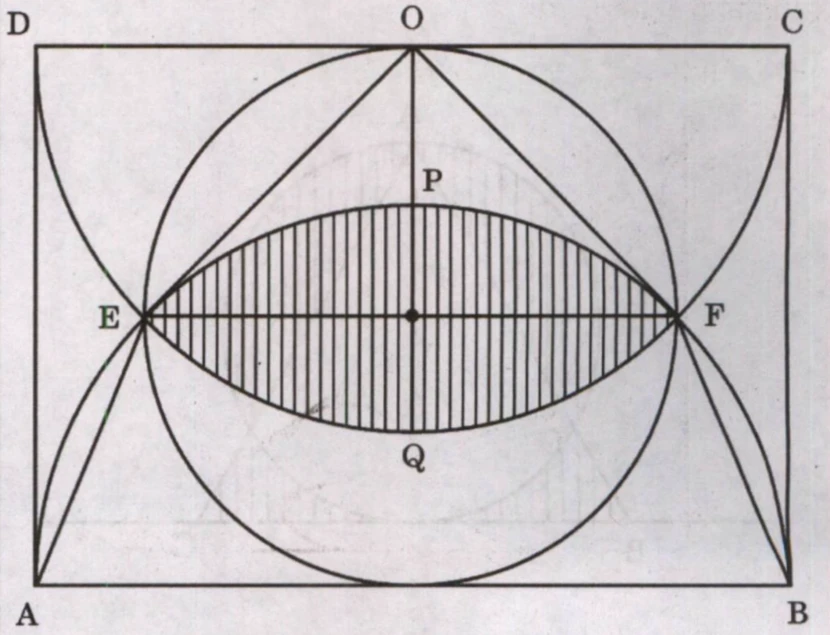
Consider two identical semicircles and one circle inscribed in a rectangle of length cm as shown in the figure given below. (Take and ).

Rectangle ABCD drawn with A at the bottom-left, B at the bottom-right, C at the top-right and D at the top-left, so AB is the horizontal bottom side and DC the horizontal top side. O is the midpoint of the top side DC. A circle is inscribed touching the top side at O and touching the bottom side AB. Two identical semicircular arcs are also drawn inside the rectangle, one springing from D and one from C, curving down into the rectangle; they cross the circle at the two points E on the left and F on the right, which lie on the horizontal line through the centre of the circle. The lens-shaped region bounded by the two arcs through E and F is hatched; P is marked on its upper boundary directly below O and Q on its lower boundary directly below P. A vertical segment runs from O down through P to Q. Two straight lines run from O down to the lower corners: O to A passing through E, and O to B passing through F. A, E, F and B are therefore the vertices of the trapezium referred to in the items, with AE lying on OA and BF on OB.

What is the area of triangle EOF?

Options
Show answer & solution

Option C

square cm

Approach

Find the height of the rectangle from the fact that lies on a semicircle of radius centred at , then find the area of triangle .

Step-by-step solution

  1. 1
    Let the circle have diameter (the height of the rectangle). is a diameter, so is to the left of 's vertical line and below

    Why: and are the ends of the horizontal line through the centre of the circle. is the top of the circle, a distance above that line.

  2. 2
    , so , giving and

    Why: is on the semicircle of diameter whose centre is , so is the radius . Use Pythagoras with the right angle between the two distances above.

  3. 3
    Area of square cm

    Why: The base is . The height is the distance from down to , which is .

Common mistakes

Option A

No clear route reaches .

Option B

No clear route reaches .

Option D

comes from taking the circle diameter as , half the length, so that and the height is .

Skills used

Ideal time: about 2.5 min
92Mensuration • Plane Figures • Quadrilateral
Hard

Same directions as Q91

What is the area of trapezium AEFB?

Options
Show answer & solution

Option A

square cm

Approach

Find the rectangle height from the semicircle through , then apply the trapezium formula to with .

Step-by-step solution

  1. 1
    Let the circle have diameter . is to the left of 's vertical line and below , and , so and

    Why: is a diameter of the inscribed circle, so is level with its centre. is on the semicircle of diameter whose centre is , so is the radius .

  2. 2
    , , and the gap between them is

    Why: and are both horizontal, so they are parallel. is level with the centre of the circle, half way up the rectangle.

  3. 3
    Area

    Why: Half the sum of the parallel sides times the gap. .

  4. 4
    With : square cm

    Why: The question tells us to take .

Common mistakes

Option B

No clear route reaches .

Option C

No clear route reaches .

Option D

comes from taking the rectangle height as , which makes : .

Skills used

Ideal time: about 2.5 min
93Mensuration • Plane Figures • Circle
Very hard

Same directions as Q91

What is the area of the shaded region?

Options
Show answer & solution

Option B

square cm

Approach

The shaded lens is two equal circular segments on the common chord ; find the angle at the centre and then use sector minus triangle.

Step-by-step solution

  1. 1
    Let the circle have diameter . is left of and below , and , so and

    Why: is a diameter of the inscribed circle, and is on the semicircle of radius centred at .

  2. 2
    , so

    Why: If the squares of two sides add to the square of the third, the angle between those two sides is a right angle.

  3. 3
    One segment

    Why: A segment is the sector less the triangle on the two radii. A sector is a quarter of the circle.

  4. 4
    Lens square cm

    Why: The upper arc comes from the semicircle on and the lower arc from the semicircle on . They have the same radius and the same chord, so the two segments are equal.

Common mistakes

Option A

No clear route reaches .

Option C

No clear route reaches . It is close to one segment, , but not equal to it.

Option D

No clear route reaches . It is close to one segment, , but not equal to it.

Skills used

Ideal time: about 3 min
94Mensuration • Plane Figures • Triangle
Easy

Consider the following for the next two (02) items that follow :

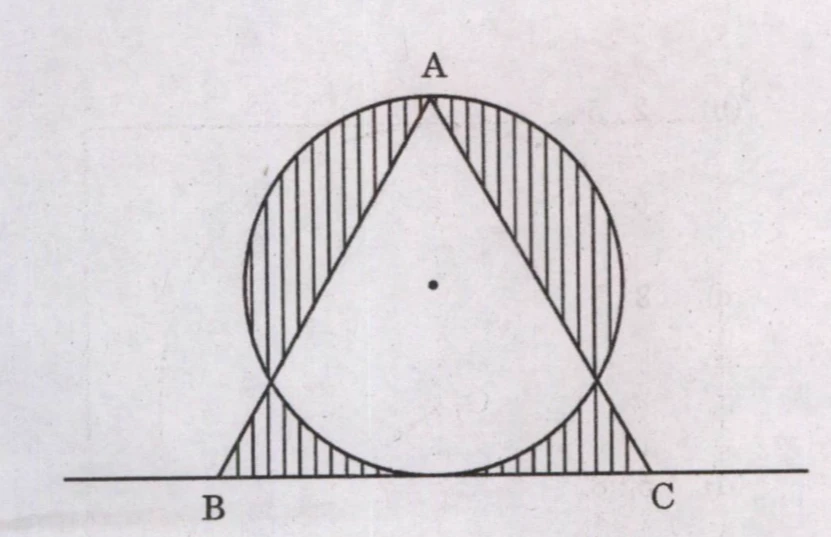
Consider a circle of area square unit and an equilateral triangle ABC as shown in the figure given below.

A circle with its centre marked by a dot. An equilateral triangle ABC is drawn with its apex A at the top, on the circle, and its base BC lying along a horizontal straight line that is drawn tangent to the bottom of the circle and extends beyond B and C on both sides. The two slanting sides AB and AC each cross the circle. The parts of the circle lying outside the triangle -- the two regions on the left and right between the circle and the sides AB and AC -- are hatched, as are the two regions inside the triangle below the circle, between the base BC, the slanting sides and the lower arc of the circle.

What is the length of the side of the triangle ABC?

Options
Show answer & solution

Option B

unit

Approach

The apex is the top of the circle and the base is a tangent at the bottom, so the height of the triangle is the diameter of the circle.

Step-by-step solution

  1. 1
    , so and the diameter is

    Why: Area of a circle is . Equate it to .

  2. 2
    Height of , so

    Why: The altitude of an equilateral triangle of side is . The distance from to the tangent line at the other end of the diameter is .

Common mistakes

Option A

comes from taking the radius , not the diameter, as the height.

Option C

No clear route reaches .

Option D

No clear route reaches .

Skills used
Ideal time: about 1 min
95Mensuration • Plane Figures • Circle
Hard

Same directions as Q94

What is the area of the shaded region?

Options
Show answer & solution

No option is correct

Approach

Find the shaded area as circle plus triangle minus twice their overlap, and confirm it numerically.

Step-by-step solution

  1. 1
    Circle: , area . Triangle: side , area

    Why: The shaded region is made of the parts of each shape that lie outside the other.

  2. 2
    Take the base at , the centre at and . Side is at distance from the centre, so it cuts a chord of length from

    Why: The distance from the centre to a side and Pythagoras give the chord.

  3. 3
    A chord of in a circle of radius subtends at the centre, so each cut-off segment is

    Why: Segment sector minus triangle.

  4. 4
    The two segments together are and the triangle outside the circle is

    Why: The overlap is the circle minus the two segments, .

  5. 5
    Shaded square unit

    Why: Add the circle part and the triangle part outside the other shape.

Skills used

Ideal time: about 2.5 min
96Mensuration • Plane Figures • Circle
Moderate

Consider the following for the next three (03) items that follow :

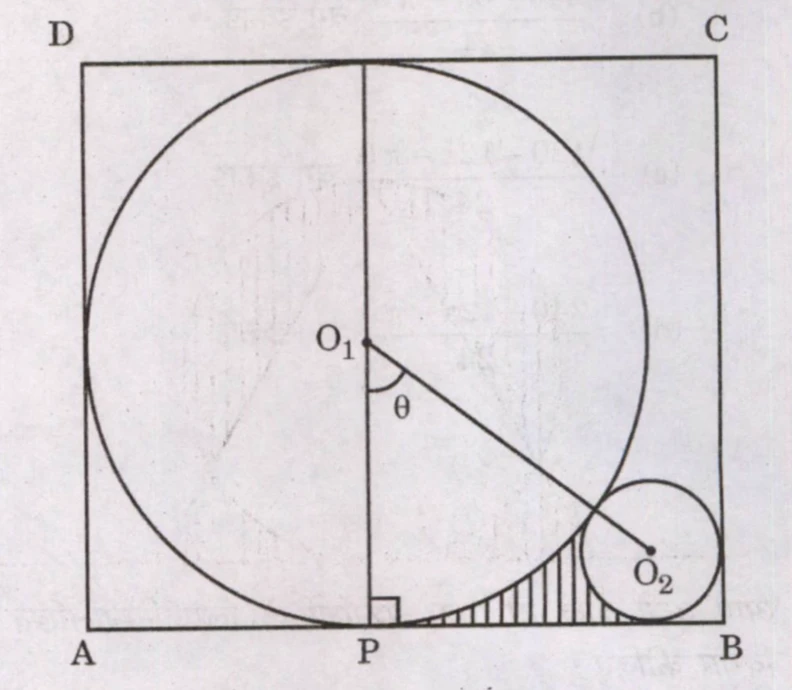
Two circles with centres at and touching each other are placed inside a rectangle of sides cm and cm as shown in the figure given below.

Rectangle ABCD with A at the bottom-left, B at the bottom-right, C at the top-right and D at the top-left. A large circle with centre O₁ is drawn touching the top side DC, the left side AD and the bottom side AB. A much smaller circle with centre O₂ sits in the bottom-right corner, touching the bottom side AB, the right side BC and touching the large circle externally. A vertical line is drawn from the top side down through O₁ to the point P on the bottom side AB, with a right-angle mark at P. The segment O₁ O₂ joining the two centres is drawn, and the angle at O₁ between the downward vertical O₁ P and the segment O₁ O₂ is marked θ. The region bounded below by the bottom side AB from P across to B, and above by the arc of the large circle and the arc of the small circle, is hatched.

What is the sum of the areas of the two circles?

Options
Show answer & solution

Option A

square unit

Approach

Place the rectangle on coordinates, test each printed sum of areas for the small radius, and check the touching condition.

Step-by-step solution

  1. 1
    Large circle touches top, bottom and left sides of the high rectangle, so its radius is and its centre is

    Why: The height is the diameter.

  2. 2
    Small circle of radius in the corner at has centre

    Why: It touches the bottom and right sides.

  3. 3
    Option A: sum means , , , and

    Why: External touching needs the distance between centres to equal the sum of radii.

  4. 4
    Option B (): distance against . Option C (): against . Option D (): against

    Why: In each of these the distance is bigger than the sum of radii, so the circles do not touch.

Common mistakes

Option B

No common slip leads to this value; it does not sit on a natural wrong path.

Option C

No common slip leads to this value; it does not sit on a natural wrong path.

Option D

No common slip leads to this value; it does not sit on a natural wrong path.

Skills used

Ideal time: about 1.5 min
97Geometry • Circle • Touching Circles
Hard

Same directions as Q96

Which one of the following is correct in respect of angle ?

Options
Show answer & solution

Option C

Approach

Find the radius of the small circle, then from the gaps between the two centres, and place it between and .

Step-by-step solution

  1. 1
    Big circle: diameter , so , centre from and from . Small circle radius has centre from and , i.e. from

    Why: The big circle touches the top and bottom sides, so its diameter is the shorter side . The longer side is , as the figure shows.

  2. 2
    , so , so

    Why: The circles touch externally, so the centres are apart. Use Pythagoras on the right triangle with the horizontal and vertical gaps. The root is too large for the rectangle.

  3. 3
    is across and down from , so

    Why: is measured from the vertical line . The side opposite is the horizontal gap , and the side next to it is the vertical gap .

  4. 4
    , so

    Why: grows steadily as goes from to , so a value between and puts between those angles.

Common mistakes

Option A

No clear route puts below .

Option B

comes from swapping the horizontal and vertical gaps, and that gives about .

Option D

No clear route puts above .

Skills used

Ideal time: about 2.5 min
98Mensuration • Plane Figures • Circle
Very hard

Same directions as Q96

What is the area of the shaded region?

Options
Show answer & solution

Option D

square unit

Approach

The shaded region is the right trapezium with a sector of each circle cut away, where is the foot of on .

Step-by-step solution

  1. 1
    Big radius (it touches , and , and ). The small radius is , from . So , and

    Why: The circles touch externally, so the centres are apart. Pythagoras on the horizontal and vertical gaps gives , and the root is too large. is from and is from .

  2. 2
    Trapezium : area

    Why: and are both perpendicular to , so they are parallel. The gap between them is .

  3. 3
    and

    Why: , so the angles on the same side of the line add to .

  4. 4
    Sector at ; sector at

    Why: The two curved edges are the arc of the big circle from to the touching point and the arc of the small circle from there to . Each cuts a sector out of the trapezium.

  5. 5
    Shaded

    Why: The terms combine to . Over , the number is and is .

Common mistakes

Option A

No clear route reaches .

Option B

No clear route reaches .

Option C

The numerator starts at , which is the trapezium area taken as (the half taken twice).

Skills used

Ideal time: about 3 min
99Mensuration • Plane Figures • Circle
Moderate

Consider the following for the next two (02) items that follow :

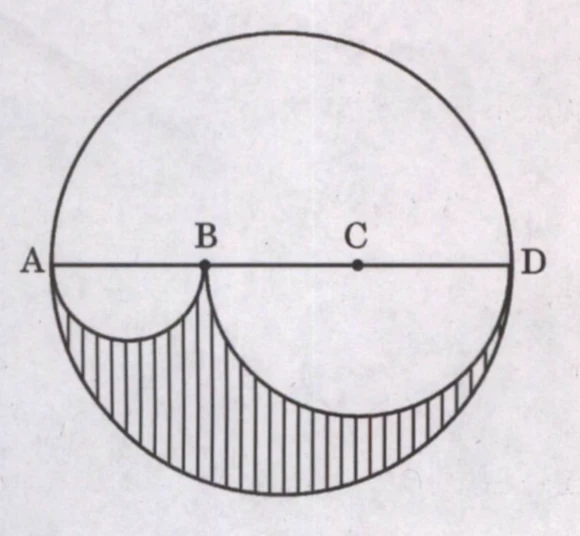
Let ABCD be the diameter of a circle of radius cm. The lengths AB, BC and CD are equal. Semi-circles are drawn with AB and BD as diameters as shown in the figure given below.

A circle with a horizontal diameter running from A on the left to D on the right. Two points B and C are marked on this diameter, dividing AD into the three equal parts AB, BC and CD; B is marked with a dot and so is C. Below the diameter two semicircles are drawn: one on AB as diameter and one on BD as diameter, both bulging downwards into the lower half of the circle. The region of the lower half of the circle that lies outside these two semicircles -- bounded below by the lower arc from A to D and above by the two semicircular arcs -- is hatched.

What is the ratio of the area of the shaded region to that of the non-shaded region?

Options
Show answer & solution

Option A

Approach

The shaded region is the lower half of the big circle with two semicircles removed; find its area and compare with the rest of the circle.

Step-by-step solution

  1. 1
    and , so ; the semicircle radii are and

    Why: The three equal parts of the diameter are each. is .

  2. 2
    Shaded

    Why: The shaded region is the lower half circle with the two semicircles cut out of it.

  3. 3
    Non-shaded , so ratio

    Why: The non-shaded region is the rest of the whole circle, including the upper half.

Common mistakes

Option B

No clear route reaches .

Option C

No clear route reaches .

Option D

No clear route reaches .

Skills used
Ideal time: about 1.5 min
100Mensuration • Plane Figures • Circle
Easy

Same directions as Q99

What is the perimeter of the shaded region?

Options
Show answer & solution

Option D

cm

Approach

The boundary of the shaded region is three curved edges; find the length of each half-circle arc and add.

Step-by-step solution

  1. 1
    Lower arc of the big circle

    Why: It is half of the circumference .

  2. 2
    Arc on (radius ) ; arc on (radius )

    Why: Each is a half circle, so its length is times its radius.

  3. 3
    Perimeter cm

    Why: The straight diameter is not part of the shaded region's boundary, so it is not included.

Shortcut

Each arc is times its diameter, and the diameters , and give .

Common mistakes

Option A

No clear route reaches .

Option B

No clear route reaches .

Option C

No clear route reaches .

Skills used
Ideal time: about 1 min