Skip to content

General Ability Test 2024 (I)

Set A

Questions 121–140 of 150

121Biology • Cell Biology • Prokaryotic Cells
Easy

In most prokaryotes, the chromosome number is :

Options
Show answer & solution

Option D

1

Why

Most prokaryotes, such as bacteria, have a single circular chromosome lying in the nucleoid. Extra small DNA rings, the plasmids, are not counted as chromosomes.

Proof

NCERT Class 11 Biology, Ch. 'Cell: The Unit of Life': prokaryotic cells

About the other options

Option A

Bacteria have one chromosome, not four.

Option B

Bacteria have one chromosome, not three.

Option C

Two would mean paired, diploid chromosomes, which is the eukaryotic pattern.

Ideal time: about 10 s
122Biology • Cell Biology • Prokaryotic Cells
Easy

Bacterial DNA is referred to as naked because it is not associated with :

Options
Show answer & solution

Option B

proteins

Why

Bacterial DNA is called naked because it is not wrapped around histone proteins to form nucleosomes, as eukaryotic DNA is. The key is mildly contestable: bacterial DNA is held by a few other proteins, so 'naked' strictly means 'without histones'.

Proof

NCERT Class 12 Biology, Ch. 'Molecular Basis of Inheritance': packaging of the DNA helix

About the other options

Option A

Scaffold proteins organise eukaryotic chromosomes, but 'naked' refers to the missing histones, not a scaffold.

Option C

Ribozymes are RNA molecules that act as enzymes. They are not part of how DNA is packed.

Option D

A plasmid is a small extra ring of DNA in bacteria. Having or lacking one has nothing to do with the word 'naked'.

Ideal time: about 13 s
123Biology • Health, Disease and Immunity • Immunity and Immune Disorders
Very easy

Which one among the following cells produces antibodies against a foreign antigen ?

Options
Show answer & solution

Option A

Lymphocytes

Why

B-lymphocytes make antibodies against a foreign antigen. T-lymphocytes help them do it.

Proof

NCERT Class 12 Biology, Ch. 'Human Health and Disease': immunity

About the other options

Option B

Erythrocytes are red blood cells. They carry oxygen and make no antibodies.

Option C

Eosinophils are white blood cells that fight parasites and act in allergies, but they do not make antibodies.

Option D

Platelets help blood to clot.

Ideal time: about 11 s
124Physics • Motion, Force and Laws of Motion • Newton's Laws and Conservation of Momentum
Easy

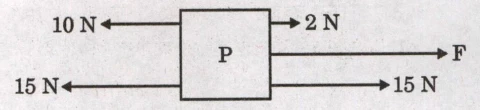
If the block P as shown in the figure below were to be at rest, what should the magnitude of force F be ?

A square block labelled P. Two arrows point left from its left side: the upper one labelled 10 N and the lower one labelled 15 N. Three arrows point right from its right side: the upper one labelled 2 N, the middle one labelled F, and the lower one labelled 15 N.
Options
Show answer & solution

Option C

8 N

Why

A body at rest has zero net force: the forces to the left must equal the forces to the right. Left: N. Right: N.

Exam-hall approach

The two 15 N forces cancel. What is left is , so N.

Proof

N

About the other options

Option A

Does not balance the forces: N, not 25 N.

Option B

Does not balance the forces: N, not 25 N.

Option D

Leaves out the 2 N force on the right: N.

Ideal time: about 36 s
125Physics • Modern and Nuclear Physics • Nuclear Fission and Fusion
Easy

Of the following, which does not belong to a nuclear reactor ?

Options
Show answer & solution

Option C

A mechanism to reduce CO2 emission

Why

A nuclear reactor gets its heat from fission, not burning fuel, so it gives off no carbon dioxide and needs no device to reduce it. A nuclear power plant has a reactor core where fission happens, a heat exchanger that turns water into steam, and a turbine that the steam drives.

Proof

NCERT Class 12 Physics, Ch. 'Nuclei': nuclear fission and nuclear reactors

About the other options

Option A

The turbine turns the generator. The steam from the heat exchanger drives it.

Option B

The heat exchanger carries heat from the coolant to water, making steam.

Option D

The reaction chamber is the reactor core, where the controlled chain reaction runs.

Ideal time: about 19 s
126Physics • Electricity • Resistance and Combination of Resistors
Moderate

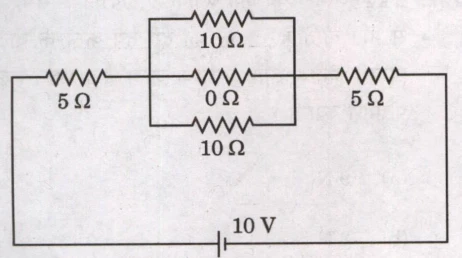
Consider the following electric circuit :

A single closed loop. The top wire carries a 5Ω resistor on the left, then a parallel block of three horizontal branches, then a 5Ω resistor on the right. The three branches, top to bottom, hold a 10Ω resistor, a resistor labelled 0Ω, and a 10Ω resistor; they join at a common node on the left and another on the right. The bottom wire of the loop holds a 10 V battery.

The current in the above electric circuit is :

Options
Show answer & solution

Option A

1 A

Why

A branch in parallel short-circuits the whole parallel block: current takes the path with no resistance, so the block's resistance is . Only the two resistors remain, in series, so and .

Proof

A

About the other options

Option B

Ignores the branch and takes the two in parallel as : , so A.

Option C

Counts only one resistor: A.

Option D

Needs , which no reading of the circuit gives.

Ideal time: about 38 s
127Physics • Light and Optics • Optical Instruments
Easy

A microscope may be a combination of :

Options
Show answer & solution

Option A

two convex lenses.

Why

A compound microscope uses two convex lenses: an objective of short focal length near the object and an eyepiece near the eye. A simple microscope is a single convex lens.

Proof

NCERT Class 12 Physics Part II, Ch. 'Ray Optics and Optical Instruments': the compound microscope

About the other options

Option B

A convex and a concave lens make the Galilean telescope, not a microscope.

Option C

Concave lenses diverge light and only form small, upright, virtual images. They cannot magnify.

Option D

A convex mirror always forms a smaller image. It is used for rear-view mirrors, not magnifiers.

Ideal time: about 16 s
128Physics • Light and Optics • Human Eye and Defects of Vision
Moderate

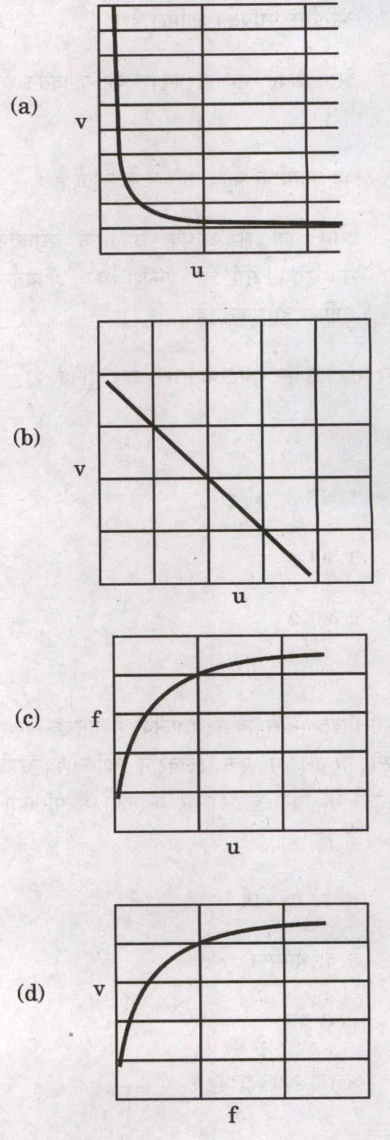
For a human eye, where u is the distance of an object from the eye, f is the focal length of the lens and v is the distance of image from the eye, which is the correct schematic graph ?

Four graphs, each drawn on a rectangular grid and labelled (a) to (d), stacked vertically; no values are marked on the axes. (a): vertical axis v, horizontal axis u; a curve falls steeply from the top near the vertical axis and flattens to run almost horizontally along the bottom. (b): vertical axis v, horizontal axis u; a straight line slopes down from the upper left to the lower right. (c): vertical axis f, horizontal axis u; a curve rises steeply from low on the left and flattens to run almost horizontally near the top. (d): vertical axis v, horizontal axis f; a curve of the same rising, flattening shape as in (c).
Options
Show answer & solution

Option C

Figure (c)

Why

In the eye the image always forms on the retina, so is fixed. The eye lens changes its focal length to focus objects at different distances: this is accommodation. From the lens formula, as grows, falls, so rises and levels off towards . That is the rising, flattening curve of figure (c).

Exam-hall approach

The one sure fact: the image always falls on the retina, so v never changes. That strikes A, B and D, which all make v vary.

Proof

: as , from below

About the other options

Option A

This falling – curve is a lens of fixed focal length, like a camera. In the eye does not change.

Option B

No lens gives a straight line between and , and in the eye does not change.

Option D

In the eye is the fixed lens-to-retina distance, so it cannot rise with .

Ideal time: about 46 s
129Physics • Light and Optics • Dispersion and Scattering of Light
Easy

Which of the following statements with regard to the phenomenon of the primary rainbow formation by water droplets is/are correct ?

1
It involves refraction and one internal reflection of sunlight.
2
It involves refraction of sunlight only.
3
It is formed as the inner bow.
4
It may involve more than one internal reflection as well as refraction of sunlight.

Select the answer using the code given below :

Options
Show answer & solution

Option B

1 and 3

Why

1 — Correct. In the primary bow, sunlight is refracted entering a droplet, reflected once inside it, and refracted again leaving it. 2 — Incorrect. Refraction alone cannot send the light back towards the observer; the internal reflection does that. 3 — Correct. The primary bow is the inner, brighter bow, with red on the outside. 4 — Incorrect. Two internal reflections make the secondary bow, the fainter outer one. The primary has exactly one.

Exam-hall approach

Statements 1 and 2 contradict each other, and NCERT's account has an internal reflection, so 1 is true and 2 false. That strikes C and D. The primary bow being the inner one picks B over A.

About the other options

Option A

Leaves out statement 3. The primary bow is the inner one.

Option C

Contains statement 4. More than one internal reflection gives the secondary bow.

Option D

Contains statement 2. The rainbow needs an internal reflection as well as refraction.

Ideal time: about 54 s
130Chemistry • Atomic Structure • Atomic Models
Very easy

Which one of the following scientists mentioned that an electron in an atom could revolve in certain stable orbits without the emission of radiant energy ?

Options
Show answer & solution

Option C

Niels Bohr

Why

Bohr's model (1913) says an electron revolves only in certain allowed orbits, the stationary states, and gives out no energy while it stays in one. This was his answer to the instability of Rutherford's model.

Proof

NCERT Class 9 Science, Ch. 'Structure of the Atom': Bohr's model of the atom

About the other options

Option A

Rutherford's model had electrons revolving around a nucleus, but by classical physics they would radiate energy and fall into it. Bohr solved this.

Option B

J.J. Thomson gave the 'plum pudding' model, with electrons set in a sphere of positive charge, and had no orbits.

Option D

Einstein explained the photoelectric effect with light quanta, not atomic orbits.

Ideal time: about 17 s
131Physics • Gravitation • Gravitational Waves
Easy

LIGO experiment confirmed one of the predictions of :

Options
Show answer & solution

Option D

General theory of relativity

Why

LIGO, the Laser Interferometer Gravitational-Wave Observatory, detected gravitational waves for the first time on 14 September 2015. Einstein's general theory of relativity predicted such waves in 1916.

Proof

LIGO detection of 14 September 2015, announced 11 February 2016

About the other options

Option A

String theory has no tested prediction yet. LIGO did not test it.

Option B

Special relativity deals with motion at high speed with no gravity. It does not predict gravitational waves.

Option C

Quantum mechanics describes atoms and particles. It is not what predicted these waves.

Ideal time: about 14 s
132Physics • Work, Energy and Power • Work Done by a Force
Easy

A block of mass 2 kg, moving with the initial speed of 3 m/s comes to rest on a rough horizontal surface after travelling a distance of 3 m. The magnitude of the frictional force is :

Options
Show answer & solution

Option B

3 N

Why

Work-energy theorem: the work done by friction equals the kinetic energy lost. So .

Exam-hall approach

Check the unit: 9 and 18 are joules of energy, not newtons, until divided by the 3 m.

Proof

N

About the other options

Option A

Gives the kinetic energy, J, as the force and forgets to divide by the distance.

Option C

Uses without the , and does not divide by the distance.

Option D

Uses in place of : , then N.

Ideal time: about 45 s
133Physics • Electricity • Conductors and Insulators
Very easy

Which one of the following is primarily responsible for conduction of current in a metal ?

Options
Show answer & solution

Option B

Free electrons

Why

A metal has electrons that are not bound to any one atom and move freely through it. An electric field makes them drift, and this drift is the current.

Proof

NCERT Class 12 Physics Part I, Ch. 'Current Electricity': drift of electrons

About the other options

Option A

Bound electrons are held to their atoms and cannot carry current. That is why insulators do not conduct.

Option C

Bound electrons play no part in conduction in a metal.

Option D

Ions carry current in electrolytes, solutions and molten salts. In a metal the positive ions stay fixed in the lattice.

Ideal time: about 14 s
134History • Sources and Methods of History • Accounts of Foreign Travellers
Moderate

Which of the following were features of the postal system of India as described by Ibn Battuta ?

1
The foot post carries a ringing bell in one hand.
2
The horse post is called uluq, stationed at a distance of every four miles.
3
The foot post or dawa has one station at every four kos of distance.
4
The foot post is quicker than horse post.

Select the correct answer using the code given below :

Options
Show answer & solution

Option A

1, 2 and 4

Why

1 — Correct. Each foot-post runner carries the letter in one hand and a rod with copper bells in the other, ringing as he runs. 2 — Correct. The horse-post, called uluq, uses royal horses stationed every four miles. 3 — Incorrect. The foot-post, dawa, has three stations per mile. Dawa means a third of a mile. 4 — Correct. Ibn Battuta says the foot-post is quicker than the horse-post.

Exam-hall approach

The name dawa means a third of a mile, so statement 3's 'four kos' is false. That strikes C and D. A or B then turns on statement 4, the surprising claim that the runners were faster.

About the other options

Option B

Leaves out statement 4. Ibn Battuta says the foot-post is the quicker one.

Option C

Contains statement 3. The dawa has a station every third of a mile, not every four kos.

Option D

Contains statement 3, and leaves out statement 2, which is correct.

Ideal time: about 1 min
135History • Science, Mathematics and Measurement in Early India
Hard

Which one of the following texts is a commentary written by Chakrapanidatta (11 Century CE from Bengal) on the Sushrut Samhita ?

Options
Show answer & solution

Option B

Bhanumati

Why

Chakrapanidatta of Bengal (11th century CE) wrote Bhanumati, a commentary on the Sushruta Samhita. He also wrote Ayurveda Dipika, a commentary on the Charaka Samhita.

Proof

NIOS Indian Culture and Heritage, lesson 'Science and Technology': Chakrapanidatta

About the other options

Option A

Sabdachandrika is also by Chakrapanidatta, but it is a dictionary of medicinal plants, not a commentary.

Option C

Nitiratnakara is a work on niti, or statecraft, not medicine.

Option D

Lohasarvasva is Sureshvara's work on the medical uses of iron (loha), not a commentary on Sushruta.

Ideal time: about 17 s
136History • Arrival of the Europeans
Easy

Consider the following statements about the arrival of tobacco in India :

1
Tobacco plant arrived first in the Deccan.
2
Tobacco spread to northern India in the early years of the seventeenth century.

Which of the statements given above is/are correct ?

Options
Show answer & solution

Option C

Both 1 and 2

Why

1 — Correct. Tobacco, brought by the Portuguese, first reached the Deccan. 2 — Correct. It spread to north India in the early years of the seventeenth century; Jahangir later banned smoking.

Proof

NCERT Class 12 Themes in Indian History Part II, Ch. 'Peasants, Zamindars and the State': tobacco

About the other options

Option A

Leaves out statement 2. Tobacco reached north India in the early seventeenth century.

Option B

Leaves out statement 1. The Deccan was where tobacco first arrived.

Option D

Both statements are correct.

Ideal time: about 33 s
137History • Socio-Religious Reform Movements • Women's Movement and Women's Organisations
Moderate

Consider the following Women’s Associations and their important associates in early twentieth century India :

1
Women’s Indian Association of 1917 : Margaret Cousins
2
National Council of Women in India of 1925 : Sarala Devi Chaudhurani
3
Bharat Stree Mahamandal of 1910 : Lady Meherbai Tata

Which of the above pairs is/are correctly matched ?

Options
Show answer & solution

Option D

1 only

Why

1 — Correct. The Women's Indian Association (1917) was founded by Annie Besant, Margaret Cousins and Dorothy Jinarajadasa. 2 — Incorrect. The National Council of Women in India (1925) was led by Lady Meherbai Tata, not Sarala Devi Chaudhurani. 3 — Incorrect. The Bharat Stree Mahamandal (1910) was founded by Sarala Devi Chaudhurani, not Lady Meherbai Tata.

Exam-hall approach

Margaret Cousins with the Women's Indian Association is the best-known pair, which strikes B. Sarala Devi with the Bharat Stree Mahamandal, a Bengali-led body, makes pairs 2 and 3 a swap. Both are false, which gives D.

About the other options

Option A

Contains pairs 2 and 3, whose associates are swapped.

Option B

Contains pairs 2 and 3, and leaves out pair 1, which is correct.

Option C

Contains pair 2. Sarala Devi led the Bharat Stree Mahamandal, not the National Council.

Ideal time: about 46 s
138History • Constitutional Development under British Rule
Moderate

Consider the following statements about the issue of separate electorate during the early decades of the twentieth century in India as a means to secure adequate representation for the deprived social categories in the absence of universal adult franchise :

1
The All India Depressed Classes Association of M.C. Rajah was staunchly in favour of joint electorate.
2
The All India Depressed Classes Leaders’ Conference demanded separate electorate.
3
The Communal Award in September 1932 recognised the right to separate electorate for the ‘untouchables’.

Which of the statements given above are correct ?

Options
Show answer & solution

Option A

1 and 2 only

Why

1 — Correct. M.C. Rajah's All India Depressed Classes Association supported joint electorates with reserved seats. Rajah agreed this with B.S. Moonje in 1932. 2 — Correct. The All India Depressed Classes Leaders' Conference, in Ambedkar's camp, demanded separate electorates. 3 — Incorrect as printed. The Communal Award gave separate electorates to the depressed classes, but it was announced on 16 August 1932, not in September. September 1932 is the month of Gandhi's fast and the Poona Pact. On the strict wording, statement 3's date is wrong, which gives A. If the date is not read strictly, all three are correct, which gives D. The key is contestable.

Exam-hall approach

Statement 2 is in A, B and D. The Communal Award granting separate electorates is the well-known fact, but its date is August 1932, which is where A and D split.

About the other options

Option B

Leaves out statement 1. Rajah's association backed joint electorates.

Option C

Contains statement 3, whose month is wrong, and leaves out statement 2.

Option D

Also defensible

Right on the substance of statement 3, so defensible if its date is read loosely. The Award came on 16 August 1932, not in September.

Ideal time: about 59 s
139History • Post-Mauryan and Gupta Period
Easy

Which of the following statements with regard to the famous ‘silk routes’ are correct ?

1
Silk routes refer to East-bound European silk cargoes along these routes.
2
There were several silk routes, over land and by sea, joining together vast regions of Asia with Europe and northern Africa.
3
They are known to have existed since before the Christian Era and thrived almost till the fifteenth century.
4
Besides silk, Chinese pottery, textiles and spices from India and South-east Asia travelled the same route.

Select the answer using the code given below :

Options
Show answer & solution

Option C

2, 3 and 4

Why

1 — Incorrect. The name comes from west-bound Chinese silk cargoes, travelling from China towards Europe, not east-bound European ones. 2 — Correct. Several silk routes, over land and sea, linked vast regions of Asia with Europe and northern Africa. 3 — Correct. They existed before the Christian Era and thrived almost till the fifteenth century. 4 — Correct. Chinese pottery, and textiles and spices from India and South-east Asia, travelled the same routes.

Exam-hall approach

Silk came from China, so the cargoes went west. Statement 1 is false, and C is the only option without it.

About the other options

Option A

Contains statement 1. The silk went west from China, not east from Europe.

Option B

Contains statement 1, which reverses the direction of the silk trade.

Option D

Contains statement 1. Silk came from China, so the cargoes moved west.

Ideal time: about 1 min
140History • Post-Mauryan and Gupta Period
Moderate

Consider the following statements about Ajanta paintings :

1
The surface of the rock was coated with clay mixed with rice husk and gum and a coat of lime was applied over this.
2
The outline drawing was done first on the lime coating and colours were added subsequently.

Which of the statements given above is/are correct ?

Options
Show answer & solution

Option C

Both 1 and 2

Why

1 — Correct. At Ajanta the rock was first coated with a plaster of clay mixed with rice husk and other binders, then with a thin coat of lime. 2 — Correct. The outlines were drawn on the lime coat first, usually in red, and the colours were filled in after.

Exam-hall approach

Drawing the outline before colouring is how any mural is painted, so statement 2 is true. That strikes A and D. Between B and C, statement 1 is a plausible process detail, and C is the better guess.

About the other options

Option A

Leaves out statement 2. The outline was drawn first, then coloured.

Option B

Leaves out statement 1. The clay-and-husk plaster, then lime, is how the wall was prepared.

Option D

Both statements describe the Ajanta method correctly.

Ideal time: about 38 s