Skip to content

General Ability Test 2024 (I)

Set A

Questions 41–60 of 150

41English • Reading Comprehension • Stated Detail
Easy

Directions Read the following passage carefully and answer the items based on it. You are required to select your answers based solely on the contents of the passage and the opinion of the author.

The grouping or assemblage of plants, animals and microbes we observe when we study a natural forest, a grassland, a pond, a coral reef or some other undisturbed area, is referred to as the area’s biota or biotic community. The plant portion of the biotic community includes all vegetation, from large trees down through to microscopic algae. Likewise, the animal portion includes everything from large mammals, birds, reptiles and amphibians through to earthworms, tiny insects and mites. Microbes encompass a large array of microscopic bacteria, fungi and protozoans. Thus, the biotic community comprises a plant community, an animal community and a microbial community.

The particular kind of biotic community found in a given area is, in large part, determined by abiotic factors such as the amount of water or moisture present, the temperature, the salinity, or the type of soil in the area. These abiotic factors both support and limit the particular community. For example, a relative lack of available moisture prevents the growth of most species of plants, but supports certain species, such as cacti; these kinds of areas are deserts. Land with plenty of available moisture and a suitable temperature supports forests. The presence of water is the major factor that sustains aquatic communities.

The first step in investigating a biotic community may be simply to catalogue all the species present. Species are the different kinds of plants, animals and microbes in the community. A given species includes all those individuals which have a strong similarity in appearance to one another and which are distinct in appearance from other such groups. Each species in a biotic community is represented by a certain population — that is, by a certain number of individuals that make up the interbreeding, reproducing group.

Which one of the following does not belong to the biotic community ?

Options
Show answer & solution

Option A

Water

Why

The biotic community is the living part of an area: its plants, animals and microbes. Water is not alive; the passage lists it among the abiotic (non-living) factors.

Proof

the biotic community comprises a plant community, an animal community and a microbial community … abiotic factors such as the amount of water or moisture present

About the other options

Option B

Humans are mammals, so they belong to the animal community, which includes large mammals.

Option C

Protozoa are microbes, which the passage lists in the biotic community.

Option D

A bush is vegetation, part of the plant community.
Ideal time: about 21 s
42English • Reading Comprehension • Stated Detail
Easy

Same directions as Q41

The nature of the biotic community largely depends on :

1
Biotic components
2
Abiotic components

Select the correct answer using the code given below :

Options
Show answer & solution

Option B

2 only

Why

The passage says the kind of community found in an area is decided, in large part, by abiotic factors. It never says the biotic components decide it.

Proof

The particular kind of biotic community found in a given area is, in large part, determined by abiotic factors

About the other options

Option A

The passage does not say biotic components decide the kind of community.

Option C

Only abiotic factors are named as deciding it; biotic components are not.

Option D

The passage names abiotic factors as the main cause.

Ideal time: about 27 s
43English • Reading Comprehension • Stated Detail
Easy

Same directions as Q41

Which of the following is not an abiotic factor ?

Options
Show answer & solution

Option C

Algae

Why

Algae are living plants: the passage puts microscopic algae in the plant portion of the biotic community. Temperature and moisture are named as abiotic factors, and humidity is moisture in the air.

Proof

The plant portion of the biotic community includes all vegetation, from large trees down through to microscopic algae. … abiotic factors such as the amount of water or moisture present, the temperature

About the other options

Option A

Temperature is named as an abiotic factor.

Option B

Humidity is moisture in the air, and moisture is named as an abiotic factor.

Option D

Moisture is named as an abiotic factor.

Ideal time: about 20 s
44English • Reading Comprehension • Vocabulary in Context
Easy

Same directions as Q41

In the passage, the word ‘aquatic community’ refers to :

Options
Show answer & solution

Option B

Biotic community found in water

Why

Aquatic means living in water. The passage says water is the main factor that keeps aquatic communities alive, so an aquatic community is one found in water.

Proof

The presence of water is the major factor that sustains aquatic communities.

About the other options

Option A

Communities on land are the deserts and forests the passage names; they are not aquatic.

Option C

The passage names no community in the air.

Option D

Rain and moisture are abiotic factors, not a community of living things.

Ideal time: about 26 s
45English • Reading Comprehension • Stated Detail
Easy

Same directions as Q41

Species are defined on the basis of :

Options
Show answer & solution

Option C

Both similarities and differences

Why

A species is defined both ways: its members are strongly similar to one another, and they are distinct from other such groups.

Proof

A given species includes all those individuals which have a strong similarity in appearance to one another and which are distinct in appearance from other such groups.

About the other options

Option A

Leaves out the second test: being distinct from other groups.

Option B

Leaves out the first test: being similar to one another.

Option D

The passage gives both tests, so one of the options does fit.

Ideal time: about 22 s
46English • Vocabulary • Synonyms
Moderate

Directions : Each item in this section consists of a sentence with an underlined word followed by four words/group of words. Select the option that is nearest in meaning to the underlined word and mark your response on the Answer Sheet accordingly.

The king’s son was banished due to the political rivalry.

Options
Show answer & solution

Option A

deported

Why

Banished means sent away from one's country as a punishment. Deported means forced to leave a country, the nearest in meaning.

Proof

The king’s son was deported due to the political rivalry.

About the other options

Option B

called back: brought back home; nearly the opposite.

Option C

accepted: taken in; the opposite of being sent away.

Option D

notified: told officially; unrelated.

Ideal time: about 13 s
47English • Vocabulary • Synonyms
Very easy

Same directions as Q46

He gave a dazzling performance at the opera.

Options
Show answer & solution

Option A

brilliant

Why

Dazzling here means extremely impressive. Its nearest word is brilliant.

Proof

He gave a brilliant performance at the opera.

About the other options

Option B

dismal: gloomy and poor; nearly the opposite.

Option C

pathetic: very poor, pitiful; nearly the opposite.

Option D

puerile: childish and silly; nearly the opposite.

Ideal time: about 12 s
48English • Vocabulary • Synonyms
Moderate

Same directions as Q46

She rebuffed all suggestions from her friends.

Options
Show answer & solution

Option B

rejected

Why

Rebuffed means refused bluntly or unkindly. Its nearest word is rejected.

Proof

She rejected all suggestions from her friends.

About the other options

Option A

took: accepted; the opposite.

Option C

criticized: found fault with; one can criticize a suggestion and still take it, while rebuff means refuse.

Option D

granted: agreed to; the opposite.

Ideal time: about 12 s
49English • Vocabulary • Synonyms
Easy

Same directions as Q46

He disowned his royal legacy and became a commoner.

Options
Show answer & solution

Option B

abandoned

Why

Disowned here means gave up and refused to claim as his own. He gave up his royal legacy to become a commoner, so abandoned.

Proof

He abandoned his royal legacy and became a commoner.

About the other options

Option A

accepted: took on; the opposite.

Option C

allowed: let something happen; unrelated.

Option D

questioned: doubted; he did more than doubt it, he gave it up.

Ideal time: about 13 s
50English • Vocabulary • Synonyms
Easy

Same directions as Q46

The public was sceptical about the new government policy.

Options
Show answer & solution

Option C

doubtful

Why

Sceptical means doubting, not easily convinced. Its nearest word is doubtful.

Proof

The public was doubtful about the new government policy.

About the other options

Option A

hopeful: expecting something good; nearly the opposite.

Option B

anxious: worried; one can be worried without doubting.

Option D

expectant: waiting for something good to happen; nearly the opposite.

Ideal time: about 13 s
51Physics • Electricity • Resistance and Combination of Resistors
Hard

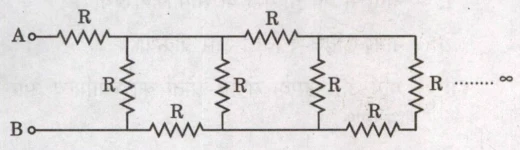
An infinite combination of resistors, each having resistance R = 4 Ω, is given below. What is the net resistance between the points A and B ? (Each resistance is of equal value, R = 4)

A ladder network of identical resistors, each labelled R, between terminal A (open circle, top left) and terminal B (open circle, bottom left). From A the top wire runs through a resistor R in series to a first node; a vertical resistor R joins that node to the bottom wire. The top wire then continues as plain wire to a second vertical resistor R, whose bottom joins the bottom wire; on the bottom wire between the first and second vertical resistors there is a series resistor R. After the second vertical resistor the top wire carries a series resistor R, then a third vertical resistor R; the bottom wire between the second and third vertical resistors is plain, and between the third and a fourth vertical resistor R it carries a series resistor R. The pattern of series resistors alternating top, bottom, top, bottom, with a vertical resistor after each, repeats to the right and ends with a row of dots and the infinity sign ∞.
Options
Show answer & solution

Option B

Why

In an infinite ladder, removing the first unit leaves the same ladder, so its resistance is still . Each unit here is one resistor in series and one across the rails; which rail the series resistor sits on does not matter. So , which gives .

Exam-hall approach

The ladder is more than the first and less than , which strikes A and D. The part after the first resistor is in parallel with at least , so it is at least . That puts at or more and strikes C ().

Proof

About the other options

Option A

Zero would mean A and B are joined by a plain wire. Every path from A to B passes through at least one resistor.

Option C

Halves the root once too often: , not .

Option D

Infinite resistance would mean no path at all. The first series and vertical resistors already join A to B.

Ideal time: about 1.5 min
52Physics • Electricity • Electric Cells and Electromotive Force
Moderate

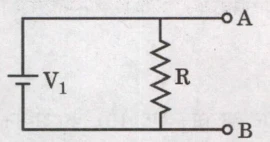
An electric circuit is given below. V1 = 1 V and Resistance R = 1000 Ω.

A circuit in a rectangle. The left branch holds a battery labelled V1 (long and short plate pair). The top wire runs from the battery to terminal A (open circle, top right) and the bottom wire to terminal B (open circle, bottom right). A single resistor labelled R is connected vertically between the top and bottom wires, just left of the terminals.

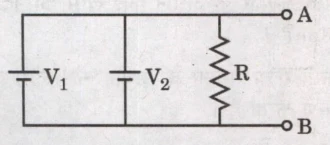
The current through the resistance R is very close to 1 mA and the voltage across point A and B, VAB = 1 V. Now the circuit is changed to :

A circuit in a rectangle with three vertical branches between the top wire and the bottom wire. The left branch holds a battery labelled V1, the middle branch a battery labelled V2, and the right branch a resistor labelled R. The top wire ends at terminal A (open circle, top right) and the bottom wire at terminal B (open circle, bottom right), so the two batteries and the resistor are in parallel.

where value of V2 = 5 V. The internal resistances of both the batteries are 0.1 Ω. The current through the resistance R is about :

Options
Show answer & solution

Option C

3.0 mA

Why

The two batteries and share the same two points, A and B, so they have one voltage across them. With both batteries facing the same way, the total current into the top junction is zero: . The internal resistances () are tiny next to , so is almost the average of the two emfs, 3 V, and the current through is mA.

Exam-hall approach

The voltage across R must lie between the two emfs, 1 V and 5 V, so the current lies between 1 mA and 5 mA. That strikes A and D. With equal internal resistances neither battery wins, so the voltage sits midway, at 3 V.

Proof

V, so mA

About the other options

Option A

Uses the first circuit's value. It leaves out the 5 V battery, which now pulls the voltage across R up.

Option B

No working on these values gives 1.2 mA. The voltage across R sits midway between 1 V and 5 V, at 3 V, not at 1.2 V.

Option D

Takes the larger battery alone, as if it set the voltage. The 1 V battery, with the same internal resistance, pulls it down to the midpoint.

Ideal time: about 1.5 min
53Physics • Electricity • Electric Current and Circuits
Easy

If the current through an electrical machine running on direct current is 15 A and the machine runs for 10 minutes, the charge that passes through the machine during this time is :

Options
Show answer & solution

Option D

9000 C

Why

Charge is current multiplied by time, , with time in seconds. 10 minutes is 600 s.

Exam-hall approach

Check the size: 15 A for even one minute already passes 900 C, so 10 minutes must pass ten times that. Only D is large enough.

Proof

C

About the other options

Option A

Divides instead of multiplying: .

Option B

Leaves the time in minutes: .

Option C

Uses one minute instead of ten: .

Ideal time: about 34 s
54Physics • Electricity • Electric Charges and Fields
Easy

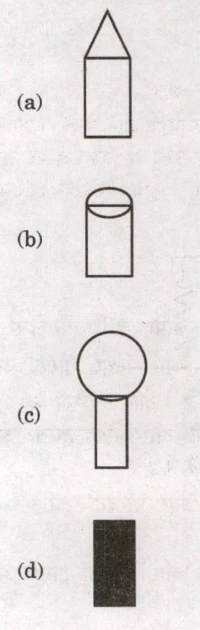
Which one of the following is the best shape of a solid metal rod to form the top end of a lightning conductor ?

Four rod shapes, each drawn in outline beside its label. (a): a vertical rectangular rod with a sharp triangular (conical) point on top. (b): a vertical cylinder whose flat top is drawn as an ellipse, so the end is flat. (c): a thin vertical rod with a large circle (a ball) on top. (d): a solid black filled vertical rectangle with a flat square-cut top.
Options
Show answer & solution

Option A

Figure (a)

Why

Charge on a conductor crowds at sharp points, so the electric field there is strongest. A pointed tip lets charge leak into the air easily and gives the lightning an easy path to the ground. That is why a lightning conductor ends in a sharp spike.

Proof

NCERT Class 12 Physics, Ch. 2 (Electrostatic Potential and Capacitance), Electrostatics of Conductors; NCERT Class 8 Science, lightning conductor

About the other options

Option B

A flat end spreads the charge out, so the field at it is weaker than at a point.

Option C

A ball has a large, smooth curve. Charge spreads over it evenly, which is how a Van de Graaff dome is made to hold charge, the opposite of what a lightning rod needs.

Option D

A flat, square-cut top has no sharp tip. Its filling does not matter, since charge sits on the outside of a conductor.

Ideal time: about 19 s
55Physics • Modern and Nuclear Physics • Fundamental Forces of Nature
Easy

Which of the following forces is/are fundamental in nature ?

1
Gravitational force
2
Electromagnetic forces
3
Strong and weak nuclear forces

Select the correct answer using the code given below :

Options
Show answer & solution

Option D

1, 2 and 3

Why

1 — Correct. Gravity is one of the four fundamental forces. 2 — Correct. The electromagnetic force is fundamental; friction, tension and the normal force all come from it. 3 — Correct. The strong and weak nuclear forces are the other two fundamental forces.

Exam-hall approach

Almost everyone knows gravity and electromagnetism are fundamental, which strikes A and C. The strong and weak forces are the other two of the four, so all three are correct.

Proof

NCERT Class 11 Physics, Physical World, Fundamental Forces in Nature

About the other options

Option A

Leaves out statements 2 and 3. Electromagnetic and nuclear forces are fundamental too.

Option B

Leaves out statement 3. The strong and weak nuclear forces complete the four fundamental forces.

Option C

Leaves out statement 1. Gravity is the weakest fundamental force, but it is still fundamental.

Ideal time: about 29 s
56Physics • Properties of Matter • Density and Relative Density
Moderate

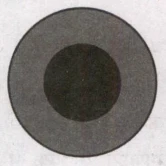
A spherical shell of outer radius R and inner radius R/2 contains a solid sphere of radius R/2 (see figure). The density of the material of the solid sphere is ρ and that of the shell is ρ/2. What is the average mass density of the larger sphere thus formed ?

Two concentric circles. The outer ring (the shell) is shaded mid-grey and the inner disc (the solid sphere) is filled darker grey, almost black. The inner circle's radius is half the outer circle's radius, and no labels or values are marked on the figure.
Options
Show answer & solution

Option B

9ρ/16

Why

Average density is total mass divided by total volume. Let be the volume of the whole sphere of radius . The inner sphere has radius , so its volume is and the shell's is .

Exam-hall approach

The inner sphere is only of the volume, so most of the material is the shell at . The average must be just above . That strikes A () and C ().

Proof

About the other options

Option A

The simple average of the two densities, . It ignores that the shell has seven times the volume.

Option C

Puts down the shell's share of the volume, , with density . The shell's density is .

Option D

Adds and : takes the shell's volume as the whole sphere's instead of of it.

Ideal time: about 1.5 min
57Physics • Light and Optics • Human Eye and Defects of Vision
Easy

The human eye is like a camera that has a lens with :

Options
Show answer & solution

Option D

variable focal length and variable aperture size.

Why

The ciliary muscles change the shape of the eye lens, so its focal length changes. This is accommodation. The iris changes the size of the pupil, so the aperture changes with the light.

Exam-hall approach

Most candidates know the pupil widens in dim light, so the aperture is variable. That strikes A and B. Accommodation then makes the focal length variable too.

Proof

NCERT Class 10 Science, The Human Eye and the Colourful World

About the other options

Option A

Both are wrong. A fixed focal length could not focus both near and far objects.

Option B

Has the aperture fixed. The iris changes the size of the pupil.

Option C

Has the focal length fixed. That describes a simple camera, which focuses by moving the lens, not the eye.

Ideal time: about 24 s
58Indian Polity • Schedules and Articles
Moderate

Under Article 371A of the Constitution of India, with respect to which of the following item(s) the Acts of the Parliament of India shall not apply to the State of Nagaland, unless the Legislative Assembly of the State of Nagaland by a resolution so decides ?

1
Religious or social practices of Nagas
2
Naga customary law and procedure
3
Ownership and transfer of land and its resources
4
Boundaries of Nagaland with other states

Select the answer using the code given below :

Options
Show answer & solution

Option C

1, 2 and 3 only

Why

1 — Correct. Religious or social practices of the Nagas are listed in Article 371A(1)(a). 2 — Correct. Naga customary law and procedure is listed. 3 — Correct. Ownership and transfer of land and its resources is listed. 4 — Not correct. Boundaries are not in Article 371A. Changing a state's boundaries is Parliament's power under Article 3.

Exam-hall approach

Article 3 gives Parliament the power to change any state's boundaries, so statement 4 is false. That strikes D. The three remaining items are the core of Naga identity that the special provision protects, so C fits.

Proof

Constitution of India, Article 371A(1)(a)

About the other options

Option A

Leaves out statements 2 and 3. Customary law and land ownership are both protected too.

Option B

Leaves out statement 1. Religious and social practices are the first item Article 371A protects.

Option D

Includes statement 4. Boundaries are not in Article 371A; Parliament alters state boundaries under Article 3.

Ideal time: about 52 s
59Indian Polity • State Government
Easy

Under Article 191 of the Constitution of India, a person shall be disqualified for being chosen as, and for being, a member of the Legislative Assembly or Legislative Council of a state if the person holds any office of profit under :

1
the Government of India.
2
any State Government.

Select the correct answer using the code given below :

Options
Show answer & solution

Option C

Both 1 and 2

Why

1 — Correct. An office of profit under the Government of India disqualifies a person from a state legislature. 2 — Correct. So does an office of profit under the government of any state, not only their own. An office the state legislature has declared by law not to disqualify is the only exception.

Proof

Constitution of India, Article 191(1)(a)

About the other options

Option A

Leaves out statement 2. An office of profit under any state government disqualifies as well.

Option B

Leaves out statement 1. An office of profit under the Government of India also disqualifies.

Option D

Article 191 names both governments, so neither statement is false.

Ideal time: about 34 s
60Indian Polity • International Relations • UN Human Rights Declarations and Conventions
Easy

Consider the following UN Declarations/Covenants :

1
Universal Declaration of Human Rights
2
Convention on the Elimination of All Forms of Discrimination Against Women
3
International Covenant of Economic, Social and Cultural Rights
4
Convention on Refugees

Which one of the following is the correct chronological order (starting with the earliest) of the above ?

Options
Show answer & solution

Option A

1, 4, 3, 2

Why

Universal Declaration of Human Rights: 1948. Convention on Refugees (Convention relating to the Status of Refugees): 1951. International Covenant on Economic, Social and Cultural Rights: 1966. Convention on the Elimination of All Forms of Discrimination Against Women (CEDAW): 1979.

Exam-hall approach

The Universal Declaration of 1948 came first, after the Second World War. That strikes D. CEDAW, of 1979, is the latest; only A puts statement 2 last.

Proof

1 — UDHR, 1948; 4 — Refugee Convention, 1951; 3 — ICESCR, 1966; 2 — CEDAW, 1979

About the other options

Option B

Puts CEDAW (1979) second and the Refugee Convention (1951) last. The Refugee Convention came soon after the UDHR.

Option C

Puts the Refugee Convention (1951) last. It is older than both the 1966 Covenant and CEDAW.

Option D

Puts the Refugee Convention before the UDHR. The UDHR (1948) came first.

Ideal time: about 47 s