Skip to content

General Ability Test 2024 (I)

Set A

Questions 81–100 of 150

81Biology • Human Physiology • Digestive System
Easy

In the human digestive system, which one among the following is the role of the pancreas ?

Options
Show answer & solution

Option C

Secretion of lipase, amylase and protease

Why

The pancreas secretes pancreatic juice, which carries enzymes for all three kinds of food: amylase for starch, trypsin (a protease) for proteins, and lipase for fats. This is its main role in digestion. Option D is also true of the pancreas: its juice carries bicarbonate, which neutralises the acid from the stomach. C is keyed as the role that defines the pancreas, the one NCERT names; D is a lesser role that NCERT Class 10 gives to bile instead.

Exam-hall approach

Bile is made by the liver and stored in the gall bladder, which strikes A and B. Pancreatic juice is the enzyme-rich juice, which points to C.

Proof

NCERT Class 10 Science, Ch. 5 (Life Processes), Nutrition in Human Beings

About the other options

Option A

Bile salts, made in the liver, break fat into small droplets (emulsification). The pancreas does not secrete them.

Option B

The gall bladder stores bile and releases it into the small intestine. The pancreas does not.

Option D

Also defensible

Also true of the pancreas: its bicarbonate neutralises stomach acid. It is keyed second because NCERT Class 10 gives this job to bile, and enzyme secretion is the pancreas's defining role.
Ideal time: about 21 s
82Biology • Cell Biology • Cell Cycle and Cell Division
Easy

Consider the following statements :

1
DNA replication takes place when chromatin is opened up.
2
Chromatin organises itself into rod-shaped chromosomes before cell division.
3
Both prokaryotes and eukaryotes have the same process for cell division.

Which of the statements given above is/are correct ?

Options
Show answer & solution

Option B

1 and 2 only

Why

1 — Correct. DNA can be copied only where the chromatin has loosened, so the enzymes can reach it. 2 — Correct. Before a cell divides, chromatin coils up into rod-shaped chromosomes. 3 — Not correct. Prokaryotes divide by binary fission. Eukaryotes divide by mitosis and meiosis, with a spindle and a nuclear envelope that breaks down.

Exam-hall approach

Prokaryotes have no nucleus, so they cannot divide the way eukaryotes do. Statement 3 is false, which strikes C and D. Statement 2 is the NCERT line on chromosomes, which gives B.

Proof

NCERT Class 9 Science, Ch. 5 (The Fundamental Unit of Life), Nucleus; NCERT Class 11 Biology, Ch. 10 (Cell Cycle and Cell Division)

About the other options

Option A

Leaves out statement 2. Chromatin does condense into rod-shaped chromosomes before division.

Option C

Contains statement 3, which is false: prokaryotes divide by binary fission.

Option D

Contains statement 3 alone, and it is the false one.

Ideal time: about 38 s
83Physics • System of Particles and Rotational Motion • Torque and Equilibrium of Rigid Bodies
Easy

A uniform meter scale of mass 0.24 kg is made of steel. It is kept on two wedges, W1 and W2, in a horizontal position. W1 is at a distance of 0.2 m from one of its ends, while W2 is at distance of 0.4 m from the other end. If the force on the scale is N1 due to W1 and N2 due to W2, then : (take g = 10.0 m s−2)

Options
Show answer & solution

Option C

N1 = 0.6 N and N2 = 1.8 N

Why

For a body at rest, the forces balance and the torques about any point balance. The scale's weight, N, acts at its middle, 0.5 m from either end. is at 0.2 m from one end and at 0.6 m from the same end. So the weight is 0.3 m from and 0.1 m from . The nearer wedge takes the larger share.

Exam-hall approach

The two forces must add up to the weight, 2.4 N, which all four options do. The middle of the scale is closer to W2, so N2 is larger, which strikes A and D. The distances 0.3 m and 0.1 m give a 1 : 3 split, which is C.

Proof

Torques about : N, so N

About the other options

Option A

Splits the weight in the ratio of the wedges' distances from the ends, . The split goes by distances from the centre of the scale.

Option B

Splits the weight , by the wedges' distances from the ends. The split goes by distances from the centre of the scale, .

Option D

Swaps the two. The wedge nearer the centre of the scale, W2, carries the larger force.

Ideal time: about 1.5 min
84Physics • Gravitation • Gravitational Potential and Potential Energy
Easy

Escape speed from the Earth is close to 11.2 km s−1. On another planet whose radius is half of the Earth’s radius and whose mass density is four times that of the Earth, the escape speed in km s−1 will be close to :

Options
Show answer & solution

Option A

11.2

Why

Escape speed is . With , this becomes , so .

Exam-hall approach

Halving halves ; four times the density doubles it, since . The two cancel, so the escape speed is the same as the Earth's.

Proof

km/s

About the other options

Option B

Takes , missing that goes as : .

Option C

Halves for the radius but ignores the density: .

Option D

km/s is the Earth's orbital speed near the surface, . It is not this planet's escape speed.

Ideal time: about 47 s
85Physics • Oscillations, Waves and Sound • Transverse and Longitudinal Waves
Very easy

Which one of the following does not apply to sound waves in fluids ?

Options
Show answer & solution

Option C

They are transverse

Why

Sound in a liquid or a gas is a longitudinal wave: the particles move back and forth along the direction the wave travels. Fluids cannot hold a shear, so they cannot carry transverse waves.

Proof

NCERT Class 9 Science, Ch. 11 (Sound)

About the other options

Option A

True of sound: every wave carries energy from place to place.

Option B

True of sound: it is a mechanical wave and cannot cross a vacuum.

Option D

True of sound: it travels about 1500 m/s in water against about 340 m/s in air.

Ideal time: about 19 s
86Physics • Motion, Force and Laws of Motion • Newton's Laws and Conservation of Momentum
Moderate

A ball of 0.1 kg mass is dropped on a hard floor from a height of 0.45 m and rises to a height of 0.20 m. If it was in touch with the floor for 0.1 s, the net force it applied on the floor while bouncing is : (take the gravitational acceleration g = 10 m s−2)

Options
Show answer & solution

Option B

6.0 N

Why

The ball reaches the floor at m/s and leaves at m/s upwards, so its momentum changes by kg m/s in 0.1 s. That needs a net upward force of 5 N on the ball. The floor must push up with 5 N more than the ball's weight, 1 N, so it pushes with 6 N. By Newton's third law, the ball presses on the floor with 6 N. The question can also be read as asking only for the rate of change of momentum, 5 N (option D), which ignores gravity during the contact. On the words as printed, the force the ball applies on the floor is 6 N.

Exam-hall approach

Directions matter: the speed reverses, so the changes add, m/s, not m/s. That strikes A. Then remember the floor also holds up the ball's weight, N.

Proof

N N

About the other options

Option A

Subtracts the speeds instead of adding them: N. The ball's direction reverses, so the changes add.

Option C

No standard slip gives 3 N. The momentum change alone needs 5 N.

Option D

Also defensible

The net force on the ball, N. It is also defensible if 'net force' is read as that rate; but the floor must also hold up the 1 N weight, so the ball presses on it with 6 N.

Ideal time: about 1.5 min
87Physics • Oscillations, Waves and Sound • Oscillations and the Simple Pendulum
Easy

Which one of the following statements regarding simple pendulum is correct ?

Simple pendulum has a time period independent of amplitude :

Options
Show answer & solution

Option D

only for small amplitudes because then the net force on its bob is proportional to its displacement.

Why

The restoring force on the bob is . For small angles , so the force is proportional to the displacement and the motion is simple harmonic. Only then is the period , free of the amplitude.

Exam-hall approach

The period is independent of amplitude only for small swings, which strikes B and C. A force independent of displacement could not give simple harmonic motion, which strikes A.

Proof

NCERT Class 11 Physics, Ch. 13 (Oscillations), The Simple Pendulum

About the other options

Option A

Right about small amplitudes, wrong about the reason: the force must be proportional to the displacement, not independent of it.

Option B

For large swings is no longer close to , so the force is not proportional to displacement and the period grows with amplitude.

Option C

Wrong on both counts: the period depends on amplitude for large swings, and a constant force gives no oscillation.

Ideal time: about 44 s
88Physics • Motion, Force and Laws of Motion • Friction
Easy

Which one of the following about different frictional forces is correct ?

Options
Show answer & solution

Option C

Static friction > Kinetic friction > Rolling friction

Why

It takes more force to start an object sliding than to keep it sliding, so static friction is greater than kinetic (sliding) friction. Rolling friction is the smallest, which is why wheels are used.

Exam-hall approach

Wheels make moving easier, so rolling friction is the least. That strikes A, B and D.

Proof

NCERT Class 8 Science, Force and Pressure / Friction (static, sliding and rolling friction)

About the other options

Option A

Puts kinetic friction above static. Starting an object moving takes more force than keeping it moving.

Option B

Puts rolling friction above kinetic. Rolling friction is the smallest of the three.

Option D

Makes kinetic and rolling friction equal. Rolling friction is much smaller than sliding friction.

Ideal time: about 23 s
89Physics • Motion, Force and Laws of Motion • Newton's Laws and Conservation of Momentum
Easy

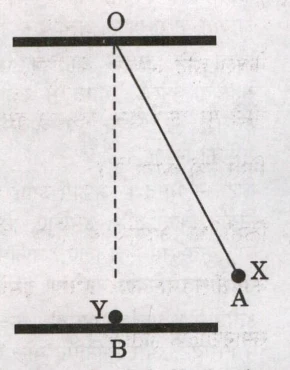
A metallic bob X of mass m is released from position A. It collides elastically with another identical bob Y placed at rest at position B on a horizontal frictionless table. The angle AOB is 30°.

A thick horizontal bar at the top with the point O marked at its centre, and a thick horizontal bar at the bottom with the point B marked beneath it. A dashed vertical line runs from O down to the bottom bar at B. A solid straight line runs from O down and to the right to a filled dot, the bob X, with the point A labelled just below X. A second filled dot, the bob Y, sits on the bottom bar just left of B and is labelled Y.

How high does the bob X rise immediately after the collision ?

Options
Show answer & solution

Option D

It stops at position B

Why

In an elastic collision between two equal masses, with one at rest, the two exchange velocities. X hands all its velocity to Y and stops dead at B, while Y moves off with X's speed.

Exam-hall approach

Equal masses, elastic collision: the moving one stops and the other carries on. Newton's cradle shows it. That leaves only D.

Proof

For , : ,

About the other options

Option A

Would happen only if X missed Y and kept all its energy. In the collision, X gives all of it to Y.

Option B

Would need X to keep part of its speed. Equal masses in an elastic collision exchange speeds completely.

Option C

X would need to bounce back with all its speed, as off a heavy wall. Y is equal in mass and free to move.

Ideal time: about 46 s
90Physics • Magnetism and Electromagnetism • Electromagnetic Waves and Spectrum
Moderate

Consider the two statements given below :

Statement-1
Infrared waves are also called heat waves.
Statement-2
Water molecules readily absorb infrared waves.

Select the correct answer using the code given below :

Options
Show answer & solution

Option A

Both the statements are individually true and Statement-2 is the correct explanation of Statement-1.

Why

Statement-1 — True. Infrared waves are sometimes called heat waves. Statement-2 — True. Water molecules, present in most materials, readily absorb infrared. Explanation — Yes. After absorbing infrared, the molecules move faster; the body heats up. That is why infrared is called heat waves.

Exam-hall approach

Both statements are well known, which strikes C and D. Ask why infrared heats things: because materials, full of water, absorb it. That makes Statement-2 the reason.

Proof

NCERT Class 12 Physics, Ch. 8 (Electromagnetic Waves), Infrared waves

About the other options

Option B

Both statements are true, but Statement-2 is the reason: absorption by water molecules is what makes infrared heat things.

Option C

Statement-2 is true: water molecules readily absorb infrared.

Option D

Statement-1 is true: infrared waves are called heat waves.

Ideal time: about 44 s
91History • British Administration and Economic Policy
Moderate

Which of the following statements are correct ?

1
British ‘trade surplus’ with India in the nineteenth century meant that the value of British exports to India was much higher than the value of British imports from India.
2
India played a crucial role in the late-nineteenth-century world economy by helping Britain balance its deficits.
3
Britain grew opium in India and exported it to China and, therefore, for a while after the 1820s, opium became India’s single largest export.
4
The nineteenth century saw export of Indian raw materials decline, and that of manufactured goods increase.

Select the answer using the code given below :

Options
Show answer & solution

Option D

1, 2 and 3 only

Why

1 — Correct. Britain sold far more to India than it bought from it, giving Britain a trade surplus. 2 — Correct. Britain used this surplus to balance its trade deficits with other countries, so India was crucial to the world economy of the late nineteenth century. 3 — Correct. Opium grown in India was sold to China to pay for tea; for a while after the 1820s it was India's single largest export. 4 — Not correct. The reverse happened: India's exports of raw materials rose, and its exports of manufactures fell as British factory goods flooded India.

Exam-hall approach

Statement 4 reverses what happened under colonial rule: India came to export raw materials and import British manufactures. That strikes B and C. A or D turns on statement 3; the opium trade with China is well known, which gives D.

Proof

NCERT Class 10 India and the Contemporary World II, Ch. 3 (The Making of a Global World); NCERT Class 8 Our Pasts III, Ruling the Countryside

About the other options

Option A

Leaves out statement 3. Opium sold to China was for a time India's largest export.

Option B

Leaves out 1 and 2, and contains statement 4, which reverses the trade: raw-material exports rose.

Option C

Contains statement 4, which is false: raw-material exports rose and manufactured exports fell.

Ideal time: about 1.5 min
92History • Science, Mathematics and Measurement in Early India
Moderate

Match List-I with List-II and select the correct answer using the code given below the Lists :

List-I (Unit in use in early India)

A
Muhurta
B
Raktika
C
Angula
D
Pada

List-II (Content)

1
Measure of weight
2
Measure of time
3
Metre of poetry
4
Measure of length
Options
ABCD
Show answer & solution

Option A

A2B1C4D3

Why

Muhurta is a unit of time, about 48 minutes. Raktika, the red gunja seed, is a unit of weight. Angula, a finger's breadth, is a unit of length. Pada, a quarter of a verse, is a unit of metre in poetry.

Exam-hall approach

Muhurta as time is the surest pair: A-2 strikes C and D. Angula as finger-width (length) then strikes B.

Proof

A–2, B–1, C–4, D–3

About the other options

Option B

Gives raktika length and angula weight. Raktika is a seed used as a weight; angula is a finger's breadth.

Option C

Gives muhurta poetic metre. Muhurta is a measure of time.

Option D

Gives muhurta poetic metre and pada time. Pada is a quarter of a verse.

Ideal time: about 41 s
93History • Post-Mauryan and Gupta Period
Easy

First coins in Indian history bearing the names and images of rulers were issued by the :

Options
Show answer & solution

Option D

Indo-Greeks

Why

The first coins to bear the names and images of rulers were issued by the Indo-Greeks, who ruled the north-west from about the second century BCE. Earlier punch-marked coins carried only symbols.

Proof

NCERT Class 12 Themes in Indian History Part I, Ch. 2 (Kings, Farmers and Towns), Coins and kings

About the other options

Option A

The Mauryas used punch-marked coins with symbols, not rulers' names or portraits.

Option B

The Pushyabhutis of Thanesar (Harsha's line) came in the 6th–7th centuries CE, long after the Indo-Greeks.

Option C

The Guptas issued fine gold coins with kings' images, but some five centuries after the Indo-Greeks.

Ideal time: about 15 s
94History • World History • Modernity and Modernisation
Very easy

Social theorists in the nineteenth and twentieth centuries emphasised the emergence of industrialisation, urbanisation, secularisation and bureaucratisation as hallmarks of :

Options
Show answer & solution

Option A

Modernity

Why

Social thinkers such as Marx, Weber and Durkheim saw industrialisation, urbanisation, secularisation and bureaucratisation as the marks of the modern age: modernity.

Proof

NCERT Class 11 Sociology, Introducing Sociology

About the other options

Option B

Feudalism is the land-based order of medieval Europe, before industry and cities grew.

Option C

Kingship is rule by a king, an older form of authority, not a hallmark of industrial society.

Option D

Medievalism refers to the Middle Ages, which these changes brought to an end.

Ideal time: about 16 s
95History • National Movement, 1919–1947 • Rowlatt Satyagraha, Khilafat and Non-Cooperation Movement
Easy

Consider the following events :

1
Launch of Non-Cooperation Movement
2
All-India Khilafat Conference in Delhi
3
Passing of the Rowlatt Act
4
Jallianwala Bagh incident

Which one of the following is the correct chronological order of the given events (earliest to latest) ?

Options
Show answer & solution

Option B

3, 4, 2, 1

Why

Rowlatt Act passed: March 1919. Jallianwala Bagh: 13 April 1919. All-India Khilafat Conference, Delhi: November 1919. Non-Cooperation Movement launched: 1920.

Exam-hall approach

The Rowlatt Act led to the protests at Jallianwala Bagh, so 3 comes before 4, and Non-Cooperation came last. Only B has that order.

Proof

3 — Rowlatt Act, March 1919; 4 — Jallianwala Bagh, April 1919; 2 — Khilafat Conference, November 1919; 1 — Non-Cooperation, 1920

About the other options

Option A

Puts Non-Cooperation first. It was launched in 1920, after all the others.

Option C

Puts the Khilafat Conference (November 1919) before Jallianwala Bagh (April 1919).

Option D

Puts the Khilafat Conference before the Rowlatt Act (March 1919).

Ideal time: about 44 s
96History • British Administration and Economic Policy
Hard

Match List-I with List-II and select the correct answer using the code given below the Lists :

List-I (System / Category)

A
Upari
B
Pattadar
C
Mirasidar
D
Inam lands

List-II (Description)

1
Peasants directly responsible for the payment of revenue
2
Category of tenancy tenure held under the Marathas
3
Gifts of land or land revenue
4
Co-parcenary title holder and designated revenue payer in southern India
Options
ABCD
Show answer & solution

Option A

A2B1C4D3

Why

Upari was a class of tenant-cultivators under the Marathas. A pattadar, holder of a patta, paid revenue directly to the state. A mirasidar in South India held land as a co-sharer and paid the revenue. Inam lands were gifts of land or of its revenue.

Exam-hall approach

Inam as a gift of land is the best-known pair: D-3 strikes C and D. Pattadar, the patta holder who pays revenue (B-1), then strikes B.

Proof

A–2, B–1, C–4, D–3

About the other options

Option B

Swaps pattadar and mirasidar. The pattadar pays revenue directly under the patta; the mirasidar is the South Indian co-sharer.

Option C

Makes upari a gift of land. That is inam; upari was a Maratha tenancy.

Option D

Makes upari a gift of land and inam a tenancy. Inam means a gift.

Ideal time: about 48 s
97History • Vijayanagara and Bahmani Kingdoms
Moderate

Which of the following statements about Vijayanagara king Krishnadevaraya’s expeditions are correct ?

1
In the early years of his reign he marched against the ruler of Orissa.
2
In 1520 CE, he captured the fort of Raichur from Ismail Adil Khan.
3
Krishnadevaraya restored Sultan Mahmud Shah to power and assumed the title of Yavana-rajya-sthapan-acharya.

Select the answer using the code given below :

Options
Show answer & solution

Option C

1, 2 and 3

Why

1 — Correct. Early in his reign (about 1513–1518) he campaigned against the Gajapati ruler of Orissa. 2 — Correct. In 1520 he took Raichur fort from Ismail Adil Khan of Bijapur. 3 — Correct. He restored the Bahmani Sultan Mahmud Shah to his throne and took the title Yavana-rajya-sthapanacharya, 'restorer of the Yavana (Muslim) kingdom'.

Exam-hall approach

The battle of Raichur (1520) and the Orissa campaign are his best-known wars, which strikes A and B. Statement 3 then decides C or D; the title literally means 'establisher of the Yavana kingdom', which fits restoring a sultan.

Proof

Satish Chandra, Medieval India (NCERT, old edition), Vijayanagara: Krishnadeva Raya

About the other options

Option A

Leaves out statement 2. Krishnadevaraya took Raichur in 1520.

Option B

Leaves out statement 1. His first campaigns were against the Gajapatis of Orissa.

Option D

Leaves out statement 3. He did restore Mahmud Shah and took the Yavana title.

Ideal time: about 46 s
98Chemistry • Non-Metals and their Compounds • Hydrogen and its Compounds
Easy

Water gas is a mixture of :

Options
Show answer & solution

Option B

CO and H2

Why

Water gas is made by passing steam over red-hot coke: . The mixture of carbon monoxide and hydrogen is also called syngas.

Proof

NCERT Class 11 Chemistry, Hydrogen (preparation of dihydrogen)

About the other options

Option A

Has carbon dioxide. forms only in the water-gas shift step, when reacts with more steam.

Option C

Carbon dioxide and steam are not fuels. Water gas is a fuel because its and burn.

Option D

Steam is a reactant, not part of the product. Producer gas, the other near-miss, is and .

Ideal time: about 14 s
99Chemistry • Acids, Bases and Salts • pH and its Applications
Easy

Human body works in the pH range of :

Options
Show answer & solution

Option B

7.0 – 7.8

Why

The human body works within a narrow pH range of 7.0 to 7.8. Blood is kept near 7.4.

Exam-hall approach

Blood is slightly alkaline, about 7.4. Ranges that dip below 7 (A and C) or start above 7.4 (D) fall away.

Proof

NCERT Class 10 Science, Ch. 2 (Acids, Bases and Salts), Importance of pH in everyday life

About the other options

Option A

Dips below 7. The body's working range starts at 7.0.

Option C

6.5 to 7.5 is close to neutral, but goes below the body's range of 7.0 to 7.8.

Option D

Starts at 7.5, above the blood's normal 7.4.

Ideal time: about 15 s
100Chemistry • Non-Metals and their Compounds • Hydrogen and its Compounds
Easy

Which one among the following statements with reference to the properties of water is not correct ?

Options
Show answer & solution

Option B

Latent heat of fusion of water is very low.

Why

The latent heat of fusion of ice is high, about J/kg. That is why ice cools a drink so well: it takes a lot of heat to melt.

Proof

NCERT Class 9 Science, Ch. 1 (Matter in Our Surroundings), Latent heat

About the other options

Option A

Correct: water's specific heat is unusually high, which is why seas warm and cool slowly.

Option C

Correct: ice floats because water is denser than ice.

Option D

Correct: pure water has almost no ions, so it barely conducts. Tap water conducts because of dissolved salts.

Ideal time: about 31 s