Skip to content

General Ability Test 2023 (I)

Set A

Questions 121–140 of 150

121Geography • Universe and Solar System
Easy

Which one of the following astronomers proved that the Earth and other planets revolve around the Sun ?

Options
Show answer & solution

Option A

Copernicus

Why

Nicolaus Copernicus put forward the heliocentric theory in 1543: the Earth and the other planets go round the Sun. He is the name the question asks for. Strictly, he did not prove it. Galileo's telescope observations, such as the phases of Venus (1610), gave the first strong evidence, so the key is contestable.

Proof

Copernicus, De revolutionibus, 1543 (NCERT Class 11 Physics, Ch. 7 Gravitation)

About the other options

Option B

Kepler: gave the three laws of planetary motion, showing the orbits are ellipses, building on Copernicus.

Option C

Also defensible

Galileo: his telescope observations supported the Sun-centred model. On a strict reading of 'proved', he has a claim, but the theory is Copernicus's.

Option D

Newton: explained why the planets move as they do, through his law of gravitation.
Ideal time: about 12 s
122Physics • Motion, Force and Laws of Motion • Newton's Laws and Conservation of Momentum
Moderate

Sand falls vertically on a conveyor belt at a rate of 0.1 kg/s. In order to keep the belt moving at a uniform speed of 2 m/s, the force required to be applied on the belt is :

Options
Show answer & solution

Option B

0.2 N

Why

The sand lands with no horizontal speed. The belt must give each kilogram a speed of 2 m/s. Force is the rate of change of momentum: .

Exam-hall approach

The answer must be speed times mass per second: 2 times 0.1. Any other product of the two numbers does not fit.

Proof

N

About the other options

Option A

Assumes uniform speed means no force. The belt keeps gaining mass, so momentum keeps rising.

Option C

Takes the weight of one second's sand: N. Weight acts downwards; the pull on the belt is horizontal.

Option D

Brings in as well: N. Gravity plays no part in the horizontal pull.

Ideal time: about 45 s
123Physics • Work, Energy and Power • Power
Easy

The power required to lift a mass of 8.0 kg up a vertical distance of 4 m in 2 s is (taking acceleration due to gravity as 10 m/s2) :

Options
Show answer & solution

Option B

160 W

Why

Power is work done per unit time. Lifting a mass through height takes work , so .

Proof

W

About the other options

Option A

Divides by 4 instead of 2: W.

Option C

Leaves out the time: J is the work, not the power.

Option D

Multiplies by the time instead of dividing: .

Ideal time: about 38 s
124Physics • Motion, Force and Laws of Motion • Friction
Moderate

One block of 2.0 kg mass is placed on top of another block of 3.0 kg mass. The coefficient of static friction between the two blocks is 0.2. The bottom block is pulled with a horizontal force F such that both the blocks move together without slipping. Taking acceleration due to gravity as 10 m/s2, the maximum value of the frictional force is :

Options
Show answer & solution

Option C

4 N

Why

Only friction from the lower block drags the upper block along. Static friction can be at most times the normal force, and the normal force on the upper block is its own weight: .

Proof

N

About the other options

Option A

Uses the weight of both blocks without : N.

Option B

Uses the weight of the lower block without : N.

Option D

Uses both masses: N. The lower block's mass does not press on the surface between the blocks.

Ideal time: about 55 s
125Physics • Gravitation • Acceleration due to Gravity, Mass and Weight
Easy

A mass is attached to a spring that hangs vertically. The extension produced in the spring is 6 cm on Earth. The acceleration due to gravity on the surface of the Moon is one-sixth of its value on the surface of the Earth. The extension of the spring on the Moon would be :

Options
Show answer & solution

Option B

1 cm

Why

At rest, the spring force balances the weight: . The mass and stay the same, so the extension is proportional to .

Proof

cm

About the other options

Option A

Takes the extension as fixed, as if the spring measured mass. A spring balance measures weight.

Option C

Assumes no gravity on the Moon. The Moon's gravity is weaker, not zero.

Option D

Multiplies by 6 instead of dividing: weaker gravity gives less stretch, not more.

Ideal time: about 41 s
126Physics • System of Particles and Rotational Motion • Levers and Simple Machines
Easy

Which one of the following is an example of Second Class Lever ?

Options
Show answer & solution

Option B

A bottle opener

Why

In a second class lever, the load lies between the fulcrum and the effort. In a bottle opener the fulcrum is the tip on the cap, the load is the edge of the cap, and the hand pulls at the far end.

Exam-hall approach

A pair of scissors is the textbook first class lever, which strikes A. A bat is swung from the hands, with the effort between the fulcrum and the load: third class.

Proof

Classes of levers by the position of fulcrum, load and effort (standard GK texts, simple machines)

About the other options

Option A

A pair of scissors: a first class lever; the fulcrum (the pivot) is between the effort and the load.

Option C

A cricket bat: a third class lever; the effort (the lower hand) is between the fulcrum and the load.

Option D

A bow and arrow: the bow stores energy as it bends; it is not used as a second class lever.

Ideal time: about 19 s
127Physics • Electricity • Resistance and Combination of Resistors
Moderate

In an electric circuit, a wire of resistance 10 Ω is used. If this wire is stretched to a length double of its original value, the current in the circuit would become :

Options
Show answer & solution

Option C

one-fourth of its original value.

Why

Resistance is . Stretching keeps the volume the same, so doubling the length halves the area, and becomes 4 times. At the same voltage, falls to one-fourth.

Exam-hall approach

Doubling the length alone would only double R and halve I, giving A. A careful candidate remembers that the wire also gets thinner, which strikes A as well as the increases B and D.

Proof

, so

About the other options

Option A

Doubles the length but forgets that the area halves: only doubles.

Option B

Inverts the effect: a longer wire has more resistance, so the current falls, not rises.

Option D

Takes the change in resistance as the change in current. Current is inversely proportional to resistance.

Ideal time: about 1 min
128Physics • Electricity • Resistance and Combination of Resistors
Easy

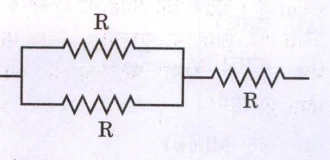
What is the total resistance in the following circuit element ?

A circuit element drawn left to right: a wire enters a loop in which two resistors, each labelled R, are connected in parallel (one on the upper branch, one on the lower branch). The loop's right junction is joined by a wire to a third resistor, labelled R, in series, with a wire leaving its right end.
Options
Show answer & solution

Option C

3R/2

Why

Two equal resistors in parallel give half of one: . That pair is in series with the third , and series resistances add.

Proof

About the other options

Option A

Takes only the parallel pair and leaves out the third resistor.

Option B

Puts all three in series: .

Option D

Puts one resistor in parallel with the other two in series: .

Ideal time: about 30 s
129Economy • Infrastructure
Easy

Which of the following scheme(s) is/are included under Bharatmala Pariyojana ?

1
Develop the road connectivity to border areas
2
Development of coastal roads
3
Improvement in the efficiency of National Corridors

Select the correct answer using the code given below :

Options
Show answer & solution

Option D

1, 2 and 3

Why

1 — Correct. Border and international connectivity roads are a component of Bharatmala. 2 — Correct. Coastal and port connectivity roads are a component. 3 — Correct. Improving the efficiency of national corridors is a component.

Exam-hall approach

Bharatmala is a single umbrella programme for all national highway building, so a narrow option is unlikely. Border roads and coastal roads are both well-known parts of it.

Proof

Bharatmala Pariyojana Phase I (2017), Ministry of Road Transport and Highways: economic corridors, inter-corridor and feeder roads, national corridor efficiency, border and international connectivity, coastal and port connectivity, expressways

About the other options

Option A

Leaves out statements 2 and 3, which are both components.

Option B

Leaves out statements 1 and 2, which are both components.

Option C

Leaves out statement 1. Border connectivity roads are part of Bharatmala.

Ideal time: about 42 s
130Geography • Transport and Communication in India
Easy

Deendayal Port was earlier known as :

Options
Show answer & solution

Option C

Kandla Port

Why

Kandla Port, in Kachchh, Gujarat, was renamed Deendayal Port in 2017, after Pandit Deendayal Upadhyaya. It was developed after Partition to replace Karachi for western India.

Proof

Kandla Port renamed Deendayal Port, 2017 (Ministry of Shipping)

About the other options

Option A

Paradip Port: in Odisha; its name has not changed.

Option B

Tuticorin Port: renamed V.O. Chidambaranar Port, after a freedom fighter.

Option D

Visakhapatnam Port: in Andhra Pradesh; its name has not changed.

Ideal time: about 13 s
131Defence and Security • Organisation of the Armed Forces
Easy

The Counter Insurgency and Jungle Warfare School of Indian Army is situated at :

Options
Show answer & solution

Option B

Vairengte

Why

The Counter Insurgency and Jungle Warfare School (CIJWS) of the Indian Army is at Vairengte in Mizoram.

Proof

Counter Insurgency and Jungle Warfare School, Vairengte, Mizoram (Indian Army)

About the other options

Option A

Dehradun: home of the Indian Military Academy, which trains officers.

Option C

Gulmarg: home of the High Altitude Warfare School, for mountain and snow warfare.

Option D

Mhow: home of the Infantry School and the Army War College.

Ideal time: about 14 s
132Geography • Rocks, Landforms and Geomorphic Processes • Soil Formation Processes
Moderate

In the soil-forming regime, which one of the following occurs in a region where evapotranspiration exceeds precipitation significantly ?

Options
Show answer & solution

Option A

Calcification

Why

Where evapotranspiration is much more than rainfall, water moves up through the soil, not down. Calcium carbonate is left behind near the surface. This is calcification, found in dry and semi-arid grasslands.

Proof

Soil-forming processes by climate (NCERT Class 11 Fundamentals of Physical Geography, Ch. 6 Geomorphic Processes)

About the other options

Option B

Laterization: heavy rain in hot, humid areas washes out silica and leaves iron and aluminium; rainfall is high, not low.

Option C

Podsolization: acidic leaching in cool, wet regions under coniferous forest.

Option D

Gleization: happens in waterlogged soils with poor drainage.

Ideal time: about 18 s
133Geography • Earth's Interior, Plate Tectonics, Earthquakes and Volcanoes • Interior of the Earth: Crust, Mantle and Core
Easy

Which one of the following is found in the innermost part of the Earth ?

Options
Show answer & solution

Option D

Lehmann discontinuity

Why

The Lehmann discontinuity separates the outer core from the inner core, about 5,150 km deep. It is the deepest of the four.

Exam-hall approach

Moho, between crust and mantle, is the one every candidate knows; it is shallow, which strikes B. Conrad is inside the crust, which strikes A.

Proof

Order with depth: Conrad (upper/lower crust), Mohorovicic (crust/mantle), Gutenberg (mantle/core), Lehmann (outer/inner core) (standard GK texts, interior of the Earth)

About the other options

Option A

Conrad discontinuity: inside the crust, between its upper and lower layers; the shallowest.

Option B

Moho discontinuity: between the crust and the mantle.

Option C

Gutenberg discontinuity: between the mantle and the outer core; deep, but not the deepest.

Ideal time: about 18 s
134Geography • Soils and Natural Vegetation of India • Forest Types of India
Easy

Which of the following tree species is/are found on Himalayas ?

1
Oak
2
Rhododendron
3
Rosewood

Select the correct answer using the code given below :

Options
Show answer & solution

Option D

1 and 2

Why

1 — Correct. Oak grows in the temperate forests of the Himalayas. 2 — Correct. Rhododendron grows in the temperate and alpine Himalayas; it is the state tree of Uttarakhand. 3 — Not correct. Rosewood is a tree of the tropical evergreen and moist deciduous forests, such as the Western Ghats.

Exam-hall approach

Rosewood is listed in NCERT with ebony and mahogany as a tropical evergreen tree, so 3 is false. That strikes B and C. Oak is a well-known Himalayan tree, which strikes A.

Proof

NCERT Class 11 India: Physical Environment, Ch. 5 Natural Vegetation

About the other options

Option A

Leaves out statement 2. Rhododendron is a typical Himalayan tree.

Option B

Contains statement 3. Rosewood is a tree of the tropical forests.

Option C

Contains statement 3, which is false.

Ideal time: about 37 s
135Geography • Earth's Interior, Plate Tectonics, Earthquakes and Volcanoes • Volcanoes and Volcanic Landforms
Easy

Which one of the following is the lowermost/innermost intrusive igneous rock ?

Options
Show answer & solution

Option B

Batholith

Why

A batholith is a large body of magma that cools deep in the crust, often as granite. It forms at greater depth than the other intrusive forms.

Proof

NCERT Class 11 Fundamentals of Physical Geography, Ch. 3 Interior of the Earth (intrusive forms)

About the other options

Option A

Laccolith: a dome-shaped intrusion with a level base, closer to the surface.

Option C

Lopolith: a saucer-shaped intrusion that sags in the middle; formed at shallower depth.

Option D

Phacolith: a wavy body of magma along the crest or trough of folds.

Ideal time: about 13 s
136Geography • Earth's Motions, Latitudes, Longitudes and Time • Longitude, Time and the International Date Line
Easy

If it is 12 noon in New Delhi, what will be the time in London, UK ?

Options
Show answer & solution

Option A

6:30 A.M.

Why

Indian Standard Time is 5 hours 30 minutes ahead of Greenwich Mean Time, London's standard time. So at 12 noon in New Delhi, it is 6:30 a.m. in London. (In summer, London uses British Summer Time, an hour ahead of GMT, but the question means standard time.)

Exam-hall approach

India is east of London, so its clock is ahead, and London must be earlier: that strikes B and D. The difference is 5 h 30 min, not 6 h 30 min, which leaves A.

Proof

IST , so 12:00 IST 5:30 6:30 a.m. GMT

About the other options

Option B

Adds 6:30 hours instead of taking away 5:30; London is behind India.

Option C

Takes away 6:30 hours, one hour too many; this would be true only if IST were GMT+6:30.

Option D

Adds 5:30 hours. India is east of London, so London's time is earlier, not later.

Ideal time: about 28 s
137Geography • Oceans • Tides
Easy

Which of the following positions of Sun, Earth and Moon is/are suitable for Spring Tide ?

1
SYZYGY Conjunction
2
SYZYGY Opposition
3
Quadrature

Select the correct answer using the code given below :

Options
Show answer & solution

Option C

1 and 2

Why

1 — Correct. In conjunction (new moon), the Sun and Moon are on the same side of the Earth, in a line. Their pulls add up and give a spring tide. 2 — Correct. In opposition (full moon), they are on opposite sides but still in a line. This also gives a spring tide. 3 — Not correct. In quadrature, the Sun and Moon are at a right angle to the Earth. This gives a neap tide.

Exam-hall approach

Spring tides come twice a month, at new moon and full moon. Both are syzygy positions, so 1 and 2 are true. Quadrature gives neap tides.

Proof

NCERT Class 11 Fundamentals of Physical Geography, Ch. 13 Movements of Ocean Water

About the other options

Option A

Leaves out statement 2. The full moon also gives a spring tide.

Option B

Leaves out statement 1. The new moon also gives a spring tide.

Option D

Contains statement 3. Quadrature gives a neap tide, not a spring tide.

Ideal time: about 34 s
138History • World History • Renaissance
Very easy

Which Renaissance artist painted 'The Last Supper' ?

Options
Show answer & solution

Option D

Leonardo da Vinci

Why

Leonardo da Vinci painted The Last Supper (1495–98) on a wall of a convent in Milan. He also painted the Mona Lisa.

Proof

The Last Supper, Leonardo da Vinci, 1495–98 (NCERT Class 11 Themes in World History, Ch. 5 Changing Cultural Traditions)

About the other options

Option A

Michelangelo: painted the ceiling of the Sistine Chapel and carved the statue of David.

Option B

Donatello: a sculptor, known for his bronze David.

Option C

Botticelli: painted The Birth of Venus.

Ideal time: about 10 s
139History • World History • Age of Exploration and Colonisation of the Americas
Very easy

Which one of the following European explorer conquered Mexico ?

Options
Show answer & solution

Option D

Hernán Cortés

Why

Hernán Cortés, a Spanish conquistador, conquered the Aztec Empire of Mexico in 1519–21.

Exam-hall approach

Vasco da Gama and Bartholomew Diaz sailed for Portugal around Africa, not to the Americas; Magellan's voyage was the first to go round the world. None of them conquered a land empire.

Proof

Cortés and the conquest of the Aztecs, 1519–21 (NCERT Class 11 Themes in World History, Ch. 8 Confrontation of Cultures)

About the other options

Option A

Vasco da Gama: Portuguese; reached Calicut in India by sea in 1498.

Option B

Bartholomew Diaz: Portuguese; first to sail round the Cape of Good Hope, in 1488.

Option C

Magellan: led the first voyage round the world (1519–22); he died in the Philippines.

Ideal time: about 11 s
140History • Post-Mauryan and Gupta Period
Very easy

Near which one of the following cities in India have large statues of Kushana rulers been discovered ?

Options
Show answer & solution

Option D

Mathura

Why

Large statues of Kushana rulers, including a headless statue of Kanishka, were found in a shrine at Mat, near Mathura in Uttar Pradesh. Mathura was a main Kushana centre and a school of sculpture.

Proof

NCERT Class 12 Themes in Indian History Part I, Ch. 2 Kings, Farmers and Towns

About the other options

Option A

Karnal: in Haryana; not a Kushana site of this kind.

Option B

Ropar: a Harappan site in Punjab.

Option C

Hisar: in Haryana; Banawali and Rakhigarhi, Harappan sites, are in this region.

Ideal time: about 15 s