Skip to content

General Ability Test 2023 (I)

Set A

Questions 81–100 of 150

81History • British Administration and Economic Policy
Easy

Which Governor General of Bengal underwent impeachment proceedings in the British Parliament ?

Options
Show answer & solution

Option C

Warren Hastings

Why

Warren Hastings was the first Governor-General of Bengal (1773–85). After he returned to England in 1785, Edmund Burke accused him of misgoverning Bengal. Impeachment proceedings followed in the British Parliament and lasted seven years; he was acquitted in 1795.

Proof

NCERT Class 8 Our Pasts III, Ch. 2 (From Trade to Territory)

About the other options

Option A

Robert Clive: Governor of Bengal. Parliament inquired into his wealth in 1772–73, but he was not impeached.

Option B

Henry Vansittart: Governor of Bengal (1760–64), between Clive's two terms; never impeached.

Option D

Lord Cornwallis: Governor-General (1786–93), known for the Permanent Settlement of 1793; never impeached.
Ideal time: about 13 s
82History • Post-Mauryan and Gupta Period
Easy

Who among the following composed the 'Prayag Prashasti' of Samudragupta ?

Options
Show answer & solution

Option A

Harishena

Why

Harishena, Samudragupta's court poet and minister, composed the Prayaga Prashasti. It is a Sanskrit poem praising Samudragupta's conquests, inscribed on the Ashokan pillar at Allahabad (Prayagraj).

Proof

NCERT Class 12 Themes in Indian History Part I, Ch. 2 (Kings, Farmers and Towns)

About the other options

Option B

Chand Bardai: court poet of Prithviraj Chauhan, author of Prithviraj Raso.

Option C

Vishakhadatta: author of the play Mudrarakshasa, about Chandragupta Maurya and Chanakya.

Option D

Kalidasa: poet linked with the court of Chandragupta II, author of Abhijnanashakuntalam.

Ideal time: about 11 s
83History • Vijayanagara and Bahmani Kingdoms
Very easy

Which one of the following kingdoms was founded by the two brothers Harihar and Bukka ?

Options
Show answer & solution

Option B

Vijayanagara

Why

Harihara and Bukka, of the Sangama dynasty, founded the Vijayanagara empire in 1336, on the banks of the Tungabhadra.

Proof

NCERT Class 12 Themes in Indian History Part II, Ch. 7 (An Imperial Capital: Vijayanagara)

About the other options

Option A

Bahmani: founded in 1347 by Alauddin Hasan Bahman Shah; Vijayanagara's rival for the Raichur doab.

Option C

Malwa: became an independent sultanate under Dilawar Khan around 1401.

Option D

Maratha: the kingdom founded by Shivaji, crowned in 1674.

Ideal time: about 12 s
84History • Arrival of the Europeans
Easy

At which one of the following places did the Danes establish their settlement in India ?

Options
Show answer & solution

Option D

Tranquebar

Why

The Danes set up their first settlement in India at Tranquebar (Tharangambadi), in Tamil Nadu, in 1620. Their other main settlement was Serampore in Bengal. They sold their Indian settlements to the British in 1845.

Exam-hall approach

Karaikal and Mahe are still part of Puducherry, so both were French; that strikes B and C. Chinsura or Tranquebar is then a two-way guess worth taking.

Proof

Rajiv Ahir, A Brief History of Modern India, 'Advent of the Europeans in India'

About the other options

Option A

Chinsura: a Dutch settlement in Bengal.

Option B

Karaikal: a French settlement, now part of Puducherry.

Option C

Mahe: a French settlement on the Malabar coast, now part of Puducherry.

Ideal time: about 15 s
85Physics • Light and Optics • Reflection of Light and Mirrors
Moderate

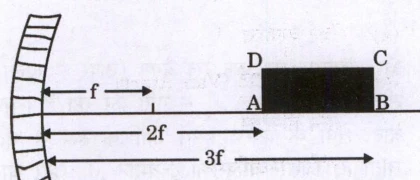
A rectangle ABCD is kept in front of a concave mirror of focal length f with its corners A and B being, respectively, at distances 2f and 3f from the mirror with AB along the principal axis as shown in the figure. It forms an image A′B′C′D′ in front of the mirror. What is the ratio of B′C′ to A′D′ ?

A concave mirror drawn as a curved hatched surface at the left, with a horizontal principal axis running right from it. Three rightward arrows start at the mirror: one labelled f ending at a small tick on the axis, one labelled 2f ending under corner A, and one labelled 3f ending under corner B. A black rectangle ABCD stands on the axis with A at its bottom left (at distance 2f), B at its bottom right (at distance 3f, with AB lying on the axis), D at its top left and C at its top right.
Options
Show answer & solution

Option C

Why

Each vertical side is imaged with its own magnification, . Side AD stands at the centre of curvature, , so its image is also at and the same size. Side BC stands at , so its image forms at and is half its size.

Exam-hall approach

An object at forms a same-size image, so . An object beyond forms a smaller image, so . That strikes A and B.

Proof

, ,

About the other options

Option A

Takes every part of the rectangle to be magnified equally. Sides at different distances have different magnifications.

Option B

Inverts the ratio: it is that is twice .

Option D

Takes the ratio of the object distances, , instead of the two magnifications.

Ideal time: about 1.5 min
86Physics • Light and Optics • Reflection of Light and Mirrors
Moderate

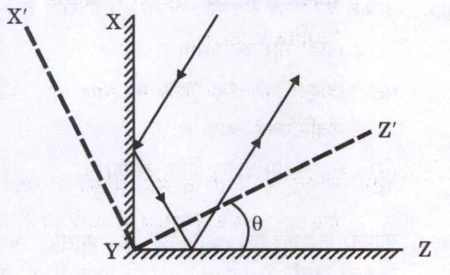
Shown in the figure are two plane mirrors XY and YZ () joined at their edge. Also shown is a light ray falling on one of the mirrors and reflected back parallel to its original path as a result of this arrangement. The two mirrors are now rotated by an angle to their new position , as shown. As a result the new reflected ray is at an angle from the original reflected ray. Then :

Two plane mirrors meet at point Y at a right angle: mirror XY is vertical, rising from Y to X, and mirror YZ is horizontal, running right from Y to Z; both are drawn with hatching on their back sides. A ray with an arrowhead travels down and to the left onto XY, reflects down to YZ, and then reflects out again. The rotated mirrors are drawn as thick dashed lines: X'Y rising to the upper left and YZ' rising to the right. The angle between YZ and YZ' at Y is marked θ. A second set of arrows shows the new reflected ray leaving up and to the right.
Options
Show answer & solution

Option A

Why

Two mirrors at right angles send any ray back parallel to the way it came, whatever angle it strikes at. Each reflection turns the ray, and the two turns always add up to . Turning the pair together by keeps them at right angles, so the ray still comes back parallel to its original path, and the new reflected ray is parallel to the old one.

Exam-hall approach

The question says the pair sends the ray back parallel to its path. Turning the pair does not change the angle between the mirrors, so it still does that.

Proof

Deviation after two mirrors at angle : for , the same for any orientation

About the other options

Option B

Gives the turn of the mirrors themselves. The ray's direction after two perpendicular mirrors does not depend on how the pair is turned.

Option C

The rule for a single plane mirror: turning it by turns the reflected ray by . With two perpendicular mirrors the two turns cancel.

Option D

Doubles the single-mirror rule for two mirrors. The turns from the two mirrors cancel, they do not add.

Ideal time: about 1 min
87Physics • Motion, Force and Laws of Motion • Newton's Laws and Conservation of Momentum
Easy

A railway wagon (open at the top) of mass is moving with speed along a straight track. As a result of rain, after some time it gets partially filled with water so that the mass of the wagon becomes and speed becomes . Taking the rain to be falling vertically and water stationary inside the wagon, the relation between the two speeds and is :

Options
Show answer & solution

Option C

Why

The rain falls straight down, so it brings no momentum along the track, and no horizontal force acts on the wagon. Horizontal momentum is therefore conserved. The wagon slows as it gains mass.

Proof

No horizontal external force: is constant, so

About the other options

Option A

Would need the momentum to grow with the mass. The rain adds mass but no forward push, so the wagon slows.

Option B

Kinetic energy falls, it does not rise: . Energy is lost as the water is brought up to the wagon's speed.

Option D

Would need a forward force on the wagon. Vertical rain gives none, so the momentum stays the same.

Ideal time: about 55 s
88Physics • Oscillations, Waves and Sound • Characteristics of Sound
Moderate

Which one of the following statements is not true for a flute, a musical instrument ?

Options
Show answer & solution

Option D

Sound comes from a vibrating column of air inside as well as outside the flute.

Why

A flute is a wind instrument. Its sound comes from the column of air inside the tube, which vibrates; the player changes the pitch by opening and closing holes, which changes the length of that column. Air outside the flute carries the sound to the ear, but it is not a vibrating column. C and D cannot both be true, so the 'not true' statement is one of them, and C is the textbook line. Statements A and B describe the air jet that drives the column; they go beyond school physics, so the key rests on C and D.

Exam-hall approach

C and D contradict each other on where the vibrating air column is, so one of them is the 'not true' statement. C is the textbook line, so take D.

Proof

NCERT Class 9 Science, Ch. 11 (Sound)

About the other options

Option A

The strength of the air jet the player blows does set how loud the note is.

Option B

The time the jet's wobbles take to reach the far edge of the mouth-hole sets which note the air column sounds.

Option C

Correct: the vibrating air column inside the tube is what makes the sound, as school textbooks say.

Ideal time: about 49 s
89Physics • Magnetism and Electromagnetism • Magnetic Effects of Electric Current
Easy

A positive charge is moving towards south in a space where magnetic field is pointing in the north direction. The moving charge will experience :

Options
Show answer & solution

Option D

no deflecting force.

Why

The magnetic force on a moving charge is , where is the angle between the velocity and the field. Moving south in a field pointing north, the charge moves exactly opposite to the field, so and . There is no force.

Exam-hall approach

A magnetic force is at right angles to the field, which strikes A. East and west are equally placed with respect to a north–south motion, so neither can be singled out; that points to no force.

Proof

About the other options

Option A

A magnetic force is always at right angles to the field, so it can never point along the field, north or south.

Option B

East would be right if the charge moved across the field, for example west to east in a field pointing up. Moving along the field line gives no force.

Option C

West, like east, would need the charge to cut across the field. Along the field line there is no force.

Ideal time: about 30 s
90Environment and Ecology • Climate Change
Very easy

Which one of the following is not a main greenhouse gas ?

Options
Show answer & solution

Option B

Oxygen

Why

A greenhouse gas absorbs the infrared heat radiated by the Earth. Water vapour, carbon dioxide and methane do. Oxygen, made of two identical atoms, lets infrared pass and is not a greenhouse gas.

Proof

NCERT Class 11 Fundamentals of Physical Geography, Ch. 12 (World Climate and Climate Change)

About the other options

Option A

Water vapour: the largest natural greenhouse gas in the atmosphere.

Option C

Carbon dioxide: the main greenhouse gas added by burning fossil fuels.

Option D

Methane: a strong greenhouse gas from rice fields, cattle and wetlands.

Ideal time: about 11 s
91Physics • Magnetism and Electromagnetism • Electromagnetic Waves and Spectrum
Very easy

Which one of the following statements about X-rays is not true ?

Options
Show answer & solution

Option C

Due to their wavelengths being shorter, these can be used for radar systems.

Why

Radar uses microwaves, not X-rays. Microwaves pass through air and cloud and bounce back off aircraft and ships. X-rays are strongly absorbed by air and are not used in radar.

Proof

NCERT Class 12 Physics Part I, Ch. 8 (Electromagnetic Waves)

About the other options

Option A

True: X-ray wavelengths run from about 10 nm down to 0.0001 nm, and 1 Å (0.1 nm) is typical.

Option B

True: an X-ray tube fires fast electrons at a metal target, which gives out X-rays.

Option D

True: X-rays are used in radiotherapy to destroy cancer cells.

Ideal time: about 34 s
92Geography • Earth's Motions, Latitudes, Longitudes and Time • Latitudes and Longitudes
Hard

Which one among the following is the northernmost geographical location ?

Options
Show answer & solution

Option A

New Delhi

Why

New Delhi lies at about 28.6° N, Kathmandu at about 27.7° N, Thimphu at about 27.5° N and Dhaka at about 23.8° N. New Delhi is the farthest north.

Exam-hall approach

Dhaka is near the Tropic of Cancer, which strikes D. The Himalaya runs south-east, so the capitals in its valleys lie south of Delhi's latitude.

Proof

New Delhi 28.6° N > Kathmandu 27.7° N > Thimphu 27.5° N > Dhaka 23.8° N

About the other options

Option B

Kathmandu: about 27.7° N. Nepal's capital lies in a valley well south of the high Himalaya.

Option C

Thimphu: about 27.5° N, a little south of Kathmandu.

Option D

Dhaka: about 23.8° N, near the Tropic of Cancer.

Ideal time: about 15 s
93Geography • Earth's Motions, Latitudes, Longitudes and Time • Latitudes and Longitudes
Easy

Consider the following statements :

1
Distance between the longitudes becomes zero on North Pole and South Pole.
2
Distance between the longitudes is maximum on the Equator.
3
Number of longitudes is more than number of latitudes.

Which of the statements given above is/are correct ?

Options
Show answer & solution

Option D

1, 2 and 3

Why

1 — Correct. All meridians meet at the poles, so the distance between them falls to zero there. 2 — Correct. Meridians are farthest apart at the equator, about 111 km per degree. 3 — Correct. At one-degree intervals there are 360 meridians of longitude but only 181 parallels of latitude, counting the equator and both poles.

Exam-hall approach

Statements 1 and 2 go together: meridians that meet at the poles are widest at the equator. Only D contains both.

Proof

NCERT Class 6 The Earth: Our Habitat, Ch. 2 (Globe: Latitudes and Longitudes)

About the other options

Option A

Leaves out statements 2 and 3. Meridians are farthest apart at the equator, and there are 360 of them against 181 parallels.

Option B

Leaves out statements 1 and 3. All meridians meet at the poles.

Option C

Leaves out statement 2. If meridians close to zero at the poles, they are widest at the equator.

Ideal time: about 44 s
94Geography • Minerals and Energy Resources of India • Distribution of Minerals in India
Easy

Which one among the following states is the leading producer of Manganese in India ?

Options
Show answer & solution

Option A

Madhya Pradesh

Why

Madhya Pradesh is India's leading producer of manganese ore, from the Balaghat and Chhindwara belt. Odisha, which NCERT names the largest producer in older years, is not among the options; among these four, Madhya Pradesh leads by a wide margin.

Proof

Indian Minerals Yearbook (Indian Bureau of Mines), Manganese Ore; NCERT Class 10 Contemporary India II, Ch. 5 (Minerals and Energy Resources)

About the other options

Option B

Jharkhand: a small manganese producer; it leads in coal and has large iron-ore deposits.

Option C

Rajasthan: produces little manganese; it leads in zinc, lead and copper.

Option D

Karnataka: a manganese producer, but well behind Madhya Pradesh.

Ideal time: about 15 s
95Geography • Minerals and Energy Resources of India • Distribution of Minerals in India
Very easy

Mica is mainly used in :

Options
Show answer & solution

Option D

electrical and electronic industries.

Why

Mica splits into thin sheets that do not conduct electricity and withstand high voltage and heat. So it is used mainly as an insulator in the electrical and electronic industries.

Proof

NCERT Class 10 Contemporary India II, Ch. 5 (Minerals and Energy Resources)

About the other options

Option A

Food and beverages: mica has no use as food; it is a mineral used as an insulator.

Option B

Iron and steel: needs iron ore, coking coal, limestone and manganese, not mica.

Option C

Aluminium: made from bauxite.

Ideal time: about 12 s
96Geography • Climate of India
Easy

According to Koppen's climatic classifications, the Great Northern Plains of India have which one of the following climates ?

Options
Show answer & solution

Option B

Cwg climate

Why

Under Koppen's scheme as NCERT applies it to India, the Ganga plain and most of the northern plains have a Cwg climate: monsoon type with a dry winter. C means warm temperate, w a dry winter, and g the hottest month comes before the summer solstice.

Proof

NCERT Class 11 India: Physical Environment, Ch. 4 (Climate), Koppen's climatic regions of India

About the other options

Option A

Aw: tropical savanna, found over most of the peninsular plateau south of the Tropic of Cancer.

Option C

Amw: monsoon with a short dry season, found on the west coast south of Goa.

Option D

Dfc: cold, humid winters with a short summer, found in Arunachal Pradesh.

Ideal time: about 17 s
97History • Marathas and Regional Powers
Easy

Which of the following statements about Lachit Borphukan is/are correct ?

1
He was a General of the Ahom Force.
2
He is known for his leadership in the Battle of Saraighat.
3
Lachit Borphukan Gold Medal is given to the best cadet at the National Defence Academy.

Select the correct answer using the code given below :

Options
Show answer & solution

Option A

1, 2 and 3

Why

1 — Correct. Lachit Borphukan was a general of the Ahom kingdom of Assam. 2 — Correct. He led the Ahom forces to victory over the Mughals at the Battle of Saraighat on the Brahmaputra in 1671. 3 — Correct. The Lachit Borphukan Gold Medal is awarded to the best passing-out cadet of the National Defence Academy.

Exam-hall approach

He led at Saraighat as the Ahom general, so 1 and 2 are both true. Only A has both.

Proof

Battle of Saraighat, 1671; Lachit Borphukan Gold Medal, National Defence Academy

About the other options

Option B

Leaves out statement 1. Lachit Borphukan was the Ahom commander.

Option C

Leaves out statements 2 and 3. He is famous for Saraighat, and the NDA's best cadet gets the medal named after him.

Option D

Leaves out statements 1 and 3. He was an Ahom general, and the NDA medal is named after him.

Ideal time: about 42 s
98Defence and Security • Military Exercises
Moderate

The 4th edition of joint military exercise 'DUSTLIK' between the Indian Army and the Uzbekistan Army was held in :

Options
Show answer & solution

Option C

Pithoragarh

Why

The 4th edition of Exercise Dustlik, between the Indian Army and the Uzbekistan Army, was held at Pithoragarh, Uttarakhand, from 20 March 2023. It trained the two armies in joint counter-terrorism operations in mountain terrain.

Proof

Exercise Dustlik, 4th edition, Pithoragarh, from 20 March 2023 (PIB, Ministry of Defence)

About the other options

Option A

Ranikhet: host of the 2nd edition of Dustlik, in 2021.

Option B

Gangtok: capital of Sikkim; it did not host Dustlik.

Option D

Leh: in Ladakh; it did not host Dustlik.

Ideal time: about 16 s
99Static General Knowledge • Recent Developments in Science and Technology
Moderate

Which of the following is India's first privately developed rocket launched by ISRO recently ?

Options
Show answer & solution

Option D

Vikram-S

Why

Vikram-S, built by the Hyderabad start-up Skyroot Aerospace, was India's first privately developed rocket. ISRO launched it from Sriharikota on 18 November 2022, on a mission named Prarambh.

Exam-hall approach

Rockets are named after people, and Vikram honours Vikram Sarabhai. Skyroot is a company and Prarambh means 'beginning', a mission name.

Proof

Vikram-S, launched 18 November 2022 from Sriharikota, mission Prarambh (ISRO, IN-SPACe)

About the other options

Option A

Skyroot: the company, Skyroot Aerospace, that built the rocket.

Option B

Prarambh: the name of the mission, not the rocket.

Option C

BazoomQ: an Armenian space company that sent one of the three payloads on board.

Ideal time: about 14 s
100Physics • Work, Energy and Power • Conventional and Non-Conventional Sources of Energy
Easy

Which one among the following villages was recently declared as India's first 24 × 7 solar-powered village ?

Options
Show answer & solution

Option B

Modhera, Gujarat

Why

Modhera, in Mehsana district of Gujarat, was declared India's first 24×7 solar-powered village on 9 October 2022. It is also known for its 11th-century Sun Temple.

Exam-hall approach

Modhera is known for its Sun Temple, a fitting place for a solar village. The other three are famous for cleanliness, a festival and a village council.

Proof

Modhera declared India's first 24×7 solar-powered village, 9 October 2022 (PIB)

About the other options

Option A

Mawlynnong, Meghalaya: known as the cleanest village in Asia.

Option C

Ziro, Arunachal Pradesh: home of the Apatani tribe and the Ziro music festival.

Option D

Malana, Himachal Pradesh: known for its ancient village council, often called one of the oldest democracies.

Ideal time: about 16 s