Skip to content

General Ability Test 2023 (I)

Set A

Questions 41–60 of 150

41English • Vocabulary • Idioms, Phrases and Proverbs
Easy

Directions : Given below are some idioms/phrases followed by four alternative meanings for each. Choose the most appropriate answer from among the options (a), (b), (c) or (d).

The lion's share

Options
Show answer & solution

Option B

The largest and the best part of something

Why

'The lion's share' means the largest part of something. It comes from a fable in which the lion takes the biggest part of the kill.

Proof

The eldest son got the lion's share of the property.

About the other options

Option A

A portion of something: any part, not the largest.

Option C

An important decision: unrelated.

Option D

An aggressive statement: a literal link to the lion's fierceness, not the idiom's meaning.

Ideal time: about 15 s
42English • Vocabulary • Idioms, Phrases and Proverbs
Easy

Same directions as Q41

Spill the beans

Options
Show answer & solution

Option A

Reveal a secret

Why

'Spill the beans' means to reveal a secret, usually by mistake or too early.

Proof

Don't spill the beans about the surprise party.

About the other options

Option B

Forced to leave belongings: a literal reading of spilling.

Option C

Share the news: close, but the idiom is about a secret, not ordinary news.

Option D

Take offence at someone's rude behaviour: unrelated.

Ideal time: about 15 s
43English • Vocabulary • Idioms, Phrases and Proverbs
Hard

Same directions as Q41

Cook someone's goose

Options
Show answer & solution

Option C

To spoil other's plans

Why

'Cook someone's goose' means to spoil someone's plans or ruin their chances of success.

Proof

The rain cooked our goose; the match had to be called off.

About the other options

Option A

To assist others: the opposite of ruining them.

Option B

Hypnotize other's mind: unrelated.

Option D

Inviting misfortune: bringing trouble on oneself; the idiom is about ruining someone else's chances.

Ideal time: about 13 s
44English • Vocabulary • Idioms, Phrases and Proverbs
Moderate

Same directions as Q41

Disappear into thin air

Options
Show answer & solution

Option D

Disappear suddenly

Why

'Disappear into thin air' means to vanish suddenly and completely, so that no one can tell where the thing went.

Proof

The thief disappeared into thin air before the police arrived.

About the other options

Option A

Lost forever: says nothing about the sudden way it vanished.

Option B

Become forgetful: unrelated.

Option C

Become uncaring: unrelated.

Ideal time: about 12 s
45English • Vocabulary • Idioms, Phrases and Proverbs
Moderate

Same directions as Q41

Put the screws on

Options
Show answer & solution

Option A

Forcing someone to do what you want

Why

'Put the screws on' someone means to put strong pressure on them, often by threats, to make them do what you want.

Proof

The bank put the screws on him to repay the loan.

About the other options

Option B

Never letting go of things: a literal reading of screwing something tight.

Option C

Keep the past alive: unrelated.

Option D

Using someone's trick for own benefit: unrelated.

Ideal time: about 17 s
46English • Vocabulary • Idioms, Phrases and Proverbs
Easy

Same directions as Q41

Sit on the fence

Options
Show answer & solution

Option C

Avoid taking sides

Why

'Sit on the fence' means to avoid taking sides in an argument or decision.

Proof

You cannot sit on the fence for ever; tell us whom you support.

About the other options

Option A

Avoid meeting someone: unrelated.

Option B

Waiting patiently: close in picture, but the idiom is about not choosing a side.

Option D

Hiding from someone: unrelated.

Ideal time: about 13 s
47English • Vocabulary • Idioms, Phrases and Proverbs
Hard

Same directions as Q41

Be as sharp as a tack

Options
Show answer & solution

Option D

A clever person

Why

'As sharp as a tack' means very clever and quick-thinking; a tack is a small sharp pin. 'A shrewd person' is close but narrower: shrewd means clever in judging what is to one's own advantage.

Proof

My grandmother is ninety, but she is still as sharp as a tack.

About the other options

Option A

A talkative person: unrelated.

Option B

A shrewd person: clever in a practical, often self-serving way; close, but the idiom means quick-witted in general.

Option C

A clumsy person: unrelated.

Ideal time: about 24 s
48English • Vocabulary • Idioms, Phrases and Proverbs
Easy

Same directions as Q41

From pillar to post

Options
Show answer & solution

Option B

Keep moving from one place to another

Why

'From pillar to post' means moving from one place to another, often without getting anything done.

Proof

He was sent from pillar to post to get his certificate.

About the other options

Option A

Upside down: unrelated.

Option C

Constructing a huge building: a literal reading of 'pillar' and 'post'.

Option D

Jumping from the top of the mountain: unrelated.

Ideal time: about 16 s
49English • Vocabulary • Idioms, Phrases and Proverbs
Hard

Same directions as Q41

Heath Robinson

Options
Show answer & solution

Option A

Very complicated system or machine for doing a simple task

Why

'Heath Robinson' describes a machine or system that is far too complicated for the simple job it does. It comes from the British artist W. Heath Robinson, who drew such machines.

Proof

His Heath Robinson device used ten levers just to switch on a light.

About the other options

Option B

Treating everyone as enemy, when they are not: unrelated.

Option C

Sleeping all day, doing nothing: unrelated.

Option D

Very lazy person, slow in action: unrelated.

Ideal time: about 19 s
50English • Vocabulary • Idioms, Phrases and Proverbs
Moderate

Same directions as Q41

As thick as thieves

Options
Show answer & solution

Option D

Very close friends who are looked upon with suspicion

Why

'As thick as thieves' means very close friends who share secrets. The option's 'looked upon with suspicion' goes beyond the usual meaning, but D is the only option about close friendship.

Proof

The two boys have been as thick as thieves since school.

About the other options

Option A

Dumb person: a literal reading, since 'thick' can mean stupid.

Option B

Good for nothing: unrelated.

Option C

Someone who uses everyone for personal gain: draws on 'thieves', not the idiom.

Ideal time: about 17 s
51Physics • Motion, Force and Laws of Motion • Newton's Laws and Conservation of Momentum
Easy

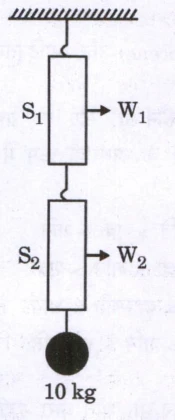
Two identical spring balances S1 and S2 are connected one after the other and are held vertically as shown in the figure. A mass of 10 kg is hanging from S2. If the readings on S1 and S2 are W1 and W2 respectively, then :

A spring balance S1 hangs from a hatched ceiling by a hook at its top. Below it, joined by a hook and ring, hangs a second identical spring balance S2. A black ball labelled 10 kg hangs from the bottom of S2. Each balance is drawn as a vertical rectangle; a rightward arrow beside S1 is labelled W1 and a rightward arrow beside S2 is labelled W2.
Options
Show answer & solution

Option D

W1 = 10 kg and W2 = 10 kg

Why

Each balance reads the pull on its own hook. The lower balance S2 holds the 10 kg mass directly, so it reads 10 kg. The upper balance S1 holds S2 and everything hanging from it, so it carries the same 10 kg and also reads 10 kg. Balances joined one below the other do not share the load; each carries all of it (the balances themselves are taken as light).

Exam-hall approach

S2 holds the mass directly, so W2 = 10 kg. That strikes B and C. S1 holds S2 and the mass, so W1 cannot be less than W2, which strikes A.

Proof

kg wt (it holds the mass); kg wt (it holds S2 and the mass)

About the other options

Option A

Splits the load as if the balances shared it. The upper balance carries everything below it, so it cannot read less than S2.

Option B

Halves the lower reading. S2 holds the mass directly, so it must read the full 10 kg.

Option C

Shares the 10 kg equally. That happens only when two balances hang side by side, each holding half.

Ideal time: about 47 s
52Physics • Motion, Force and Laws of Motion • Kinematics
Easy

A stone is thrown horizontally from the top of a 20 m high building with a speed of 12 m/s. It hits the ground at a distance R from the building. Taking g = 10 m/s2 and neglecting air resistance will give :

Options
Show answer & solution

Option C

R = 24 m

Why

A horizontal throw starts with no vertical speed, so the fall time depends only on the height: . The horizontal speed stays 12 m/s all the way down, so .

Exam-hall approach

Every option is 12 m/s times a fall time: 1 s, 1.5 s, 2 s or 2.5 s. A body falls 5 m in 1 s and 20 m in 2 s, so only 2 s fits.

Proof

s, m

About the other options

Option A

Takes the fall time as 1 s. In 1 s a body falls only m.

Option B

Drops the 2 in : s gives m, nearest 18 m.

Option D

Needs a 2.5 s fall, which is a drop of m, not 20 m.

Ideal time: about 50 s
53Physics • Properties of Matter • Buoyancy and Archimedes' Principle
Moderate

A sphere of volume V is made of a material with lower density than water. While on Earth, it floats on water with its volume () submerged. On the other hand, on a spaceship accelerating with acceleration ( is the acceleration due to gravity on Earth) in outer space, its submerged volume in water is . Then :

Options
Show answer & solution

Option A

Why

A floating body sinks until the liquid it pushes aside weighs as much as the body. In the accelerating ship, the floor pushes everything with acceleration , which acts on the body and the water like a gravity of strength . That same appears on both sides of the balance and cancels, so the fraction submerged is just the ratio of densities, , on Earth and in the ship alike.

Exam-hall approach

Think of a boat on the Moon: it floats at the same mark, because weaker gravity lightens the boat and the water equally. So the fraction does not depend on gravity, which strikes B, C and D at once.

Proof

About the other options

Option B

Treats the ship like a lift going down, with gravity . Even then the fraction would not change, since the water feels the same reduced gravity as the body.

Option C

A larger fraction would need the body to be denser or the water lighter. Neither density changes in the ship.

Option D

Scales the fraction with the strength of gravity, . Gravity acts on the body and the water alike, so its strength cancels.

Ideal time: about 57 s
54Physics • Work, Energy and Power • Kinetic and Potential Energy
Easy

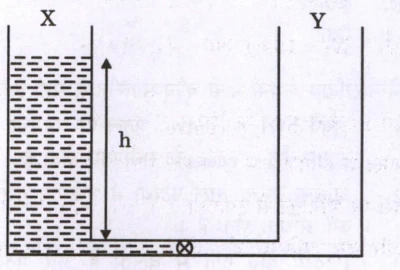
Two identical containers X and Y are connected at the bottom by a thin tube of negligible volume. The tube has a valve in it, as shown in the figure. Initially container X has a liquid filled up to height in it and container Y is empty. When the valve is opened, both containers have equal amount of liquid in equilibrium. If the initial (before the valve is opened) potential energy of the liquid is and the final potential energy is then :

Two identical open-topped containers, X on the left and Y on the right, joined at their bottoms by a thin horizontal tube. A valve, drawn as a circle with a cross, sits on the tube just below the right wall of X. Container X is filled with liquid (drawn as dashed hatching) up to a height h, marked by a double-headed vertical arrow labelled h from the bottom of X to the liquid surface; the tube also holds liquid. Container Y is empty.
Options
Show answer & solution

Option C

Why

The potential energy of a liquid is its weight times the height of its centre of mass. At first all the liquid stands to height in X, so its centre of mass is at . At the end each container holds half, standing to , so the centre of mass of all the liquid is at . The lost energy turns into heat as the flow dies out.

Exam-hall approach

Liquid flows from X into Y by itself, so it loses potential energy: , which strikes A. The same mass ends up with its centre of mass half as high, from to .

Proof

, , so

About the other options

Option A

Assumes the energy is kept. Liquid flows on its own only by losing potential energy; the loss becomes heat as the motion settles.

Option B

Counts the liquid in one container only: , a quarter of .

Option D

Takes the energy of a column to fall as the cube of its height. It falls as the square: each half-height column has , and the two together .

Ideal time: about 1.5 min
55Physics • Motion, Force and Laws of Motion • Circular Motion
Moderate

A particle is moving in a circle of radius R with a constant speed v. Its average acceleration over the time when it moves over half the circle is :

Options
Show answer & solution

Option C

Why

Average acceleration is the change in velocity divided by the time taken. It is not the instantaneous . Over half a circle the velocity turns round completely, from to , so it changes by . The time taken is half the circumference over the speed, .

Exam-hall approach

The velocity reverses, so the average acceleration is not zero; that strikes D. An average of a vector that keeps turning is smaller than its constant size , which strikes A and B (since ).

Proof

About the other options

Option A

The size of the instantaneous centripetal acceleration. Its direction keeps turning, so its average over half a circle is only of it.

Option B

Inverts the factor: is larger than the instantaneous value, which an average of a turning vector cannot exceed.

Option D

Zero is the average acceleration over a full circle, where the velocity returns to its starting value. Over half a circle it reverses.

Ideal time: about 42 s
56Physics • Motion, Force and Laws of Motion • Scalars and Vectors
Easy

Two forces of 5.0 N each are acting on a point mass. If the angle between the forces is 60°, then the net force acting on the point mass has magnitude close to :

Options
Show answer & solution

Option A

8.6 N

Why

Two forces add by the parallelogram law: . For two equal forces this becomes , along the line that bisects them.

Exam-hall approach

Forces less than apart add to more than they do at right angles, N. Only 8.6 N is larger.

Proof

N

About the other options

Option B

Half the right answer: N is one force's share along the bisector, without the other force.

Option C

The answer for : two equal forces that far apart add to just one of them, 5 N.

Option D

Less than the N the two forces give even at right angles. It would need an angle of about .

Ideal time: about 39 s
57Geography • Rocks, Landforms and Geomorphic Processes • Minerals, Rocks and the Rock Cycle
Very easy

Which one of the following is not an igneous rock ?

Options
Show answer & solution

Option B

Slate

Why

Slate is a metamorphic rock. It forms when shale, a sedimentary rock, is changed by heat and pressure. Granite, basalt and gabbro all form when magma cools, so they are igneous.

Proof

NCERT Class 11 Fundamentals of Physical Geography, Ch. 5 (Minerals and Rocks)

About the other options

Option A

Granite: an igneous rock that cooled slowly deep underground, so its crystals are large.

Option C

Basalt: an igneous rock that cooled quickly from lava at the surface; the Deccan Traps are made of it.

Option D

Gabbro: an igneous rock with the same make-up as basalt, but cooled slowly at depth, so it is coarse-grained.

Ideal time: about 13 s
58Geography • Earth's Interior, Plate Tectonics, Earthquakes and Volcanoes • Earthquakes and Seismic Waves
Easy

Which of the following statements is/are correct ?

1
Hypocenter is the point on the surface of the Earth, nearest to the focus.
2
Velocity of earthquake waves is higher in denser materials.
3
P waves move faster and are the first to arrive at the surface of the Earth.

Select the correct answer using the code given below :

Options
Show answer & solution

Option B

2 and 3

Why

1 — Not correct. The hypocentre is the focus itself, the point inside the Earth where the energy is released. The point on the surface nearest to it is the epicentre. 2 — Correct. Earthquake waves travel faster through denser material. 3 — Correct. P waves are the fastest earthquake waves, so they are the first to reach the surface.

Exam-hall approach

The surface point above the focus is the epicentre, so statement 1 is false. That strikes A and C. P waves, the primary waves, arrive first, so 3 is true and B or D is left; a two-way guess is worth taking under the one-third penalty.

Proof

NCERT Class 11 Fundamentals of Physical Geography, Ch. 3 (Interior of the Earth)

About the other options

Option A

Contains statement 1. The point on the surface is the epicentre; the hypocentre is the focus.

Option C

Contains statement 1, which mixes up the hypocentre and the epicentre.

Option D

Leaves out statement 2. Earthquake waves do move faster in denser material.

Ideal time: about 47 s
59Geography • Universe and Solar System • Geological Time Scale
Easy

In terms of geological time scale, the quaternary period consists of two epochs. They are :

Options
Show answer & solution

Option B

Holocene and Pleistocene

Why

The Quaternary is the latest period of the Cenozoic era. It has two epochs: the Pleistocene, the time of the great ice ages, and the Holocene, which began as the last ice age ended and continues today.

Exam-hall approach

The Quaternary is the latest period, so it must contain the Holocene, the epoch we live in. That strikes A and C. The Eocene is far older, in the Tertiary, which strikes D.

Proof

NCERT Class 11 Fundamentals of Physical Geography, Ch. 2 (The Origin and Evolution of the Earth), geological time scale

About the other options

Option A

Pliocene: the last epoch of the Tertiary period, just before the Pleistocene.

Option C

Miocene: an epoch of the Tertiary period, before the Pliocene.

Option D

Eocene: an early epoch of the Tertiary period.

Ideal time: about 17 s
60Geography • Universe and Solar System
Easy

Which one of the following is the correct sequence of arrangement of the given planets in descending order of their density (in gm/cm3) ?

Options
Show answer & solution

Option C

Earth > Venus > Jupiter > Saturn

Why

The rocky inner planets are dense and the gas giants are light. Earth is the densest planet in the Solar System, with Venus just below it. Jupiter is much lighter, and Saturn is the least dense planet of all, less dense than water.

Exam-hall approach

Rocky planets are far denser than gas giants, so Earth and Venus come first; that strikes A and B. Saturn is the planet that would float in water, so it comes last, which strikes D.

Proof

Earth 5.51 > Venus 5.24 > Jupiter 1.33 > Saturn 0.69 g/cm³ (NASA Planetary Fact Sheet)

About the other options

Option A

Puts Jupiter above Venus. A gas giant is much less dense than any rocky planet.

Option B

Puts Jupiter first. Earth is the densest planet in the Solar System.

Option D

Puts Saturn above Jupiter. Saturn is the least dense planet, less dense than water.

Ideal time: about 32 s