Skip to content

Elementary Mathematics 2020 (I)

Set A

Questions 81–100 of 100

81Mensuration • Plane Figures • Quadrilateral
Very easyIdeal time: about 25 s

If the diagonals of a rhombus are and , then what is its area ?

Options
Show answer & solution

Option A

Approach

A rhombus has perpendicular diagonals, so its area is half their product.

Step-by-step solution

  1. 1

    Why: This is what separates a rhombus from a general parallelogram, and it is what makes the half-product formula apply.

  2. 2

    Why: For any quadrilateral with perpendicular diagonals and the area is .

Common mistakes

Option B

Halved twice — used the half-diagonals and and then halved their product again.

Option C

Dropped the factor , treating the rhombus like a rectangle of sides and .

Option D

No plausible route reaches .

Skills used
82Geometry • Triangle • Pythagoras Theorem
ModerateIdeal time: about 1.5 min

The lengths of sides of a triangle are , where . If one of the angles is , then what are the minimum integral values of respectively ?

Options
Show answer & solution

Option C

Approach

The coefficients already form a Pythagorean triple, so look for the values that leave the three sides as exactly , and .

Step-by-step solution

  1. 1

    Why: The ordering makes the longest side, so it faces the right angle and is the hypotenuse.

  2. 2

    Why: Square each side: and .

  3. 3
    gives

    Why: is the smallest value each of can take, and it makes the three sides exactly — the triple the coefficients were pointing at. Since no smaller positive integers exist, this is the minimum.

Shortcut

Read the coefficients: is already a right triangle, so the multipliers , , should all be .

Common mistakes

Option D

Took the triple off the coefficients and wrote it down as the values of themselves.

Option A

Read the strict inequalities as forcing to be distinct and increasing, so took the first three integers; .

Option B

No plausible route reaches .

Skills used
83Geometry • Triangle • Triangle Centres
Very easyIdeal time: about 20 s

What is the maximum number of circum-circles that a triangle can have ?

Options
Show answer & solution

Option A

Approach

A circle through all three vertices has its centre equidistant from them, and only one point of the plane is.

Step-by-step solution

  1. 1

    Why: A circum-circle passes through all three vertices, so its centre is equidistant from them and the common distance is the radius.

  2. 2

    Why: The perpendicular bisectors of the three sides meet at exactly one point, so there is one possible centre and one possible radius — hence one circle.

Common mistakes

Option C

Counted one circle per side or per pair of vertices, as though each needed its own.

Option D

Confused the circum-circle with the infinitely many circles through just two of the vertices.

Option B

No plausible route reaches .

Skills used
84Mensuration • Plane Figures • Circle
EasyIdeal time: about 50 s

If an arc of a circle of radius cm subtends a central angle measuring , then which one of the following is an approximate length of the arc ?

Options
Show answer & solution

Option A

cm

Approach

Take the share of the full circumference.

Step-by-step solution

  1. 1

    Why: An arc is the same fraction of the circumference as its central angle is of .

  2. 2

    Why: is a twelfth of the circle, and , so the twelfth is exactly .

  3. 3
    cm

    Why: The question asks for an approximate length, so give as a decimal.

Shortcut

In radians, and arc .

Common mistakes

Option C

Reached but wrote the decimal with the wrong leading digit, for .

Option B

No plausible route reaches .

Option D

No plausible route reaches .

Skills used
85Geometry • Triangle • Pythagoras Theorem
EasyIdeal time: about 1.5 min

A ladder long is placed in a room so as to reach a point high on a wall and on turning the ladder over to the opposite side of the wall without moving the base, it reaches a point high. What is the breadth of the room?

Options
Show answer & solution

Option C

Approach

Each position of the ladder is a right triangle with the same hypotenuse ; find the two foot-to-wall distances and add them.

Step-by-step solution

  1. 1

    Why: The ladder, the wall and the floor form a right triangle with the ladder as hypotenuse; is the base's distance from the first wall.

  2. 2

    Why: The base has not moved, so the same hypotenuse applies to the opposite wall, where the ladder reaches m.

  3. 3
    m

    Why: The base sits between the two walls, so the room's breadth is the sum of its distances from them.

Shortcut

is the triple scaled by , so the two legs simply swap when the ladder is turned over.

Common mistakes

Option A

No plausible route reaches m.

Option B

No plausible route reaches m.

Option D

No plausible route reaches m.

Skills used

86Mensuration • Plane Figures • Composite and Shaded Regions
EasyIdeal time: about 1 min

What is the area of the largest square plate cut from a circular disk of radius one unit?

Options
Show answer & solution

Option D

Approach

The largest square that fits in a circle is the inscribed one, whose diagonal is the diameter.

Step-by-step solution

  1. 1

    Why: A square can be no wider than the circle, and the widest chord is the diameter; the inscribed square reaches it with its diagonal.

  2. 2

    Why: A square of side has diagonal by Pythagoras.

  3. 3

    Why: Area of a square is the side squared, and the surd disappears at once.

Shortcut

With perpendicular diagonals of length each, the area is — no need to find the side.

Common mistakes

Option A

Took the diameter as the square's side, giving — a square too big to fit in the circle.

Option B

Multiplied the side by the diagonal, , instead of squaring the side.

Option C

Gave the area of the circle itself rather than of the square cut from it.

Skills used

87Mensuration • Solids • Sphere
Very hardIdeal time: about 3 min

Out of identical balls of radius , balls are placed on a plane such that each ball touches the other two balls. The ball is placed on them such that this ball touches all the three balls. What is the distance of centre of ball from the plane?

Options
Show answer & solution

Option D

Approach

The four centres form a regular tetrahedron of edge ; add its height to the by which the bottom centres already stand above the plane.

Step-by-step solution

  1. 1

    Why: A ball resting on a plane touches it at one point, so its centre is one radius up.

  2. 2

    Why: Two balls that touch have their centres apart, and each of the three touches the other two.

  3. 3

    Why: An equilateral triangle inscribed in a circle of radius has side , so . The top ball's centre sits directly above this circumcentre, being equidistant from all three.

  4. 4

    Why: The top centre is from each bottom centre (the balls touch), and that slant, the circumradius and the vertical rise form a right triangle.

  5. 5

    Why: Add the from step ; writing as and taking as the common denominator puts it in the printed form.

Common mistakes

Option A

Gave only the rise from the bottom centres to the top centre, , forgetting the by which the bottom centres already stand above the plane.

Option B

Reached the right numerator but divided by instead of when combining over a common denominator.

Option C

No plausible route reaches .

Skills used
88Mensuration • Solids
EasyIdeal time: about 1 min

A right circular cylinder just encloses a sphere. If is the surface area of the sphere and is the curved surface area of the cylinder, then which one of the following is correct?

Options
Show answer & solution

Option A

Approach

'Just encloses' fixes the cylinder's radius and height in terms of the sphere's radius; then write both surfaces and compare.

Step-by-step solution

  1. 1

    Why: The sphere touches the curved wall all round, so the radii match, and it touches both ends, so the height is a full diameter.

  2. 2

    Why: Surface area of a sphere of radius .

  3. 3

    Why: Curved surface of a cylinder is ; here and .

  4. 4

    Why: Both come to , so the two areas are equal — Archimedes' result.

Common mistakes

Option B

Took the cylinder's height as rather than the diameter , giving and so .

Option C

Used — the curved surface of a hemisphere — for the whole sphere, giving against .

Option D

No plausible route reaches .

Skills used
89Mensuration • Plane Figures • Quadrilateral
ModerateIdeal time: about 1.5 min

is a quadrilateral such that , and . What is the approximate area of the quadrilateral ?

Options
Show answer & solution

Option A

Approach

splits the quadrilateral into an equilateral triangle and a right triangle; find each area and add.

Step-by-step solution

  1. 1

    Why: is given, so the diagonal cuts off an equilateral triangle.

  2. 2

    Why: Area of an equilateral triangle of side is ; take .

  3. 3

    Why: , so is the hypotenuse of and one leg — the triple scaled by .

  4. 4

    Why: In a right triangle the two legs serve as base and height.

  5. 5

    Why: and lie on opposite sides of , so the two triangles do not overlap and the areas simply add.

Common mistakes

Option B

Treated and as the two legs of the right angle, giving and a total near .

Option C

No plausible route reaches .

Option D

No plausible route reaches .

Skills used
90Mensuration • Plane Figures • Circle
ModerateIdeal time: about 1.5 min
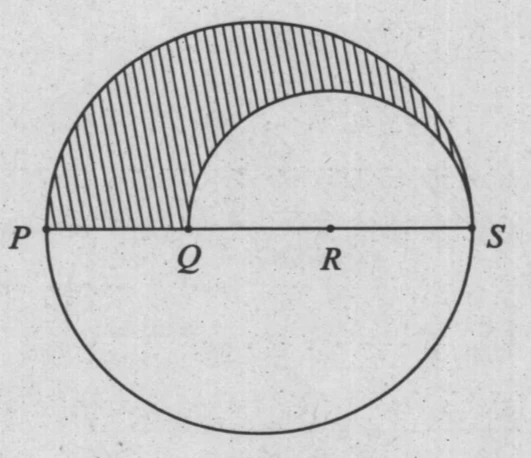
A circle with a horizontal diameter marked with points P, Q, R, S in order from left to right. The segments PQ, QR, and RS appear equal. A semi-circle is drawn above the segment QS. The region enclosed between the upper half of the main circle and the upper semi-circle on QS is shaded.

Let be the diameter of a circle of radius . The length , and are equal. Semi-circle is drawn with as diameter (as shown in the given figure). What is the ratio of the shaded region to that of the unshaded region?

Options
Show answer & solution

Option B

Approach

The shaded piece is the upper half of the big circle less the semi-circle on ; the unshaded piece is everything else.

Step-by-step solution

  1. 1

    Why: is a diameter of the circle of radius , and the three equal parts make each , so .

  2. 2

    Why: is a diameter, so the arc above it bounds a semi-circle of radius .

  3. 3

    Why: is its diameter, so its radius is .

  4. 4

    Why: The figure shades the part of the upper semi-circle lying outside the semi-circle on .

  5. 5

    Why: Everything in the circle that is not shaded is unshaded; divide both by to reduce.

Shortcut

Drop and work in units of a half: shaded half-units, whole circle , so shaded : unshaded .

Common mistakes

Option C

Compared the shaded region with the whole circle, , instead of with the unshaded part.

Option A

No plausible route reaches .

Option D

No plausible route reaches .

Skills used
91Mensuration • Plane Figures • Circle
ModerateIdeal time: about 1.5 min
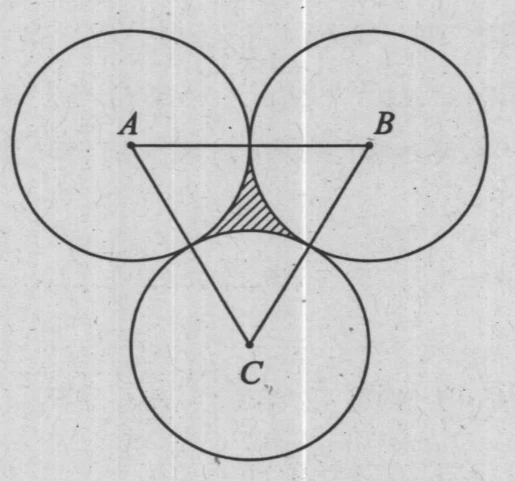
Three identical circles intersect. Their centers A, B, and C form a triangle ABC. The region bounded by the three circles between the centers is shaded.

What is the area of the shaded region in the given figure, if the radius of each of the circles is ?

Options
Show answer & solution

Option A

Approach

Join the three centres: the shaded piece is that triangle with one sector cut from each corner.

Step-by-step solution

  1. 1

    Why: Each pair of circles touches, so each centre distance is the sum of the two radii; the three centres form an equilateral triangle.

  2. 2

    Why: Area of an equilateral triangle of side is .

  3. 3

    Why: Each angle of an equilateral triangle is , and the circle at that corner has radius ; the three angles total , so the three sectors make half a circle.

  4. 4

    Why: The shaded curvilinear triangle is what is left of once the three circular corners are removed.

Shortcut

Three sectors of equal radius always make half a circle, so the answer is 'triangle minus half a circle': .

Common mistakes

Option D

Used the altitude in place of the area , and subtracted the triangle from the sectors rather than the other way round.

Option C

Halved every length — took the triangle's side as and the circles' radius as — which scales the whole answer down by four.

Option B

No plausible route reaches , which is negative.

Skills used

92Mensuration • Plane Figures • Composite and Shaded Regions
ModerateIdeal time: about 2 min
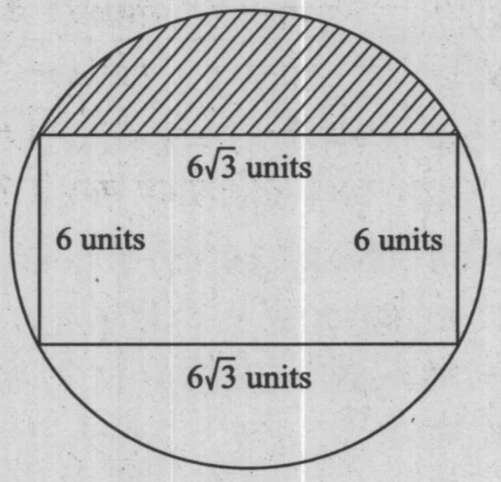
A rectangle inscribed inside a circle. The top side is labeled 6\sqrt{3} \text{ units} and the left side is labeled 6 \text{ units}. The bottom side is 6\sqrt{3} \text{ units} and the right side is 6 \text{ units}. The region of the circle above the top side of the rectangle is shaded.

In the given figure, what is the area of the shaded region?

Options
Show answer & solution

Option B

Approach

The rectangle's diagonal is a diameter, so find the radius; the shaded piece is the segment cut off by the top side.

Step-by-step solution

  1. 1

    Why: Each corner of the rectangle lies on the circle, and the angle in a semi-circle is , so the diagonal is a diameter.

  2. 2

    Why: The perpendicular from the centre bisects the chord , making a right triangle with hypotenuse and opposite side .

  3. 3

    Why: The shaded segment sits inside the sector standing on that chord.

  4. 4

    Why: The two radii to the chord's ends enclose , so use .

  5. 5

    Why: A segment is the sector less the triangle formed by the two radii.

Shortcut

The centre is from the top side and the half-chord is , so the segment is the sector minus the triangle .

Common mistakes

Option A

Took the central angle as , giving a sector of and a triangle of , i.e. after the surd was carried through.

Option C

Transposed the and the when writing in the factored form .

Option D

Subtracted the sector from the triangle instead of the triangle from the sector, giving a negative area.

Skills used

93Geometry • Line • Angles at a Point
EasyIdeal time: about 50 s
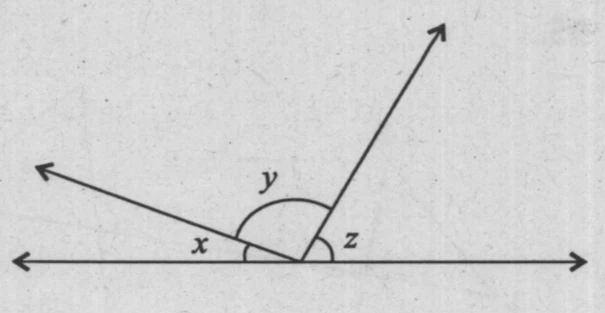
A horizontal line with an arrow pointing right. From a point on this line, a ray extends upwards and rightwards, forming an angle z. From the same point, another ray extends leftwards and upwards, forming an angle y. The angle between the horizontal line extending left and the left ray is x.

In the given figure, if and , then what is the value of ?

Options
Show answer & solution

Option C

Approach

The three angles sit side by side above one straight line, so they add to .

Step-by-step solution

  1. 1

    Why: The two rays divide the half-turn above the straight line into exactly these three angles, and angles on one side of a straight line add to .

  2. 2

    Why: The given ratios written as equations, so everything is in one unknown.

  3. 3

    Why: Substitute and solve the linear equation.

Common mistakes

Option B

Used for angles round a point instead of for angles on a straight line, giving .

Option A

No plausible route reaches .

Option D

No plausible route reaches .

Skills used
94Mensuration • Plane Figures • Quadrilateral
HardIdeal time: about 2.5 min

is a trapezium, where is parallel to . If , , and , then what is the area of the trapezium?

Options
Show answer & solution

Option D

Approach

Drop perpendiculars from and to and use the two slant sides to find the common height.

Step-by-step solution

  1. 1

    Why: With , the two perpendiculars have the same length , and the strip between their feet is long, so the foot from is from .

  2. 2
    and

    Why: Pythagoras in the two right triangles cut off at each end: and are their hypotenuses.

  3. 3

    Why: Subtracting the two equations eliminates and leaves a linear equation in .

  4. 4

    Why: Back-substitute into ; .

  5. 5

    Why: Half the sum of the parallel sides times the perpendicular distance between them.

Shortcut

Draw with on : has sides and . Heron gives its area as , so .

Common mistakes

Option A

Wrote the height as , pulling the denominator inside the root.

Option B

Made the same move and then inverted the fraction inside the root, giving .

Option C

No plausible route reaches .

Skills used
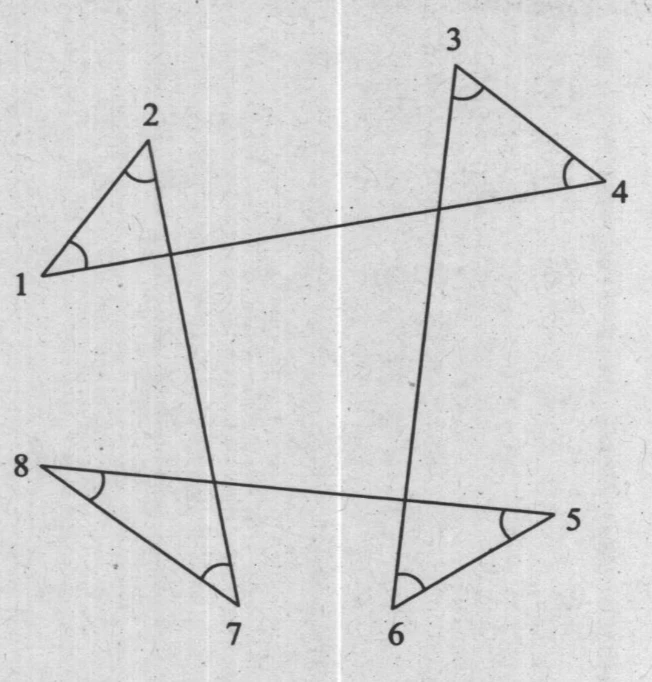
95Geometry • Polygon
HardIdeal time: about 2.5 min
A figure showing several intersecting lines forming an eight-pointed star-like shape, with four outward-pointing triangular regions. The outer pointed angles are numbered 1 through 8. Angles 1 and 2 are in one part, 3 and 4 in another, 5 and 6 in another, 7 and 8 in another.

Angles are shown in the given figure. What is value of ?

Options
Show answer & solution

Option B

Approach

The eight marked angles are the outer angles of four triangles; the remaining angles of those triangles are the angles of the central quadrilateral.

Step-by-step solution

  1. 1

    Why: Each triangle has two of the numbered angles for its outer vertices and its third vertex at a crossing point.

  2. 2

    Why: Every plane triangle has angles summing to .

  3. 3

    Why: At each crossing point the triangle's angle and the central quadrilateral's angle are formed by the same two lines on opposite sides, so they are vertically opposite and equal.

  4. 4

    Why: The four third angles together equal the interior angles of the central quadrilateral, which sum to .

Common mistakes

Option D

Added the angle sums of the four triangles, , and forgot to take out the four angles at the crossing points.

Option A

No plausible route reaches .

Option C

No plausible route reaches .

Skills used

96Geometry • Line • Parallel Lines and Transversals
ModerateIdeal time: about 2 min
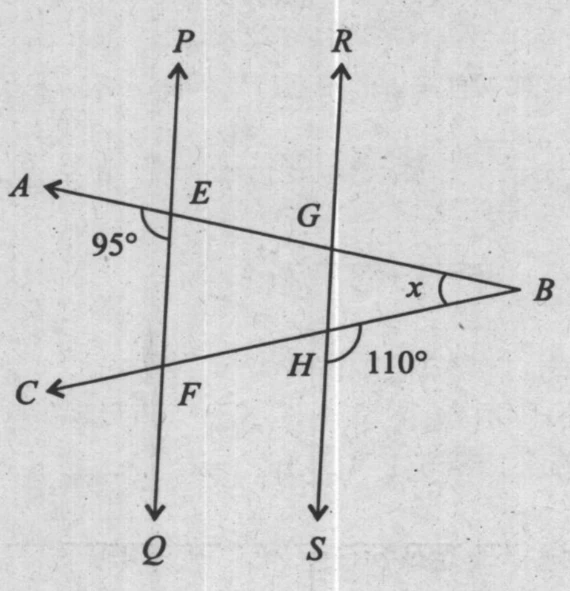
Two vertical parallel lines, PQ and RS, with arrows pointing downwards and upwards respectively. A transversal line intersects them at E and G. Another transversal line intersects them at F and H. The two transversals intersect each other at a point B on the right side. The angle at E is labeled 95^\circ below the transversal on the left parallel line. The angle at H is labeled 110^\circ below the transversal on the right parallel line. The angle at B is x.

In the given figure is parallel to , , , and . Then what is the value of ?

Options
Show answer & solution

Option B

Approach

Carry each given angle across to the line with the parallel-line rules, then use the triangle that cuts off.

Step-by-step solution

  1. 1

    Why: is measured from down to along ; lies on the straight line , so the angle on the other side of is its supplement.

  2. 2

    Why: and is a transversal, so the angle the line makes below on equals the one it makes below on — corresponding angles.

  3. 3

    Why: and lies on the straight line , so the angle from up to is its supplement.

  4. 4

    Why: , and form a triangle whose angle at is , at is and at is .

Shortcut

is the exterior angle at of the pair of lines: , the difference of the two angles each line makes with the parallels.

Common mistakes

Option A

Carried straight across to instead of its supplement , giving .

Option C

No plausible route reaches .

Option D

No plausible route reaches .

Skills used

97Geometry • Line • Parallel Lines and Transversals
ModerateIdeal time: about 2 min
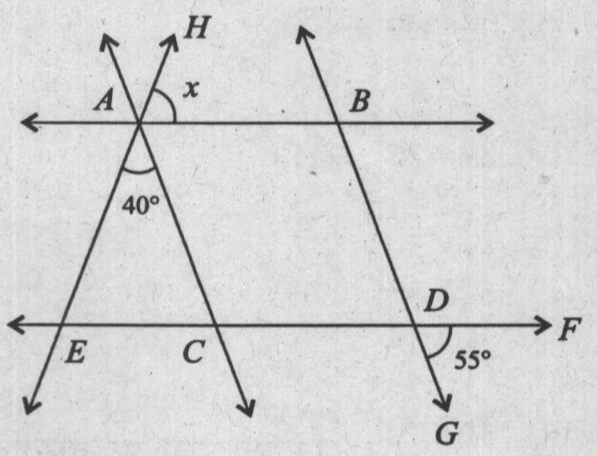
Two horizontal parallel lines, the top one contains points A and B, the bottom one contains points E, C, and D. A line passes through E and A, extending to H. Another line passes through C and B, extending upwards. Another line passes through D and A. The angle between EA and AC is 40^\circ. The angle at D is 55^\circ. The angle between AH and AB is x.

In the given figure is parallel to and is parallel to . If , , , then what is the value of ?

Options
Show answer & solution

Option A

Approach

is a parallelogram, so equals ; then is what is left of the straight line .

Step-by-step solution

  1. 1

    Why: and are opposite rays, and so are and , so the two angles are vertically opposite at .

  2. 2
    and , so is a parallelogram

    Why: Both pairs of opposite sides are parallel, which is the definition.

  3. 3

    Why: and are opposite angles of the parallelogram , and opposite angles are equal.

  4. 4

    Why: Ray lies between ray and ray , so the two angles sit side by side.

  5. 5

    Why: In the figure is the upward continuation of , so , , are collinear and and are a linear pair.

Common mistakes

Option B

No plausible route reaches .

Option C

No plausible route reaches .

Option D

No plausible route reaches .

Skills used

98Mensuration • Plane Figures • Circle
EasyIdeal time: about 1.5 min
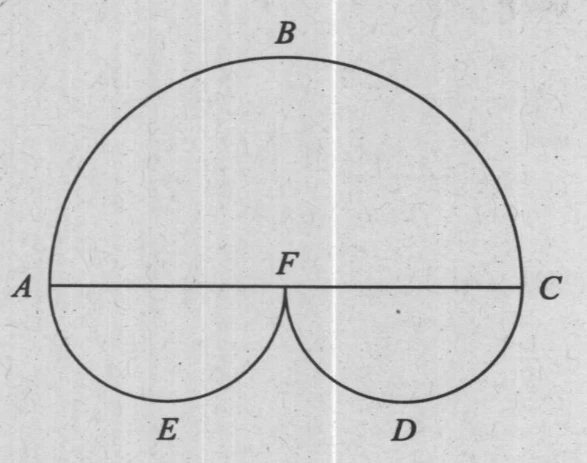
A large semi-circle with diameter AC. A point F lies on AC. A semi-circle is drawn below the segment AF, and another semi-circle is drawn below the segment FC. Point B is on the large semi-circle, E is on the left small semi-circle, D is on the right small semi-circle.

In the given figure, there are three semi circles , and . The distance between and is and is the mid-point of . What is the total area of the three semi circles?

Options
Show answer & solution

Option D

Approach

Get each semi-circle's radius from and add the three half-areas.

Step-by-step solution

  1. 1

    Why: is the diameter of the big semi-circle, and bisects it, so and are the diameters of the two small ones.

  2. 2

    Why: A semi-circle is half of .

  3. 3

    Why: Each small semi-circle is and there are two of them.

  4. 4

    Why: The question asks for the total of the three, not for the region they enclose. and .

Shortcut

Halving a semi-circle's radius quarters its area, so the two small ones together are half the big one: total .

Common mistakes

Option A

Used whole circles instead of semi-circles throughout, giving exactly double: .

Option B

No plausible route reaches .

Option C

No plausible route reaches .

Skills used

99Mensuration • Plane Figures • Composite and Shaded Regions
ModerateIdeal time: about 1.5 min
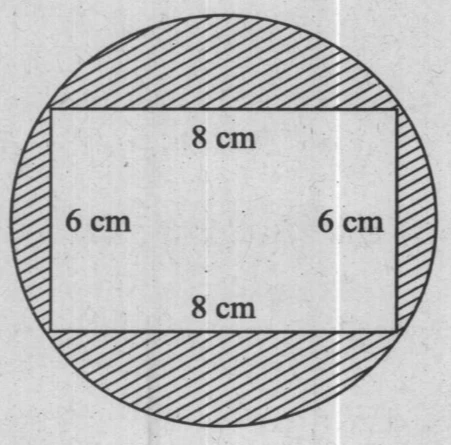
A circle with a rectangle inscribed inside. The rectangle has dimensions 8 \text{ cm} horizontally and 6 \text{ cm} vertically. The region between the circle and the top and bottom sides of the rectangle is shaded. The region between the circle and the left and right sides is unshaded.

What is the approximate area of the shaded region in the figure given?

Options
Show answer & solution

Option D

Approach

The rectangle's diagonal is a diameter; the shaded region is everything inside the circle but outside the rectangle.

Step-by-step solution

  1. 1

    Why: The rectangle's corners lie on the circle, so its diagonal is a diameter — the triple doubled.

  2. 2

    Why: Area of a circle of radius .

  3. 3

    Why: Length times breadth.

  4. 4

    Why: In the figure every part of the circle outside the rectangle is hatched, so the shaded area is the circle less the rectangle.

Common mistakes

Option A

Took only half the region — one side of the rectangle's horizontal axis — giving about .

Option B

No plausible route reaches .

Option C

No plausible route reaches .

Skills used

100Geometry • Quadrilateral • Parallelogram
HardIdeal time: about 2.5 min
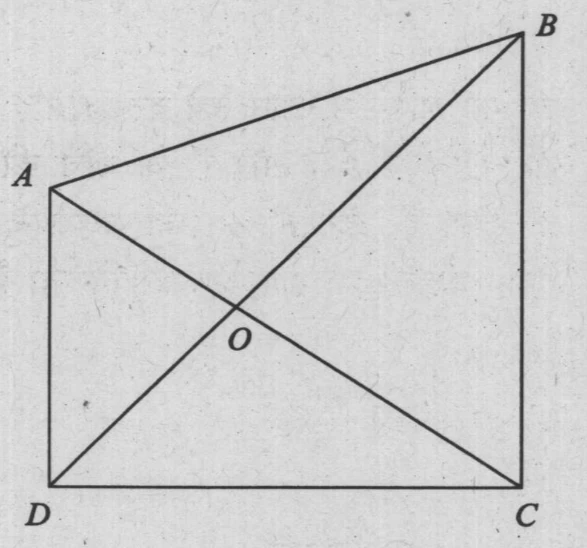
A rectangle ABCD. Diagonals AC and BD intersect at point O.

Consider the following statements with reference to the given figure:

1
The sum of the areas of and is equal to the sum of the areas of and .
2
3

Which of the above statements are correct?

Options
Show answer & solution

Option B

Approach

Read the figure as drawn — with , not a rectangle — and test the three statements on it.

Step-by-step solution

  1. 1
    — statement is correct

    Why: , , are collinear and so are , , , so these two angles are vertically opposite wherever the diagonals cross.

  2. 2

    Why: Triangle inequality in , , and in turn.

  3. 3
    — statement is correct

    Why: Adding the four inequalities counts each side twice and each diagonal twice; halving gives the perimeter against the sum of the diagonals.

  4. 4

    Why: Take , , , as the figure shows, with and both perpendicular to and . The diagonals meet at , and each triangle's area follows from base and height.

  5. 5
    — statement is wrong

    Why: beats by the factor against , and . The two sums are equal only if , which the figure does not show.

Common mistakes

Option D

Read the figure as a rectangle, which makes the four triangles equal in area and statement true as well.

Option A

Read the figure as a rectangle and so accepted statement , and missed the four-triangle-inequality argument for statement .

Option C

Read the figure as a rectangle and so accepted statement , and rejected statement despite the two angles being vertically opposite.

Skills used