Skip to content

Elementary Mathematics 2017 (I)

Set A

Questions 81–100 of 100

81Geometry • Circle • Chords
ModerateIdeal time: about 1.5 min

Two parallel chords of a circle whose diameter is cm are respectively cm and cm in length. If both the chords are on the same side of the diameter, then the distance between these chords is

Options
Show answer & solution

Option C

cm

Approach

Get each chord's distance from the centre from a right triangle on its half-chord and the radius; on the same side those distances subtract.

Step-by-step solution

  1. 1

    Why: The radius is half the given diameter.

  2. 2

    Why: The perpendicular from the centre bisects the cm chord, so the right triangle has legs and with hypotenuse .

  3. 3

    Why: The same construction on the cm chord, whose half is .

  4. 4

    Why: Both chords lie on the same side of the centre, so the gap between them is the difference of the two distances, not their sum.

Common mistakes

Option A

No route reaches cm here.

Option B

No route reaches cm here.

Option D

Slipped on , reading it as rather than .

Skills used
82Mensuration • Solids • Cone
ModerateIdeal time: about 1.5 min

If the radius of a right circular cone is increased by without increasing its height, then what is the percentage increase in the volume of the cone?

Options
Show answer & solution

Option D

Approach

With the height fixed the volume goes as , so multiply by and subtract .

Step-by-step solution

  1. 1

    Why: Only changes, so is proportional to and the constants drop out of any ratio.

  2. 2

    Why: An increase of is the multiplier .

  3. 3

    Why: Expand with the square-of-a-sum identity; the cross term is what a careless answer loses.

  4. 4

    Why: Subtracting leaves the fractional increase; multiplying by turns it into a percentage.

Common mistakes

Option A

No route reaches here.

Option B

No route reaches here.

Option C

Kept only the square term of the expansion and dropped the .

Skills used

83Mensuration • Plane Figures • Circle
EasyIdeal time: about 1 min

A copper wire when bent in the form of a square encloses an area of cm. If the same wire is bent in the form of a circle, it encloses an area equal to

Options
Show answer & solution

Option C

cm

Approach

Bending the wire preserves its length, so the square's perimeter becomes the circle's circumference.

Step-by-step solution

  1. 1

    Why: The square's area gives its side.

  2. 2

    Why: That side gives the perimeter, which is the length of the wire.

  3. 3

    Why: The same wire bent into a circle has that length as its circumference.

  4. 4

    Why: The radius gives the enclosed area.

Common mistakes

Option A

Assumed bending the wire preserves the enclosed area rather than the length.

Option B

No route reaches cm here.

Option D

No route reaches cm here.

Skills used

84Geometry • Triangle • Similarity
ModerateIdeal time: about 1.5 min

ABC is a triangle and D is a point on the side BC. If BC cm, BD cm and ADC BAC, then the length of AC is equal to

Options
Show answer & solution

Option B

cm

Approach

The given equal angles plus the shared angle at make triangles and similar, which turns into the mean proportional between and .

Step-by-step solution

  1. 1

    Why: lies on , so the two pieces add to the whole.

  2. 2

    Why: Two pairs of equal angles is AA similarity; the angle at is common to both triangles, and the vertices correspond as , , .

  3. 3

    Why: Corresponding sides of similar triangles are in one ratio; written out, this says is the mean proportional between the whole and the far piece .

  4. 4

    Why: Take the positive square root, since is a length.

Common mistakes

Option A

Paired the wrong two segments, using and rounding to .

Option C

No route reaches cm here.

Option D

Read off the given cm as the answer.

Skills used

85Mensuration • Solids • Sphere
Very easyIdeal time: about 30 s

If the surface area of a sphere is reduced to one-ninth of the area, its radius reduces to

Options
Show answer & solution

Option B

One-third

Approach

Surface area goes as the square of the radius, so a factor on the area is a factor on the radius.

Step-by-step solution

  1. 1

    Why: The surface area of a sphere is proportional to .

  2. 2

    Why: The constant cancels in the ratio.

  3. 3

    Why: Take the positive square root; a radius is positive.

Common mistakes

Option A

No route reaches one-fourth here.

Option C

No route reaches one-fifth here.

Option D

Carried the area ratio straight across to the radius without taking the square root.

Skills used

86Geometry • Quadrilateral • Trapezium
EasyIdeal time: about 55 s

In a trapezium ABCD, AB is parallel to CD and the diagonals intersect each other at O. What is the ratio of OA to OC equal to?

Options
Show answer & solution

Option A

Ratio of OB to OD

Approach

makes triangles and similar, and similarity puts both pairs of diagonal pieces in the same ratio.

Step-by-step solution

  1. 1

    Why: with the diagonals and as transversals gives equal alternate angles.

  2. 2

    Why: Two pairs of equal angles is AA similarity, with , , .

  3. 3

    Why: Corresponding sides of similar triangles share one ratio, so is the same as .

Common mistakes

Option B

No route makes equal to in a general trapezium.

Option C

No route makes equal to in a general trapezium.

Option D

Confused the pieces of the diagonals with the whole diagonals, which are not in that ratio unless the trapezium is isosceles.

Skills used

87Mensuration • Recasting and Melting
ModerateIdeal time: about 2 min

Ice-cream, completely filled in a cylinder of diameter cm and height cm, is to be served by completely filling identical disposable cones of diameter cm and height cm. The maximum number of persons that can be served in this way is

Options
Show answer & solution

Option C

Approach

Compute the cylinder's volume and one cone's volume, then divide.

Step-by-step solution

  1. 1

    Why: The tub is a cylinder of radius cm and height cm; , so the arithmetic stays exact.

  2. 2

    Why: Each cone has radius cm and height cm, and a cone is one third of the cylinder on the same base.

  3. 3

    Why: Every cone is filled completely, so the number served is the total volume divided by one cone's volume.

Common mistakes

Option A

No route reaches here.

Option B

Rounded the cylinder's volume to cm before dividing.

Option D

No route reaches here.

Skills used

88Mensuration • Plane Figures • Circle
EasyIdeal time: about 1 min

The radius of a circle is increased so that its circumference increases by . The area of the circle will increase by

Options
Show answer & solution

Option B

Approach

Circumference is proportional to radius, so a rise in circumference is a rise in radius, and the area multiplies by .

Step-by-step solution

  1. 1

    Why: and are in direct proportion, so the same percentage rise applies to the radius.

  2. 2

    Why: A rise of is the multiplier .

  3. 3

    Why: Area goes as the square of the radius, so the multiplier is squared.

  4. 4

    Why: Subtract to turn the factor into an increase.

Shortcut

.

Common mistakes

Option A

Took as instead of in the successive-change formula.

Option C

No route reaches here.

Option D

No route reaches here.

Skills used

89Geometry • Quadrilateral • Parallelogram
EasyIdeal time: about 45 s

ABCD is a rectangle. The diagonals AC and BD intersect at O. If AB cm and AD cm, then what is OD equal to?

Options
Show answer & solution

Option B

cm

Approach

The diagonals of a rectangle are equal and bisect each other, so is half a diagonal, and the diagonal comes from Pythagoras.

Step-by-step solution

  1. 1

    Why: is a right angle in a rectangle, so triangle is right-angled at with as hypotenuse.

  2. 2

    Why: is , so the root is exact.

  3. 3

    Why: The diagonals of a rectangle bisect each other at , so is the midpoint of .

Shortcut

, so the diagonal is and is .

Common mistakes

Option A

No route reaches cm here.

Option C

No route reaches cm here.

Option D

Halved the side instead of the diagonal.

Skills used

90Mensuration • Plane Figures • Composite and Shaded Regions
Very hardIdeal time: about 3.5 min

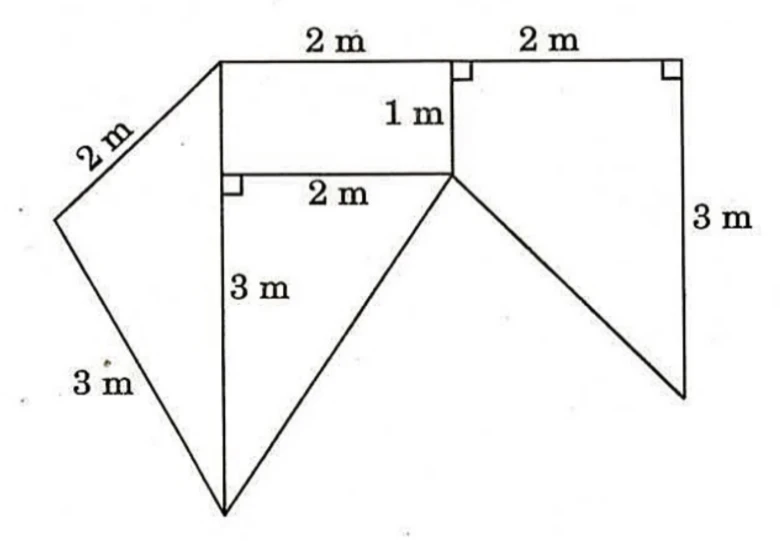
A field is divided into four regions as shown in the given figure. What is the area of the field in square metres?

A compound polygon with no lettered vertices, divided into four regions by internal segments. The top edge is horizontal and is split by a mid-point into two parts, each labelled 2 m. A right-angle mark sits at that mid-point, between the top edge and a short vertical segment labelled 1 m that drops from it; a second right-angle mark sits at the top-right corner, between the top edge and the right-hand edge, which is vertical and labelled 3 m. From the foot of the 1 m segment a horizontal segment labelled 2 m runs left to a point on a second, longer vertical line, meeting it at a marked right angle. That second vertical runs from the top-left corner of the top edge down to the bottom apex of the figure, and the part of it lying below the horizontal segment is what the internal label 3 m measures. Two further segments leave the foot of the 1 m segment: one slanting down-left to the bottom apex, and one slanting down-right to the foot of the right-hand edge, so the boundary turns inward at that foot and the figure has a notch there. The left boundary is two slant edges: one labelled 2 m from the top-left corner down-left to the leftmost vertex, and one labelled 3 m from that leftmost vertex down-right to the bottom apex. The four regions are therefore the quadrilateral between the top edge and the horizontal segment, the triangle below that horizontal segment, the quadrilateral to the right of the 1 m segment, and the triangle on the two left-hand slants.
Options
Show answer & solution

Option C

Approach

Cut the field along the segments already drawn into a rectangle, two triangles and a trapezium, and add the four areas.

Step-by-step solution

  1. 1
    Top edge , , with ; down from ; left to on the vertical through ; down to the bottom apex ; down from ; at the far left with and

    Why: Name the corners from the drawing. The right angles marked at and at make and vertical against the horizontal top edge, and the right angle at makes horizontal; the m label sits beside the part of the internal vertical BELOW , so it measures and not the whole of .

  2. 2

    Why: has two vertical sides and and two horizontal sides and , so it is a rectangle of sides m and m; this also fixes m.

  3. 3

    Why: Triangle is right-angled at , with the horizontal m as base and the vertical m as height.

  4. 4

    Why: and are both vertical, so they are the parallel sides, of lengths m and m; the horizontal m is the distance between them.

  5. 5

    Why: The left region is the triangle on m, m and the whole internal vertical m; no height is marked for it, so Heron's formula is what is left.

  6. 6

    Why: The four regions tile the field and do not overlap, so their areas add.

Common mistakes

Option A

No route reaches here.

Option B

No route reaches here.

Option D

Read the m label as the whole internal vertical , which makes the left triangle a one of area and shortens to m, and then counted the right-hand region as a triangle on the m edge rather than a trapezium, leaving .

Skills used

91Geometry • Circle • Touching Circles
HardIdeal time: about 2 min

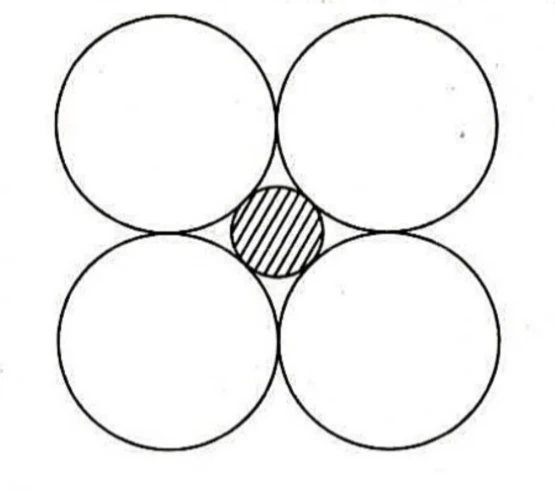
In the figure given below, D is the diameter of each circle. What is the diameter of the shaded circle?

Four equal circles of diameter D arranged in a 2 \times 2 square, each touching its two neighbours. A small hatched (shaded) circle sits in the central gap, tangent to all four.
Options
Show answer & solution

Option A

Approach

The four centres form a square of side ; the shaded circle sits at its centre and touches each big circle externally.

Step-by-step solution

  1. 1

    Why: Neighbouring circles touch externally, so the distance between their centres is the sum of their radii, and the four centres form a square of side .

  2. 2

    Why: The shaded circle's centre is the centre of that square, half a diagonal from each of the four centres, and the diagonal of a square of side is by Pythagoras.

  3. 3

    Why: The shaded circle touches each big circle externally, so that half-diagonal is the sum of the two radii.

  4. 4

    Why: Subtract, then double: the question asks for the diameter, not the radius.

Common mistakes

Option B

Added the radii instead of subtracting, which gives a circle bigger than the four it sits between.

Option C

No route reaches here.

Option D

Turned the radius into a diameter by multiplying by rather than by .

Skills used

92Geometry • Triangle • Similarity
ModerateIdeal time: about 1.5 min

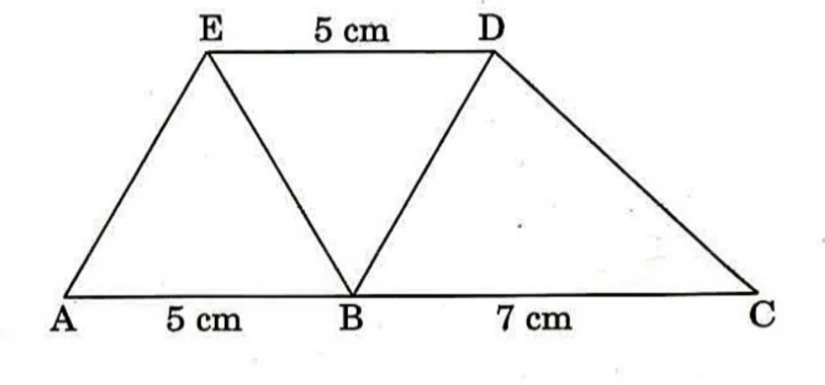
In the figure given below, AC is parallel to ED and AB DE cm and BC cm. What is the area ABDE : area BDE : area BCD equal to?

Points A, B, C lie on a horizontal base line with AB labelled 5 cm and BC labelled 7 cm. Points E and D lie on a horizontal line above it with ED labelled 5 cm; E is above the segment AB and D is above the segment BC. Segments AE, EB, BD and DC are drawn, forming triangle ABE, triangle EBD and triangle BCD.
Options
Show answer & solution

Option A

Approach

Every triangle here has a base on one of the two parallel lines and its apex on the other, so all share the same height and their areas are proportional to their bases.

Step-by-step solution

  1. 1

    Why: , so the distance between the two lines is the height of every one of these triangles; is the apex above the base cm.

  2. 2

    Why: Here the base cm lies on the upper line and the apex on the lower one; the height is the same .

  3. 3

    Why: Base cm on the lower line, apex on the upper.

  4. 4

    Why: The segment splits the quadrilateral into exactly those two triangles.

  5. 5

    Why: Multiply through by to clear the common height.

Common mistakes

Option B

No route reaches here.

Option C

Got correctly but then assumed the remaining triangle equals the quadrilateral.

Option D

No route reaches here.

Skills used

93Geometry • Quadrilateral • Parallelogram
EasyIdeal time: about 1 min

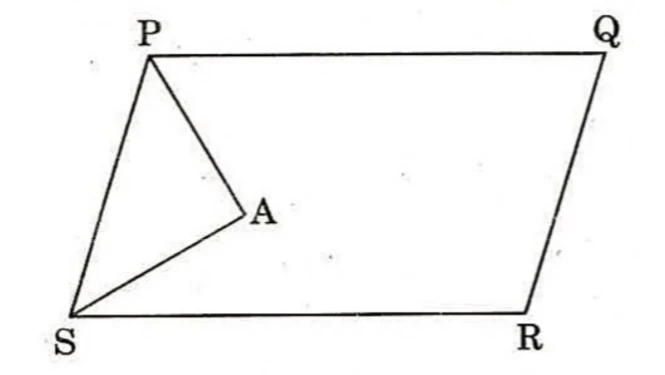
In the figure given below, PQRS is a parallelogram. PA bisects angle P and SA bisects angle S. What is angle PAS equal to?

Parallelogram PQRS with P at the top left, Q at the top right, R at the bottom right and S at the bottom left. An interior point A lies near the left side; segments PA and SA are drawn, meeting at A.
Options
Show answer & solution

Option C

Approach

and are co-interior angles of the parallelogram and so add to ; their halves add to , leaving for the third angle of triangle .

Step-by-step solution

  1. 1

    Why: with as transversal, so the two interior angles on the same side of are supplementary.

  2. 2

    Why: bisects the angle at and bisects the angle at .

  3. 3

    Why: Half of a supplementary pair is a complementary pair.

  4. 4

    Why: The three angles of triangle add to .

Shortcut

The bisectors of two co-interior angles always meet at right angles -- the answer is whatever the parallelogram.

Common mistakes

Option A

Assumed the parallelogram has angles and and then quoted a half-angle rather than .

Option B

No route reaches here.

Option D

No route reaches here.

Skills used

94Geometry • Triangle • Angle Bisector
EasyIdeal time: about 1 min

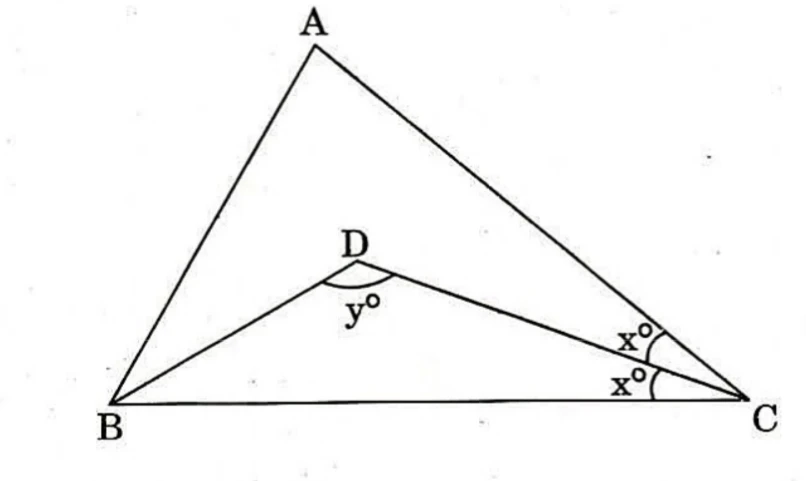
In the figure given below, A and ABC . BD and CD bisect angles B and C respectively. What are the values of and respectively?

Triangle ABC with A at the apex, B at the bottom left and C at the bottom right. An interior point D lies below A; segments BD and CD are drawn. The angle at D in triangle BDC is labelled y^\circ. At vertex C two adjacent angles are each labelled x^\circ, formed by the bisector CD.
Options
Show answer & solution

Option C

and

Approach

Get from the angle sum of triangle , halve it for , then use the angle sum in triangle for .

Step-by-step solution

  1. 1

    Why: The three angles of triangle add to .

  2. 2

    Why: bisects into the two angles marked in the figure.

  3. 3

    Why: bisects .

  4. 4

    Why: Angle sum in triangle , whose other two angles are the two half-angles.

Shortcut

is the incentre, so , and .

Common mistakes

Option A

Halved twice, taking as a quarter of .

Option B

Made both errors: quartered and mis-subtracted.

Option D

Slipped in , giving for .

Skills used

95Geometry • Triangle
HardIdeal time: about 2 min

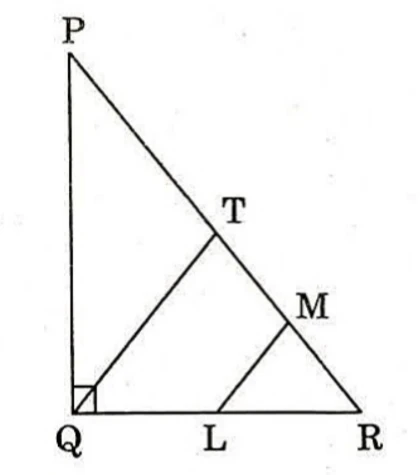
In the figure given below, PQR is a non-isosceles right-angled triangle, right angled at Q. If LM and QT are parallel and QT PT, then what is RLM equal to?

Right-angled triangle PQR with the right angle marked at Q at the bottom left, P at the top and R at the bottom right. T lies on the hypotenuse PR and M lies on PR below T. L lies on the base QR between Q and R. Segment QT joins Q to T, and segment LM joins L to M, drawn parallel to QT.
Options
Show answer & solution

Option B

LRM

Approach

forces to be the midpoint of the hypotenuse, so and triangle is isosceles; the parallel then copies down to .

Step-by-step solution

  1. 1

    Why: lies on and is equidistant from and . In a triangle right-angled at the point of the hypotenuse equidistant from all three vertices is its midpoint, the circumcentre -- so is that midpoint and joins the list.

  2. 2

    Why: Triangle has , so its base angles are equal.

  3. 3

    Why: cut by the transversal , with between and , gives equal corresponding angles at and at .

  4. 4

    Why: lies on and on , so and are the same angle at .

Common mistakes

Option A

, which equals only when the triangle is isosceles -- and the question says it is not.

Option C

Took the third angle of triangle ; it equals , not the two equal base angles.

Option D

is the same angle as , so this fails for the same reason as A.

Skills used

96Geometry • Quadrilateral • Parallelogram
HardIdeal time: about 2 min

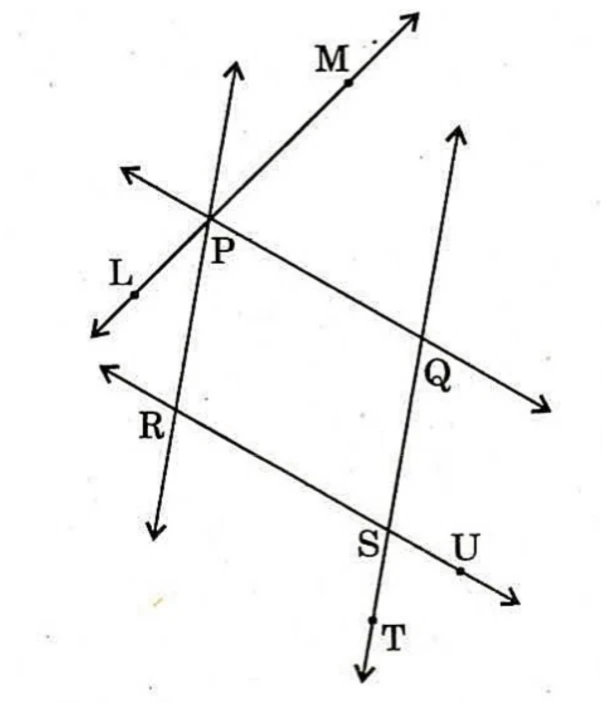
In the figure given below, PQ is parallel to RS and PR is parallel to QS. If LPR and UST , then what is MPQ equal to?

Five straight lines, each drawn with an arrowhead at both ends. Four of them bound a parallelogram PQSR, with P at the top left, Q at the right, S at the bottom and R at the left: the line through P and Q is parallel to the line through R and S, and the line through P and R is parallel to the line through Q and S, each of the four extending beyond both vertices it passes through. The fifth line passes through P alone and carries the point L on it below and to the left of P and the point M on it above and to the right of P, so L, P, M are collinear and the rays PR and PQ both lie between the rays PL and PM; the three angles \angle LPR, \angle RPQ and \angle QPM therefore make up the straight angle at P. The point U is marked on the extension of RS beyond S and the point T on the extension of QS beyond S, so \angle UST is vertically opposite the parallelogram's interior angle \angle RSQ. No angle values are printed in the figure.
Options
Show answer & solution

Option C

Approach

The vertical angle at gives the parallelogram's angle there, its opposite angle at equals it, and the three angles at on one side of the line through and close a straight angle.

Step-by-step solution

  1. 1

    Why: and are the rays beyond , so is vertically opposite the parallelogram's interior angle at .

  2. 2

    Why: and make a parallelogram, and opposite angles of a parallelogram are equal.

  3. 3

    Why: , and lie on one straight line, with the rays and both on the same side of it, so the three angles at make a straight angle.

  4. 4

    Why: Substitute the two known angles.

Common mistakes

Option A

No route reaches here.

Option B

Copied the given , taking for the parallelogram's opposite angle.

Option D

No route reaches here.

Skills used

97Geometry • Triangle • Congruence
ModerateIdeal time: about 2 min

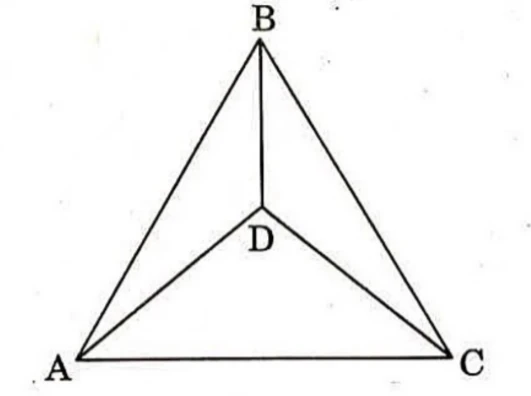
In the figure given below, ABC is a triangle with AB BC and D is an interior point of the triangle ABC such that DAC DCA.

Triangle ABC with B at the apex, A at the bottom left and C at the bottom right. An interior point D lies below B on the line from B towards the base. Segments BD, AD and DC are drawn.

Consider the following statements:

1
Triangle ADC is an isosceles triangle.
2
D is the centroid of the triangle ABC.
3
Triangle ABD is congruent to the triangle CBD.

Which of the above statements are correct?

Options
Show answer & solution

Option C

1 and 3 only

Approach

Test the three statements separately: the equal base angles make isosceles, that plus gives an SSS congruence, but nothing pins to the centroid.

Step-by-step solution

  1. 1

    Why: Sides opposite equal angles of a triangle are equal, so triangle is isosceles -- statement 1 holds.

  2. 2

    Why: Three pairs of equal sides is SSS congruence, the third pair being the shared side -- statement 3 holds.

  3. 3

    Why: That perpendicular bisector is the whole median from (since too), and the centroid is only one point of it, so need not be the centroid -- statement 2 fails.

  4. 4

    Why: Only the option listing exactly and can be right.

Common mistakes

Option A

Read the centroid off the figure and missed that the shared side completes an SSS congruence.

Option B

Accepted the centroid and overlooked that is precisely the isosceles condition.

Option D

Took the figure, in which happens to be drawn near the centroid, as proof of statement 2.

Skills used

98Geometry • Triangle • Congruence
EasyIdeal time: about 1 min

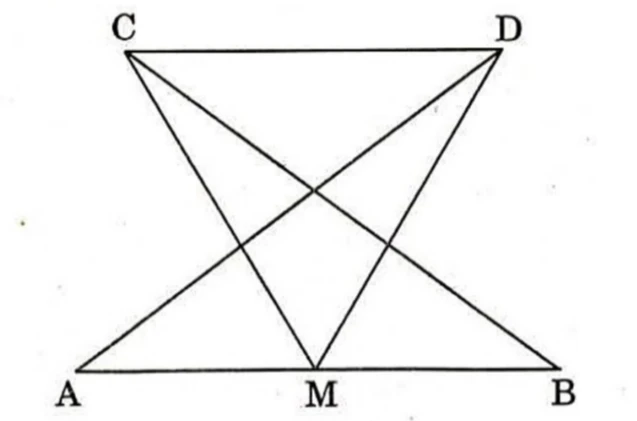
In the figure given below, M is the mid-point of AB and DAB CBA and AMC BMD. Then the triangle ADM is congruent to the triangle BCM by

C at the top left and D at the top right, with A at the bottom left, M at the bottom middle and B at the bottom right. Segments CD, CA, CM, CB, DA, DM and AB are drawn, so that CB and DA cross to form an X between the top and bottom edges.
Options
Show answer & solution

Option C

ASA rule

Approach

Strip the common angle out of to get , then pair that with and the given equal angles at and .

Step-by-step solution

  1. 1

    Why: is the midpoint of .

  2. 2

    Why: This is the given , since lies on the segment .

  3. 3

    Why: Both of the given angles contain : and , so removing the common part leaves the two remaining angles equal.

  4. 4

    Why: Two angles and the side lying between them match in the two triangles, which is exactly the ASA criterion.

Common mistakes

Option A

Counted together with the two angles as though a second pair of sides were known.

Option B

Only one pair of equal sides is given, so SSS cannot apply.

Option D

AAA establishes similarity, never congruence.

Skills used

99Geometry • Triangle • Congruence
HardIdeal time: about 2 min

ABCD is a square. X is the mid-point of AB and Y is the mid-point of BC.

Consider the following statements:

1
Triangles ADX and BAY are congruent.
2
DXA AYB.
3
DX is inclined at an angle with AY.
4
DX is not perpendicular to AY.

Which of the above statements are correct?

Options
Show answer & solution

Option D

1 and 2 only

Approach

Triangles and are congruent by SAS; the congruence gives statement 2, and an angle chase on it forces , which kills both statement 3 and statement 4.

Step-by-step solution

  1. 1

    Why: In the square all sides are and all angles right; and are midpoints, so . Side-angle-side gives -- statement 1 holds.

  2. 2

    Why: They are the angles opposite the equal sides and in that congruence -- statement 2 holds.

  3. 3

    Why: Triangle is right-angled at , so its two acute angles are complementary.

  4. 4

    Why: Corresponding angles of the congruent triangles. In the small triangle cut off where crosses , those two angles are two of the three, so the third is : .

  5. 5

    Why: Only statements 1 and 2 survive.

Common mistakes

Option A

Rejected the congruence and read the crossing angle off the picture as .

Option B

Got the congruence but never established the perpendicularity, so kept statement 4.

Option C

Kept both false angle statements and dropped the true statement 2.

Skills used

100Trigonometry • Heights and Distances
ModerateIdeal time: about 1.5 min

From an aeroplane vertically over a straight horizontal road, the angles of depression of two consecutive kilometre-stones on the opposite sides of the aeroplane are observed to be and . The height of the aeroplane above the road is

Options
Show answer & solution

Option B

Approach

The two ground distances are and , and because the stones are on opposite sides of the plane they add to the km between them.

Step-by-step solution

  1. 1

    Why: The plane is vertically above the road, so each stone gives a right triangle in which is opposite the depression angle and the ground distance is adjacent to it.

  2. 2

    Why: The stones are consecutive kilometre-stones, and they lie on opposite sides of the foot of the vertical, so the two distances add rather than subtract.

  3. 3

    Why: Substitute and make the subject.

  4. 4

    Why: Replace each cotangent by the reciprocal of the tangent and clear the compound fraction.

Common mistakes

Option A

Inverted the final fraction, writing for the height instead of its reciprocal.

Option C

Swapped for throughout, which is rather than the height.

Option D

This equals : the reciprocal was taken on the wrong side of the equation.

Skills used