Skip to content

General Studies Paper II (CSAT) 2018

Set A

Questions 1–20 of 80

1Logical Reasoning • Visual Reasoning
Easy

Consider the following three-dimensional figure :
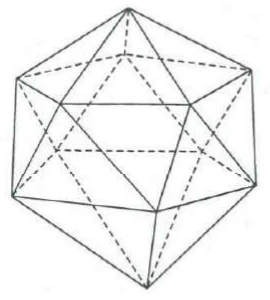
A line drawing of a convex solid with triangular faces, in a roughly hexagonal outline. A single top vertex is joined by edges to a ring of vertices around the upper part; a single bottom vertex is joined by edges to a ring of vertices around the lower part; the upper and lower rings are joined to each other by a zigzag of edges. Edges on the near side are drawn solid; edges on the far side are drawn dashed. No labels.

How many triangles does the above figure have?

Options
Show answer & solution

Option B

20

Why

The solid is drawn with hidden edges dashed, so every face counts, front and back. It has one top corner, one bottom corner, and two rings of 5 corners between them. Count the triangular faces in three bands: the 5 faces around the top corner, the 5 faces around the bottom corner, and the zigzag band between the two rings. In the band, each of the 5 upper-ring edges makes one face with a lower corner, and each of the 5 lower-ring edges makes one face with an upper corner, so the band has 10 faces.

Proof

triangular faces.

About the other options

Option A

18 misses one face from each cap, or misjudges the middle band.

Option C

22 adds faces the solid does not have, often by counting triangles formed where front and back lines cross in the drawing.

Option D

24 counts too many faces in the middle band.
Ideal time: about 1 min
2Quantitative Aptitude • Cryptarithms
Easy

Consider the following sum :

In the above sum, • stands for

Options
Show answer & solution

Option D

8

Approach

Write each number with by its place value, so the sum becomes a simple equation in one digit.

Step-by-step solution

  1. 1
    Call the digit . Then , , , , , and .

    Why: A digit in the tens place is worth ten times the digit, so is , not .

  2. 2
    Left side: .

    Why: Collect the terms and the plain numbers separately.

  3. 3
    , so and .

    Why: Take and 34 from both sides.

Shortcut

Look at the units column only: must end in , so ends in 0. That leaves or , and is far from .

Common mistakes

Option A

With the units column gives , ending in 6, not 4.

Option B

With the units column gives , ending in 9, not 5.

Option C

With the units column gives , ending in 2, not 6.

Skills used

Ideal time: about 1 min
3Logical Reasoning • Series
Easy

Consider the following pattern of numbers :

8101513
6574
4688
61116?

What is the number at ? in the above pattern?

Options
Show answer & solution

Option A

17

Why

Read each column down. The bottom number is the first number, minus the second, plus the third.

Proof

; ; ; so .

About the other options

Option B

19 does not fit the rule that works for the first three columns.

Option C

21 is 13 + 8, which ignores the middle number.

Option D

23 does not fit the rule that works for the first three columns.

Ideal time: about 1 min
4Quantitative Aptitude • Permutations and Combinations
Very easy

How many diagonals can be drawn by joining the vertices of an octagon?

Options
Show answer & solution

Option A

20

Approach

Count the diagonals from one corner, then use all corners and halve for double counting.

Step-by-step solution

  1. 1
    An octagon has 8 corners. From one corner, leave out itself and its 2 neighbours: diagonals.

    Why: A line to a neighbouring corner is a side, not a diagonal.

  2. 2
    counts each diagonal from both of its ends.

    Why: Every diagonal has two ends, so it was counted once at each.

  3. 3
    .

Common mistakes

Option B

: counting 3 diagonals per corner and not halving.

Option C

counts every pair of corners, including the 8 sides.

Option D

pairs every corner with every corner, itself included.

Skills used

Ideal time: about 30 s
5Quantitative Aptitude • Speed, Distance and Time
Easy

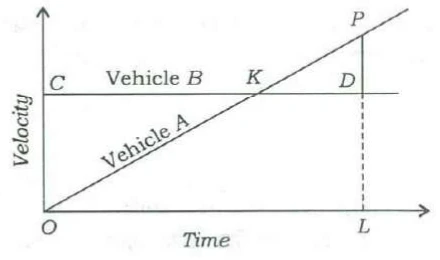
The figure drawn below gives the velocity graphs of two vehicles and . The straight line represents the velocity of vehicle at any instant, whereas the horizontal straight line represents the velocity of vehicle at any instant. In the figure, is the point where perpendicular from meets the horizontal line such that :

A graph with Velocity on the vertical axis and Time on the horizontal axis, origin O. A straight line labelled Vehicle A rises from O to a point P at the upper right. A horizontal line labelled Vehicle B starts at C on the velocity axis, crosses the rising line at K, and continues to D. A vertical line drops from P through D (solid from P to D, dashed from D down) to L on the time axis. No numerical values are marked.

What is the ratio between the distances covered by vehicles and in the time interval ?

Options
Show answer & solution

Option C

3 : 4

Approach

On a velocity-time graph the distance is the area under the line, so compare the triangle under 's line with the rectangle under 's.

Step-by-step solution

  1. 1
    Over the time , 's area is the triangle , , , and 's area is the rectangle with width and height .

    Why: Distance is speed times time, which is the area under the speed line; 's speed stays at the height .

  2. 2
    .

    Why: lies on the line , so the height is made of and .

  3. 3
    : . : .

    Why: Triangle area is half of base times height; rectangle area is width times height.

  4. 4
    Ratio .

    Why: The shared cancels.

Common mistakes

Option A

: comparing the given lengths instead of the areas.

Option B

: comparing with , the final speeds, not the areas.

Option D

: assuming the two meet at means equal distances; equal speeds at one moment do not give equal distances.

Skills used

Ideal time: about 1.5 min
6Quantitative Aptitude • Speed, Distance and Time
Very easy

A train 200 metres long is moving at the rate of 40 kmph. In how many seconds will it cross a man standing near the railway line?

Options
Show answer & solution

Option D

18

Approach

To pass a man standing still, the train must move its own length; turn the speed into metres per second first.

Step-by-step solution

  1. 1
    To cross the man, the train covers its own length: 200 m.

    Why: The man is a point; the train has passed him when its back end reaches him.

  2. 2
    km/h m/s.

    Why: Length is in metres and time is wanted in seconds, so the speed must be in m/s.

  3. 3
    Time s.

Common mistakes

Option A

12 has no route from these numbers; it is a filler.

Option B

15 has no route from these numbers; it is a filler.

Option C

16 has no route from these numbers; it is a filler.

Skills used

Ideal time: about 30 s
7Reading Comprehension • Inference
Moderate

Directions for the following 4 (four) items :

Read the following four passages and answer the items that follow. Your answers to these items should be based on the passages only.

Passage—1

Global population was around 1.6 billion in 1990—today it is around 7.2 billion and growing. Recent estimates on population growth predict a global population of 9.6 billion in 2050 and 10.9 billion in 2100. Unlike Europe and North America, where only three to four per cent of population is engaged in agriculture, around 47 per cent of India's population is dependent upon agriculture. Even if India continues to do well in the service sector and the manufacturing sector picks up, it is expected that around 2030 when India overtakes China as the world's most populous country, nearly 42 per cent of India's population will still be predominantly dependent on agriculture.

Which of the following is the most logical and rational inference that can be made from the above passage?

Options
Show answer & solution

Option A

Prosperity of agriculture sector is of critical importance to India.

Why

The passage says India's population keeps growing and almost half of it lives on farming, and that 42 per cent will still depend on it in 2030. So the health of farming decides the lives of a very large share of Indians, which makes its prosperity critical to India.

Proof

around 47 per cent of India's population is dependent upon agriculture … nearly 42 per cent of India's population will still be predominantly dependent on agriculture

About the other options

Option B

Not in the passage: it speaks of the share of people who depend on farming, not of how much the economy earns from it.

Option C

Not in the passage: it reports population figures but never says growth should be controlled.

Option D

Reverses the passage: it expects most farm people to stay in farming and never advises them to leave it.

Ideal time: about 1.5 min
8Reading Comprehension • Inference
Moderate

Directions for the following 4 (four) items :

Read the following four passages and answer the items that follow. Your answers to these items should be based on the passages only.

Passage—2

Many pathogens that cause foodborne illnesses are unknown. Food contamination can occur at any stage from farm to plate. Since most cases of food poisoning go unreported, the true extent of global foodborne illnesses is unknown. Improvements in international monitoring have led to greater public awareness, yet the rapid globalization of food production increases consumers' vulnerability by making food harder to regulate and trace. "We have the world on our plates", says an official of WHO.

Which of the following is the most logical corollary to the above passage?

Options
Show answer & solution

Option A

With more options for food come more risks.

Why

The passage says food now comes from all over the world, and this makes food harder to regulate and trace. So the wider choice on our plates brings a greater risk of illness, which is what option A says.

Proof

the rapid globalization of food production increases consumers' vulnerability by making food harder to regulate and trace. "We have the world on our plates"

About the other options

Option B

Too strong: the passage says contamination can occur at any stage from farm to plate, not only in processing.

Option C

Not in the passage: it describes a risk but gives no advice about eating only local food.

Option D

Not in the passage: it explains why global food is risky but does not say global production should be cut.

Ideal time: about 1 min
9Reading Comprehension • Inference
Moderate

Directions for the following 4 (four) items :

Read the following four passages and answer the items that follow. Your answers to these items should be based on the passages only.

Passage—3

I am a scientist, privileged to be somebody who tries to understand nature using the tools of science. But it is also clear that there are some really important questions that science cannot really answer, such as : Why is there something instead of nothing? Why are we here? In those domains, I have found that faith provides a better path to answers. I find it oddly anachronistic that in today's culture there seems to be a widespread presumption that scientific and spiritual views are incompatible.

Which of the following is the most logical and rational inference that can be made from the above passage?

Options
Show answer & solution

Option B

Science and faith can be mutually complementary if their proper domains are understood.

Why

The author is a scientist who says science cannot answer some questions, and in those areas faith gives better answers. The author calls it odd to think the two cannot go together. So science and faith can support each other when each keeps to its own area.

Proof

there are some really important questions that science cannot really answer … In those domains, I have found that faith provides a better path to answers … there seems to be a widespread presumption that scientific and spiritual views are incompatible

About the other options

Option A

Too strong: faith is better only in some domains, and the author still uses science to understand nature.

Option C

Reverses the passage: the author says faith does give a path to answers for the questions science cannot answer.

Option D

Not in the passage: it says people think the two views are incompatible, not that science is valued more.

Ideal time: about 1 min
10Reading Comprehension • Factual Detail
Easy

Directions for the following 4 (four) items :

Read the following four passages and answer the items that follow. Your answers to these items should be based on the passages only.

Passage—4

Though I have discarded much of past tradition and custom, and am anxious that India should rid herself of all shackles that bind and contain her and divide her people, and suppress vast numbers of them, and prevent the free development of the body and the spirit; though I seek all this, yet I do not wish to cut myself off from that past completely. I am proud of that great inheritance that has been and is, ours and I am conscious that I too, like all of us, am a link in that unbroken chain which goes back to the dawn of history in the immemorial past of India.

The author wants India to rid herself of certain past bonds because

Options
Show answer & solution

Option D

they obstruct her physical and spiritual growth

Why

The author wants India to break the shackles (chains) that bind her and divide her people. The reason given is that these shackles stop the free development of the body and the spirit, which is option D.

Proof

India should rid herself of all shackles that bind and contain her and divide her people, and suppress vast numbers of them, and prevent the free development of the body and the spirit

About the other options

Option A

Reverses the passage: the author does not want to cut off from the past completely.

Option B

Reverses the passage: the author says "I am proud of that great inheritance".

Option C

Reverses the passage: the author sees himself as a link in a chain going back to the dawn of history.

Ideal time: about 1 min
11Quantitative Aptitude • Simplification and Approximation
Very easy

Directions for the following 3 (three) items :

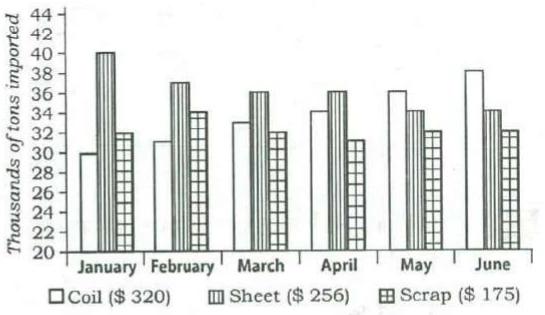
The following three items are based on the graph given below which shows imports of three different types of steel over a period of six months of a year. Study the graph and answer the three items that follow.

A grouped bar chart. Vertical axis: Thousands of tons imported, from 20 to 44 in steps of 2 (the axis starts at 20, not 0). Horizontal axis: January, February, March, April, May, June, with three bars per month in the order Coil (plain white bar), Sheet (vertical-line hatching), Scrap (grid hatching). Legend: Coil ( 320), Sheet ( 256), Scrap ( 175). Bar heights as read from the gridlines (thousands of tons): January Coil 30, Sheet 40, Scrap 32; February Coil 31, Sheet 37, Scrap 34; March Coil 33, Sheet 36, Scrap 32; April Coil 34, Sheet 36, Scrap 31; May Coil 36, Sheet 34, Scrap 32; June Coil 38, Sheet 34, Scrap 32.

The figures in the brackets indicate the average cost per ton over six months period.

By how much (measured in thousands of tons) did the import of sheet steel exceed the import of coil steel in the first three months of the year?

Options
Show answer & solution

Option C

19

Why

Add the Sheet bars and the Coil bars for January, February and March, then subtract.

Proof

Sheet: . Coil: . thousand tons.

About the other options

Option A

11 is about the gap for January and February only; March is left out.

Option B

15 comes from misreading a bar by a few units, such as taking February Coil as 35.

Option D

23 comes from misreading a bar, such as taking January Sheet as 44.

Ideal time: about 50 s
12Quantitative Aptitude • Simplification and Approximation
Easy

Same directions as Q11

What was the approximate total value (in $) of sheet steel imported over the six months period?

Options
Show answer & solution

No option is correct

Why

The bars are in thousands of tons. Sheet steel over six months is thousand tons, that is tons. At a ton, the value is , about 55.55 million dollars. The question asks for the value in dollars. No option gives this: option C, 55,550, has the right digits but is 1000 times too small, because it leaves out the thousands from the graph's units. So no printed option is correct as printed.

Proof

dollars, while the options are all below dollars.

About the other options

Option A

45,555 is not the value in dollars, and does not match the digits of the true value either.

Option B

50,555 is not the value in dollars, and does not match the digits of the true value either.

Option C

55,550 matches the value in thousands of dollars, but the question asks in dollars, so it is 1000 times too small as printed.

Option D

65,750 is not the value in dollars, and does not match the digits of the true value either.

Ideal time: about 1.5 min
13Quantitative Aptitude • Ratio and Proportion
Easy

Same directions as Q11

What was the approximate ratio of sheet steel and scrap steel imports in the first three months of the year?

Options
Show answer & solution

Option B

1.2 : 1

Why

Add the Sheet bars and the Scrap bars for January, February and March, then divide.

Proof

Sheet: . Scrap: . , nearest to .

About the other options

Option A

1 : 1 would need the two totals to be nearly equal; 113 is 15 more than 98.

Option C

1.4 : 1 would need Sheet to be about 137, far above 113.

Option D

1.6 : 1 would need Sheet to be about 157, far above 113.

Ideal time: about 1 min
14Logical Reasoning • Cubes and Dice
Easy

Directions for the following 3 (three) items :

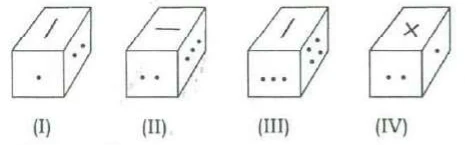
Rotated positions of a single solid are shown below. The various faces of the solid are marked with different symbols like dots, cross and line. Answer the three items that follow the given figures.

Four views of the same rectangular block, labelled (I) to (IV), each showing a top face, a front face and a right side face. (I): top a line (drawn slanting), front one dot, right side two dots. (II): top a line (drawn horizontal), front two dots, right side three dots. (III): top a line (drawn slanting), front three dots, right side four dots. (IV): top a cross, front two dots, right side one dot.

What is the symbol on the face opposite to that containing a single dot?

Options
Show answer & solution

Option B

Three dots

Approach

Find which faces are seen together; a face seen beside four others is opposite the sixth, and the ring of four gives the other pairs.

Step-by-step solution

  1. 1
    The line is on top in views (I), (II) and (III), next to one dot, two dots, three dots and four dots.

    Why: Faces seen together share an edge, so the line touches all four. The only face never seen with the line is the cross, so the line is opposite the cross.

  2. 2
    Going round the line, the views show one dot beside two dots (I), two dots beside three dots (II), and three dots beside four dots (III). So the ring round the line is 1, 2, 3, 4 dots, in that order.

    Why: Each view shows a front face with the next face of the ring on its right.

  3. 3
    In a ring of four, faces two steps apart are opposite: one dot is opposite three dots, and two dots is opposite four dots.

    Why: Neighbours in the ring share an edge; the face two steps away is on the far side.

  4. 4
    So the face opposite one dot has three dots.

Common mistakes

Option A

Four dots is never shown beside one dot, but in the ring round the line (one, two, three, four) it sits next to one dot, so it is a neighbour, not opposite.

Option C

Two dots is seen beside one dot in view (I), so it cannot be opposite.

Option D

The cross is seen beside one dot in view (IV), so it cannot be opposite.

Skills used

Ideal time: about 40 s
15Logical Reasoning • Cubes and Dice
Easy

Same directions as Q14

What is the symbol on the face opposite to that containing two dots?

Options
Show answer & solution

Option C

Four dots

Approach

Find which faces are seen together; a face seen beside four others is opposite the sixth, and the ring of four gives the other pairs.

Step-by-step solution

  1. 1
    The line is on top in views (I), (II) and (III), next to one dot, two dots, three dots and four dots.

    Why: Faces seen together share an edge, so the line touches all four. The only face never seen with the line is the cross, so the line is opposite the cross.

  2. 2
    Going round the line, the views show one dot beside two dots (I), two dots beside three dots (II), and three dots beside four dots (III). So the ring round the line is 1, 2, 3, 4 dots, in that order.

    Why: Each view shows a front face with the next face of the ring on its right.

  3. 3
    In a ring of four, faces two steps apart are opposite: one dot is opposite three dots, and two dots is opposite four dots.

    Why: Neighbours in the ring share an edge; the face two steps away is on the far side.

  4. 4
    So the face opposite two dots has four dots.

Common mistakes

Option A

One dot is seen beside two dots in views (I) and (IV), so it cannot be opposite.

Option B

Three dots is seen beside two dots in view (II), so it cannot be opposite.

Option D

The line is seen beside two dots in view (II), so it cannot be opposite.

Skills used

Ideal time: about 40 s
16Logical Reasoning • Cubes and Dice
Easy

Same directions as Q14

What is the symbol on the face opposite to that containing the cross?

Options
Show answer & solution

Option C

Line

Approach

Find which faces are seen together; a face seen beside four others is opposite the sixth.

Step-by-step solution

  1. 1
    The line is on top in views (I), (II) and (III), next to one dot, two dots, three dots and four dots.

    Why: Faces seen together share an edge, so the line touches all four. The only face never seen with the line is the cross, so the line is opposite the cross.

  2. 2
    So the face opposite the cross is the line.

Common mistakes

Option A

One dot is seen beside the cross in view (IV).

Option B

Two dots is seen beside the cross in view (IV).

Option D

Four dots is never shown with the cross, but it is shown with the line, which is the face that touches all four dotted faces.

Skills used

Ideal time: about 40 s
17Reading Comprehension • Factual Detail
Hard

Directions for the following 4 (four) items :

Read the following passage and answer the four items that follow. Your answers to these items should be based on the passage only.

Passage

It is no longer enough for us to talk about providing for universal access to education. Making available schooling facilities is an essential prerequisite, but is insufficient to ensure that all children attend school and participate in the learning process. The school may be there, but children may not attend or they may drop out after a few months. Through school and social mapping, we must address the entire gamut of social, economic, cultural and indeed linguistic and pedagogic issues, factors that prevent children from weaker sections and disadvantaged groups, as also girls, from regularly attending and complementing elementary education. The focus must be on the poorest and most vulnerable since these groups are the most disempowered and at the greatest risk of violation or denial of their right to education.

The right to education goes beyond free and compulsory education to include quality education for all. Quality is an integral part of the right to education. If the education process lacks quality, children are being denied their right. The Right of Children to Free and Compulsory Education Act lays down that the curriculum should provide for learning through activities, exploration and discovery. This places an obligation on us to change our perception of children as passive receivers of knowledge, and to move beyond the convention of using textbooks as the basis of examinations. The teaching-learning process must become stress-free; and a massive programme for curricular reform should be initiated to provide for a child-friendly learning system, that is more relevant and empowering. Teacher accountability systems and processes must ensure that children are learning, and that their right to learn in a child-friendly environment is not violated. Testing and assessment systems must be reexamined and redesigned to ensure that these do not force children to struggle between school and tuition centres, and bypass childhood.

According to the passage, which of the following is/are of paramount importance under the Right to Education?

1
Sending of children to school by all parents
2
Provision of adequate physical infrastructure in schools
3
Curricular reforms for developing child-friendly learning system

Select the correct answer using the code given below.

Options
Show answer & solution

Option C

3 only

Why

The passage says access to schools is no longer enough, and that quality is an integral (necessary) part of the right to education. 1 not supported: the passage never speaks of parents sending children to school. 2 not paramount: school facilities are called a prerequisite, but the passage says they are insufficient. 3 supported: the passage asks for a massive programme of curricular reform for a child-friendly learning system, as part of quality.

Proof

Making available schooling facilities is an essential prerequisite, but is insufficient … Quality is an integral part of the right to education … a massive programme for curricular reform should be initiated to provide for a child-friendly learning system

About the other options

Option A

Includes 1, which is not in the passage: parents are never mentioned.

Option B

Includes 1 and 2: parents are not mentioned, and the passage says facilities alone are insufficient.

Option D

Drops 3, though the passage calls for curricular reform as part of quality, which is integral to the right.

Ideal time: about 1 min
18Reading Comprehension • Assumption
Hard

Same directions as Q17

With reference to the above passage, the following assumptions have been made :

1
The Right to Education guarantees teachers' accountability for the learning process of children.
2
The Right to Education guarantees 100% enrolment of children in the schools.
3
The Right to Education intends to take full advantage of demographic dividend.

Which of the above assumptions is/are valid?

Options
Show answer & solution

Option A

1 only

Why

The passage argues that the right to education includes learning that really happens, not just a seat in school. 1 valid: the author says teacher accountability must ensure children are learning, so the author takes the right to hold teachers answerable for learning. 2 not valid: the passage says children may not attend or may drop out, so enrolment is not guaranteed. 3 not valid: the passage never mentions the demographic dividend (the gain from a large young population).

Proof

If the education process lacks quality, children are being denied their right … Teacher accountability systems and processes must ensure that children are learning

About the other options

Option B

Includes 2 and 3: the passage says children may not attend even when a school exists, and it says nothing of the demographic dividend.

Option C

Keeps 3, which is not in the passage, and drops 1, which the passage rests on.

Option D

Includes 2, which the passage contradicts, and 3, which it never raises.

Ideal time: about 1.5 min
19Reading Comprehension • Factual Detail
Moderate

Same directions as Q17

According to the passage, which one of the following is critical in bringing quality in education?

Options
Show answer & solution

Option D

Inculcating learning through activities and discovery

Why

The second paragraph is about quality. The one practice it names from the Act is learning through activities, exploration and discovery. So option D is what the passage treats as critical to quality.

Proof

Quality is an integral part of the right to education … the curriculum should provide for learning through activities, exploration and discovery

About the other options

Option A

True but not what was asked: attendance belongs to the first paragraph, on access, not quality.

Option B

Not in the passage: it speaks of teacher accountability, never of paying teachers more.

Option C

True but not what was asked: social and cultural factors are named as reasons children do not attend, not as the key to quality.

Ideal time: about 1 min
20Reading Comprehension • Main Idea
Moderate

Same directions as Q17

What is the essential message in this passage?

Options
Show answer & solution

Option C

The Right to Free and Compulsory Education should include quality education for all.

Why

The passage says it is not enough to give every child a school. Its main point is that the right must include quality education for all. The first paragraph leads up to this point, and the second paragraph explains it.

Proof

It is no longer enough for us to talk about providing for universal access to education … The right to education goes beyond free and compulsory education to include quality education for all

About the other options

Option A

Not in the passage: it never says the right is a Fundamental Right, even if that is true.

Option B

Too narrow: weaker sections are the focus of the first paragraph only, and the passage says access alone is not enough.

Option D

Too narrow: attendance is one part of the first paragraph, and parents are never mentioned.

Ideal time: about 1 min