Skip to content

General Ability Test 2024 (II)

Set A

Questions 121–140 of 150

121Physics • Light and Optics • Refraction by Lenses
Easy

Which one among the following is the correct focal length of a combination of lenses of power 2.5 D and –2.0 D ?

Options
Show answer & solution

Option C

+2.0 m

Why

Powers of lenses in contact add: . Focal length in metres is , with the same sign as .

Exam-hall approach

The total power is positive, so the combination is converging and f is positive: this strikes B and D. A gives the power, not the focal length.

Proof

D; m

About the other options

Option A

+0.5 is the total power in dioptres. The focal length is its reciprocal, 2.0 m.

Option B

Gives the power, with the wrong sign. The focal length is m.

Option D

The size is right, but the sign is wrong. The total power is positive, so the combination converges and is positive.

Ideal time: about 35 s
122Physics • Magnetism and Electromagnetism • Domestic Electric Circuits
Moderate

The AC mains domestic supply current in India changes direction in every

Options
Show answer & solution

Option D

s

Why

AC in India has a frequency of 50 Hz: 50 full cycles each second. In each cycle the current changes direction twice. So it changes direction 100 times a second, once every 1/100 s.

Proof

NCERT Class 10 Science, Ch. 12 (Magnetic Effects of Electric Current): in India, AC changes direction after every 1/100 second, a frequency of 50 Hz

About the other options

Option A

50 is the frequency in hertz, not a time. A change every 50 s would be far too slow.

Option B

1/50 s is the time of one full cycle. The current changes direction twice in each cycle.

Option C

100 is the number of direction changes in one second, not a time.

Ideal time: about 27 s
123Physics • Work, Energy and Power • Work Done by a Force
Easy

A block of mass 2.0 kg slides on a rough horizontal plane surface. Let the speed of the block at a particular instant is 10 m/s. It comes to rest after travelling a distance of 20 m. Which one of the following could be the magnitude of the frictional force ?

Options
Show answer & solution

No option is correct

Why

The work done by friction removes all the kinetic energy: . So N. None of the options is 5 N, so no option is correct as printed. With a speed of 20 m/s the force would be 20 N; with a distance of 2.0 m it would be 50 N; either may be what was meant.

Proof

N

About the other options

Option A

10 N would stop the block in 10 m, not 20 m. As printed, the force is 5 N.

Option B

20 N would stop the block in 5 m. It is the answer if the speed were 20 m/s, but the paper prints 10 m/s.

Option C

40 N would stop the block in 2.5 m, not 20 m.

Option D

50 N would stop the block in 2 m. It is the answer if the distance were 2.0 m, but the paper prints 20 m.

Ideal time: about 50 s
124Physics • Heat and Thermodynamics • Modes of Heat Transfer
Easy

Given below are the four cases in which certain heat transfer is taking place :

1
Ice is melting in a glass full of water
2
Water is boiling in an open container
3
A metal rod is heated in a furnace
4
A cup of coffee is allowed to cool on a table

In which of the above cases, the Newton’s Law of Cooling is applicable ?

Options
Show answer & solution

Option B

4 only

Why

1 — Not applicable. Melting ice stays at 0 °C while it takes in heat; its temperature does not fall with the temperature difference. 2 — Not applicable. Boiling water stays at 100 °C; the heat goes into the change of state. 3 — Not applicable. A rod in a furnace is being heated by a very hot source, mostly by radiation, with a large temperature difference. 4 — Applicable. Hot coffee loses heat to cooler surroundings, at a rate proportional to the temperature difference: Newton's law of cooling.

Exam-hall approach

Newton's law of cooling is about a body cooling, and its temperature falling. Only the coffee cools; ice and boiling water stay at a fixed temperature. That leaves B.

About the other options

Option A

Melting ice stays at 0 °C while it absorbs heat. Its temperature does not change, so the law does not describe it.

Option C

Contains case 1: melting ice stays at 0 °C, so its temperature does not change in the way the law describes.

Option D

Cases 1 and 2 are changes of state at a fixed temperature, and case 3 is heating in a furnace. None is a body cooling to its surroundings.

Ideal time: about 57 s
125Physics • Motion, Force and Laws of Motion • Newton's Laws and Conservation of Momentum
Easy

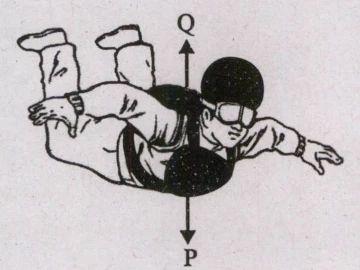
The figure given below shows the direction of the two forces P and Q acting on a skydiver :

A skydiver in free fall, drawn lying face-down and horizontal with arms and legs spread, wearing a helmet and goggles. A vertical line with an arrowhead at the top runs upwards through the body and is labelled Q above the figure. A vertical line with an arrowhead at the bottom runs downwards and is labelled P below the figure. So Q points up and P points down.

Which one among the following statements is correct about the two forces ?

Options
Show answer & solution

Option C

After the parachute opens, force P remains the same while force Q increases

Why

P points down: it is the skydiver's weight, from gravity. Q points up: it is air resistance (drag). When the parachute opens, the weight does not change, but the large canopy greatly increases air resistance. So P stays the same and Q increases. A can also be defended, since air resistance is fluid friction.

Exam-hall approach

Opening a parachute cannot change the skydiver's mass, so P cannot decrease: this strikes D. A net downward force means speeding up: this strikes B.

Proof

Weight = mg, unchanged; drag grows with area and speed. NCERT Class 8 Science, Friction: fluid friction (drag)

About the other options

Option A

Also defensible

P is from gravity and Q is air resistance. Air resistance is a kind of friction (fluid friction or drag), so A can also be defended. C is keyed because it states the change exactly.

Option B

When P is bigger than Q, there is a net downward force, so the skydiver speeds up. The speed stays the same only when P equals Q.

Option D

P is the weight, . Opening the parachute does not change the mass, so P does not decrease.

Ideal time: about 1 min
126History • Vijayanagara and Bahmani Kingdoms
Easy

Vijayanagara rulers claimed that they were ruling on behalf of

Options
Show answer & solution

Option C

Shri Virupaksha

Why

The Vijayanagara rulers claimed to rule on behalf of the god Virupaksha, a form of Shiva. Royal orders were signed "Shri Virupaksha" in Kannada.

Proof

NCERT Class 12 Themes in Indian History Part II, An Imperial Capital: Vijayanagara, The Sacred Centre

About the other options

Option A

Lord Murugan (Kartikeya) is widely worshipped in Tamil Nadu. The Vijayanagara rulers did not rule in his name.

Option B

Lord Venkateshwara of Tirupati was given large gifts by Vijayanagara kings, but they did not claim to rule on his behalf.

Option D

Shri Vallabha is a title of Vishnu, also used by Chalukya and Rashtrakuta kings. It was not the Vijayanagara rulers' claim.

Ideal time: about 12 s
127History • Vijayanagara and Bahmani Kingdoms
Easy

Domingo Paes describes a king in these words : ‘Of medium height, and of fair complexion and good figure, rather fat than thin; he has on his face signs of smallpox’. Identify the king from the options given below.

Options
Show answer & solution

Option A

Krishnadeva Raya

Why

Domingo Paes, a Portuguese traveller, visited Vijayanagara in the reign of Krishnadeva Raya (1509–1529). This is his description of that king.

Proof

NCERT Class 12 Themes in Indian History Part II, An Imperial Capital: Vijayanagara: Paes's description of Krishnadeva Raya

About the other options

Option B

Rama Raya was the regent whose army lost the Battle of Talikota in 1565, decades after Paes's visit.

Option C

Devaraya II ruled in the 15th century. He was described by the Persian envoy Abdur Razzaq, not by Paes.

Option D

Devaraya I ruled in the early 15th century. He was described by the Italian traveller Niccolò de Conti, not by Paes.

Ideal time: about 24 s
128Indian Polity • Constitutional Amendments • Anti-Defection Law
Easy

In which Schedule of the Constitution of India, provisions as to disqualification on grounds of defection are given ?

Options
Show answer & solution

Option B

Tenth Schedule

Why

The Tenth Schedule holds the anti-defection law. It was added by the 52nd Amendment in 1985.

Proof

Constitution of India, Tenth Schedule

About the other options

Option A

The Ninth Schedule lists laws protected from court challenge, such as land-reform laws.

Option C

The Eleventh Schedule lists the 29 subjects of panchayats.

Option D

The Sixth Schedule covers the administration of tribal areas in Assam, Meghalaya, Tripura and Mizoram.

Ideal time: about 14 s
129Indian Polity • Constitutional Bodies
Easy

Consider the following statements :

1
The duties of the Attorney General of India are to give advice to the Government of India upon such legal matters, and to perform such other duties of a legal character, as may from time to time be referred to or assigned to him by the President of India
2
The Solicitor General of India is the secondary Law Officer of the country, who assists the Attorney General, and is himself assisted by several Additional Solicitor Generals of India

Which of the statements given above is/are correct ?

Options
Show answer & solution

Option C

Both 1 and 2

Why

1 — Correct. This is the duty of the Attorney General as Article 76(2) words it. 2 — Correct. The Solicitor General is the second law officer. He assists the Attorney General and is himself assisted by Additional Solicitors General.

About the other options

Option A

Leaves out statement 2, which is true: the Solicitor General ranks below the Attorney General and assists him.

Option B

Leaves out statement 1, which is true: it follows Article 76(2).

Option D

Both statements are true: 1 follows Article 76(2), and 2 describes the Solicitor General's role.

Ideal time: about 50 s
130Indian Polity • Parliament
Moderate

Which of the following Committees does NOT consist of Members from the Upper House of the Parliament ?

1
Public Accounts Committee
2
Estimates Committee
3
Committee on Public Undertakings

Select the answer using the code given below :

Options
Show answer & solution

Option C

2 only

Why

1 — Has Rajya Sabha members. The Public Accounts Committee has 15 Lok Sabha and 7 Rajya Sabha members. 2 — Has none. All 30 members of the Estimates Committee are from the Lok Sabha. 3 — Has Rajya Sabha members. The Committee on Public Undertakings has 15 Lok Sabha and 7 Rajya Sabha members.

Exam-hall approach

The Estimates Committee is the one with Lok Sabha members only. That leaves A and C; A also names the Public Accounts Committee, which has Rajya Sabha members.

About the other options

Option A

Contains the Public Accounts Committee, which has 7 Rajya Sabha members.

Option B

Both the Public Accounts Committee and the Committee on Public Undertakings have 7 Rajya Sabha members each.

Option D

The Committee on Public Undertakings has 7 Rajya Sabha members.

Ideal time: about 35 s
131Indian Polity • Parliament • Legislative Procedure and Money Bills
Easy

In the passing of a Money Bill, the Rajya Sabha has limited powers in that it shall return the Bill, with or without any recommendation, within the stipulated time of

Options
Show answer & solution

Option C

14 days

Why

The Rajya Sabha must return a Money Bill within 14 days, with or without recommendations. The Lok Sabha may accept or reject them. If the Rajya Sabha does not return it in time, the Bill is taken as passed by both Houses.

Proof

Constitution of India, Article 109

About the other options

Option A

12 days is not a limit in the Constitution for Money Bills.

Option B

21 days is not the Money Bill limit; it is 14 days under Article 109.

Option D

30 days is not the Money Bill limit; it is 14 days under Article 109.

Ideal time: about 18 s
132Indian Polity • Fundamental Rights
Very easy

Which of the following statements with regard to Article 19(1) of the Constitution of India is/are correct ?

1
Freedoms under this Article are not absolute
2
Reasonable restrictions can be imposed on the exercise of freedoms under this Article

Select the answer using the code given below :

Options
Show answer & solution

Option C

Both 1 and 2

Why

1 — Correct. The six freedoms of Article 19(1) are not absolute. 2 — Correct. Clauses (2) to (6) of Article 19 let the State impose reasonable restrictions, for example for public order, security of the State or morality.

About the other options

Option A

Leaves out statement 2, which is true: Articles 19(2)–19(6) allow reasonable restrictions.

Option B

Leaves out statement 1, which is true: the freedoms are not absolute. Statement 2 is why.

Option D

Both statements are true. They say the same thing in two ways.

Ideal time: about 32 s
133History • Post-Independence India • India's External Relations
Easy

Which of the following is NOT a part of the five principles enshrined in the ‘Panchsheel’ agreement signed by India and China in 1954 ?

Options
Show answer & solution

Option D

Cultural cooperation

Why

The five principles of Panchsheel (1954) are: mutual respect for each other's territorial integrity and sovereignty; mutual non-aggression; mutual non-interference in internal affairs; equality and mutual benefit; and peaceful co-existence. Cultural cooperation is not one of them.

Proof

Agreement between India and China on Trade and Intercourse between the Tibet Region of China and India, 29 April 1954, Preamble; NCERT Class 12 Politics in India since Independence, India's External Relations

About the other options

Option A

Mutual non-aggression is the second principle of Panchsheel.

Option B

Mutual non-interference in internal affairs is the third principle.

Option C

Peaceful co-existence is the fifth principle.

Ideal time: about 19 s
134History • National Movement, 1919–1947
Easy

Freedom Fighter Kanaklata Barua sacrificed her life while participating in

Options
Show answer & solution

Option D

Quit India Movement

Why

Kanaklata Barua, aged 17, was shot dead by the police on 20 September 1942 at Gohpur, Assam, while leading a procession to hoist the national flag at the police station during the Quit India Movement.

Proof

Kanaklata Barua, killed at Gohpur, 20 September 1942. Rajiv Ahir, A Brief History of Modern India (Spectrum), Quit India Movement

About the other options

Option A

The Rowlatt Satyagraha was in 1919, before Kanaklata Barua was born (1924).

Option B

The Non-Cooperation Movement was in 1920–22, before she was born.

Option C

The Civil Disobedience Movement was in 1930–34, when she was a child.

Ideal time: about 13 s
135Geography • Atmosphere, Weather and Climate • Winds, Pressure Belts and the Coriolis Force
Easy

Where is the Coriolis Effect the largest ?

Options
Show answer & solution

Option C

At the North Pole

Why

The Coriolis force grows with latitude. It is largest at the poles and zero at the equator.

Proof

NCERT Class 11 Fundamentals of Physical Geography, Atmospheric Circulation and Weather Systems: Coriolis force is maximum at the poles and absent at the equator

About the other options

Option A

At the equator the Coriolis force is zero. That is why cyclones do not form right on the equator.

Option B

At the tropics it is larger than at the equator, but smaller than at the poles.

Option D

At 45° it is about 70% of its value at the poles. It keeps growing up to 90°.

Ideal time: about 16 s
136Geography • Earth's Motions, Latitudes, Longitudes and Time • Motions of the Earth: Rotation, Revolution and Seasons
Moderate

In which among the following states in India, the Sun rays are never perpendicular ?

1
Bihar
2
Chhattisgarh
3
Manipur
4
Rajasthan

Select the answer using the code given below :

Options
Show answer & solution

Option B

1 and 3

Why

The Sun is overhead only between the Tropic of Cancer (23.5° N) and the Tropic of Capricorn. Land north of the Tropic of Cancer never gets vertical rays. 1 — Correct. Bihar lies wholly north of the Tropic of Cancer. 2 — Not correct. The Tropic of Cancer passes through Chhattisgarh, so its southern part gets vertical rays. 3 — Correct. Manipur lies wholly north of the Tropic of Cancer. 4 — Not correct. The Tropic of Cancer passes through southern Rajasthan.

Exam-hall approach

Recall the states the Tropic of Cancer crosses: Gujarat, Rajasthan, Madhya Pradesh, Chhattisgarh, Jharkhand, West Bengal, Tripura and Mizoram. Rajasthan and Chhattisgarh are on the list, which strikes A, C and D.

About the other options

Option A

Contains Chhattisgarh. The Tropic of Cancer passes through it, so its south gets vertical rays.

Option C

Contains Chhattisgarh, which the Tropic of Cancer crosses.

Option D

Contains Chhattisgarh and Rajasthan. The Tropic of Cancer crosses both.

Ideal time: about 43 s
137Geography • Rivers and Drainage of India
Easy

Which of the following is/are east flowing rivers in India ?

1
Palar
2
Periyar
3
Pennar
4
Kalinadi

Select the answer using the code given below :

Options
Show answer & solution

Option B

1 and 3

Why

1 — East-flowing. The Palar flows through Tamil Nadu into the Bay of Bengal. 2 — West-flowing. The Periyar flows through Kerala into the Arabian Sea. 3 — East-flowing. The Pennar flows through Andhra Pradesh into the Bay of Bengal. 4 — West-flowing. The Kalinadi flows through Karnataka into the Arabian Sea.

Exam-hall approach

The Periyar is Kerala's river, and Kerala drains west. That strikes C. The Pennar is a Bay of Bengal river, which picks B over A.

About the other options

Option A

Leaves out the Pennar, which also flows east to the Bay of Bengal.

Option C

The Periyar and the Kalinadi both flow west into the Arabian Sea.

Option D

The Kalinadi flows west, from Karnataka into the Arabian Sea.

Ideal time: about 41 s
138Geography • Rivers and Drainage of India
Easy

Which of the following tributaries is/are correctly matched with the Deccan Rivers ?

TributaryRiver
1. BhavaniKrishna
2. KabiniKaveri
3. ManjraGodavari
4. BhimaMahanadi

Select the answer using the code given below :

Options
Show answer & solution

Option B

2 and 3

Why

1 — Not correct. The Bhavani is a tributary of the Kaveri. 2 — Correct. The Kabini is a tributary of the Kaveri. 3 — Correct. The Manjra is a tributary of the Godavari. 4 — Not correct. The Bhima is a tributary of the Krishna.

Exam-hall approach

The Bhima joins the Krishna; that strikes D. The Bhavani joins the Kaveri; that strikes A and C.

About the other options

Option A

Contains pair 1, which is wrong: the Bhavani joins the Kaveri, not the Krishna.

Option C

Contains pair 1, which is wrong: the Bhavani joins the Kaveri.

Option D

Contains pair 4, which is wrong: the Bhima joins the Krishna, not the Mahanadi.

Ideal time: about 46 s
139Geography • Soils and Natural Vegetation of India
Moderate

Which one of the following is found in appreciable amount in Laterite soil in India ?

Options
Show answer & solution

Option C

Potash

Why

Laterite soil forms under heavy rain and high heat, which wash out lime and silica. It is poor in organic matter, nitrogen, phosphate and calcium, but rich in iron oxide and potash.

Proof

NCERT Class 11 India: Physical Environment, Soils, Laterite Soils: "poor in organic matter, nitrogen, phosphate and calcium, while iron oxide and potash are in excess"

About the other options

Option A

Calcium is washed out by heavy rain. Laterite soil is poor in it.

Option B

Laterite soil is poor in phosphate.

Option D

Laterite soil is poor in nitrogen, because it has little organic matter.

Ideal time: about 18 s
140Geography • Rivers and Drainage of India
Easy

Consider the following statements regarding River Brahmaputra :

1
It rises in Tibet, near Lake Mansarovar
2
It takes a “U” turn near Namcha Barwa and enters India through a gorge

Which of the statements given above is/are correct ?

Options
Show answer & solution

Option C

Both 1 and 2

Why

1 — Correct. The Brahmaputra rises in the Chemayungdung glacier of the Kailash range, near Lake Mansarovar in Tibet. 2 — Correct. Near Namcha Barwa it takes a U-turn and enters India in Arunachal Pradesh through a gorge.

About the other options

Option A

Leaves out statement 2, which is true: the river makes a U-turn round Namcha Barwa.

Option B

Leaves out statement 1, which is true: the river rises near Lake Mansarovar.

Option D

Both statements are the NCERT description of the Brahmaputra.

Ideal time: about 32 s