Skip to content

General Ability Test 2024 (II)

Set A

Questions 61–80 of 150

61Chemistry • Chemical Reactions and Equations • Types of Chemical Reactions
Easy

The chemical reaction :

2AgCl (s) → 2Ag (s) + Cl2 (g)

takes place

Options
Show answer & solution

Option B

in sunlight

Why

Silver chloride is white. In sunlight it breaks down into grey silver and chlorine gas. This is decomposition by light, and it is used in black-and-white photography.

Proof

NCERT Class 10 Science, Ch. 1 (Chemical Reactions and Equations), Decomposition Reaction: silver chloride in sunlight

About the other options

Option A

In the dark, silver chloride does not change. That is why it is kept in dark bottles.

Option C

Heat is used for other decompositions, such as calcium carbonate or ferrous sulphate. This one needs light.

Option D

Pressure plays no part in this reaction.

Ideal time: about 16 s
62Chemistry • Industrial Chemistry • Paints, Pigments and Varnishes
Moderate

Which one among the following is commonly used as an ‘anti-skinning agent’ in paints ?

Options
Show answer & solution

Option D

Polyhydroxy phenol

Why

An anti-skinning agent stops a skin forming on the top of paint in the tin. Polyhydroxy phenols do this by slowing the drying of the oil in the paint.

Proof

Lucent's General Knowledge, General Science: components of paint (anti-skinning agent, polyhydroxy phenol)

About the other options

Option A

Gelatin is a protein used as a thickener and binder. It does not stop skinning.

Option B

N-methyl pyrrolidone is a strong solvent, used in paint strippers.

Option C

Pyridine is a solvent and a base used in labs. It is not a paint additive.

Ideal time: about 17 s
63Physics • Electricity • Resistance and Combination of Resistors
Easy

Two resistances of 5.0 Ω and 7.0 Ω are connected in series and the combination is connected in parallel with a resistance of 36.0 Ω. The equivalent resistance of the combination of three resistors is

Options
Show answer & solution

Option C

9.0 Ω

Why

In series, resistances add: . In parallel, .

Exam-hall approach

A parallel combination is always less than its smallest branch, here 12 Ω. That strikes A and B. 6 Ω would need two equal 12 Ω branches; 36 Ω is much larger, so the answer is closer to 12.

Proof

About the other options

Option A

Subtracts instead of combining: . A parallel result must be below .

Option B

Stops after the series step: 12 Ω is only the 5 Ω and 7 Ω pair, before the 36 Ω is added in parallel.

Option D

Takes the 36 Ω as if it were 12 Ω: two equal 12 Ω branches give 6 Ω.

Ideal time: about 39 s
64Physics • Properties of Matter • Buoyancy and Archimedes' Principle
Easy

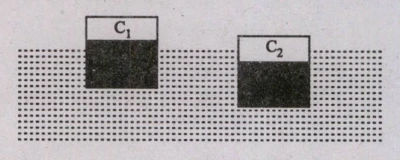
Shown in the figure are two hollow cubes and of negligible mass partially filled (depicted by darkened area) with liquids of densities and , respectively, floating in water (density ). The relationship between , and is

A tank of water drawn as a dotted region, with two square hollow cubes floating in it, C1 on the left and C2 on the right. Each cube has the lower part darkened to show the liquid in it. C1 sits higher: about the upper third of the cube is above the water surface, and the liquid level inside C1 is slightly above the water surface outside. C2 sits lower: only a small strip at the top is above the water surface, and the liquid level inside C2 is below the water surface outside. Both cubes are about the same size and both are about two-thirds filled.
Options
Show answer & solution

Option D

Why

The cubes have no mass, so each floats when the weight of its liquid equals the weight of water it pushes aside: . If the liquid inside stands higher than the water outside, , so . If it stands lower, .

Exam-hall approach

In C2 the liquid inside is below the outside water line, yet the cube sinks deeper than the liquid. So the liquid in C2 is heavier than water. Only D puts ρ2 above ρW.

Proof

: level inside above water ; : level inside below water

About the other options

Option A

Swaps the two cubes. floats high, with its liquid above the water line, so its liquid is lighter than water.

Option B

Puts below water. But sinks deeper than its own liquid, so .

Option C

Puts both liquids below water. sits below its own liquid level, so .

Ideal time: about 1 min
65Physics • Gravitation • Acceleration due to Gravity, Mass and Weight
Moderate

An astronaut whose weight on the Earth is 600 N experiences weightlessness on International Space Station orbiting around the Earth. It means that

Options
Show answer & solution

Option B

normal reaction of the space-station floor on the astronaut is zero

Why

The astronaut and the station fall around the Earth together, with the same acceleration. So the floor does not push on the astronaut. Weight felt is the push of the floor; with no push, the astronaut feels weightless. Gravity still acts and gives the circular motion.

Exam-hall approach

Gravity is what keeps the station in orbit, so it cannot be zero: this strikes C. Moving in a circle means accelerating: this strikes A.

Proof

NCERT Class 11 Physics, Ch. 7 (Gravitation), Weightlessness

About the other options

Option A

The astronaut moves in a circle, so there is a centripetal acceleration. It is about 90% of g at the station's height.

Option C

Gravity at the station is about 90% of its value on the ground. It provides the centripetal force that keeps the orbit.

Option D

Centrifugal force is a pseudo force seen only from inside the rotating station. The station does not apply it.

Ideal time: about 39 s
66Physics • Motion, Force and Laws of Motion • Newton's Laws and Conservation of Momentum
Easy

Which of the following statements give characteristics of contact forces ?

1
It appears between an object when it is in contact with some other object
2
It satisfies the third law of motion
3
It may appear between a pair of solid and fluid

Select the answer using the code given below :

Options
Show answer & solution

Option D

1, 2 and 3

Why

1 — Correct. A contact force arises only when two objects touch, as friction or a push does. 2 — Correct. Every force, contact or not, comes in an equal and opposite pair: the third law. 3 — Correct. A solid and a fluid can push on each other: buoyancy and viscous drag are contact forces.

Exam-hall approach

The third law holds for every force, so 2 is true. That strikes A. Buoyancy is a push by a fluid on a solid, so 3 is true. That strikes C.

About the other options

Option A

Leaves out statement 2, which is true: the third law applies to all forces.

Option B

Leaves out statement 1, which is true: it is the definition of a contact force.

Option C

Leaves out statement 3, which is true: buoyancy and viscous drag act between a solid and a fluid.

Ideal time: about 46 s
67Physics • Light and Optics • Refraction by Lenses
Easy

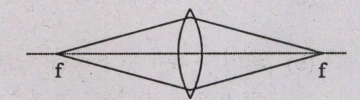
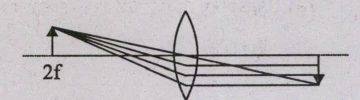
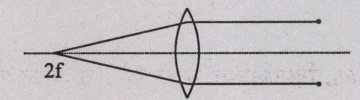
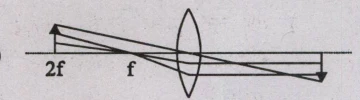
Which one among the following figures correctly represents the ray diagram ? (Consider the lens to be thin)

Option (a): a thin convex lens drawn as a vertical lens shape on a horizontal principal axis (dotted line). Two rays start from the point labelled f on the axis at the far left, spread out to the upper and lower parts of the lens, and after the lens come together at the point labelled f on the axis at the far right.
Option (b): a thin convex lens on a horizontal principal axis, with an upright object arrow at the left, its base on the axis at the point labelled 2f. Several rays from the tip of the arrow slope down and cross the axis before the lens at points that are not labelled. After the lens three of them run parallel to the axis at different heights below it, and one slopes down to the tip of an inverted arrow on the right, below the axis.
Option (c): a thin convex lens on a principal axis. Two rays start from the point labelled 2f on the axis at the left and spread out to the upper and lower parts of the lens. After the lens they run parallel to the axis, one above and one below it, each ending in a dot at the right.
Option (d): a thin convex lens on a principal axis, with the points 2f and f labelled on the left. An upright object arrow stands on the axis at 2f. One ray from its tip passes through the centre of the lens and goes straight on; rays from the arrow that pass through f leave the lens parallel to the axis, below it. The rays meet at the tip of an inverted arrow on the right, below the axis.
Options
Show answer & solution

Option D

Figure (d)

Why

For a thin convex lens, a ray from the object that passes through the focus f leaves the lens parallel to the axis, and a ray through the centre of the lens goes straight on. Where such rays meet is the image. Figure (d) draws exactly these rays, through f and through the centre, and they meet at a real, inverted image on the far side.

About the other options

Option A

Wrong: rays from the focus come out parallel to the axis. They do not meet at the other focus.

Option B

Wrong: several rays from the same point of the object leave the lens parallel to the axis. Only a ray through the focus does that, and parallel rays from one point can never meet at one image point.

Option C

Wrong: rays from 2f meet again at 2f on the far side. Rays leave parallel only when they start from f.

Ideal time: about 39 s
68Physics • Electricity • Electric Charges and Fields
Moderate

Lightning is due to

Options
Show answer & solution

Option D

The induction of positive charge on the ground below the negative charge at the base of the cloud

Why

In a thundercloud, negative charge gathers at the base and positive charge at the top. The negative base induces positive charge on the ground below it. When the charges become large, the air can no longer stop them, and the spark that jumps between cloud and ground is lightning. Lightning also happens inside a cloud, between its charged parts, so A can also be defended; this key is contestable.

Exam-hall approach

The base of a thundercloud is negative, not positive: this strikes C. B's "short-circuiting" is not a term the textbook uses for lightning.

Proof

NCERT Class 8 Science, Some Natural Phenomena, Lightning: negative charge near the lower edge of the cloud and positive charge near the ground

About the other options

Option A

Also defensible

Discharge between parts of the cloud is real: it is lightning inside a cloud. So A can also be defended. But the textbook account of a lightning strike is cloud-to-ground.

Option B

Charges do meet between the top and the base of a cloud, but "short-circuiting" is not how lightning is explained. The textbook account is the cloud base and the ground.

Option C

Reversed: the base of the cloud collects negative charge and the top collects positive charge.

Ideal time: about 42 s
69Physics • Electricity • Electric Current and Circuits
Easy

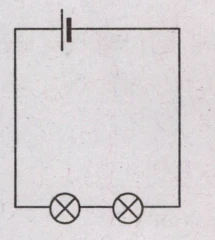
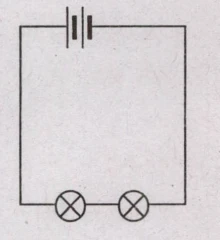
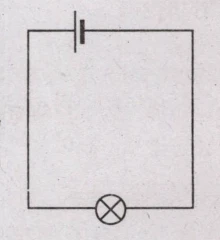
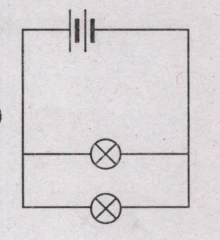
In which one among the following situations, the bulb ⊗ would glow the most ? (Consider all batteries are the same)

Option (a): a rectangular circuit with a single cell at the top and two bulbs in series on the bottom wire.
Option (b): a rectangular circuit with a battery of two cells in series at the top and two bulbs in series on the bottom wire.
Option (c): a rectangular circuit with a single cell at the top and one bulb on the bottom wire.
Option (d): a rectangular circuit with a battery of two cells in series at the top and two bulbs in parallel, one on the lower wire and one on a second wire just above it, both joined between the left and right sides.
Options
Show answer & solution

Option D

Figure (d)

Why

A bulb glows more when more power goes into it, and for each bulb. So the bulb with the largest voltage across it glows most. Take one cell as and each bulb as .

Exam-hall approach

In parallel, each bulb gets the full voltage of the battery. Figure (d) gives each bulb two cells' worth; no other figure does.

Proof

(a) ; (b) ; (c) ; (d) across each bulb , the largest

About the other options

Option A

One cell shared by two bulbs in series: each gets only half a cell's voltage, the dimmest of all.

Option B

Two cells, but shared by two bulbs in series: each gets one cell's voltage, the same as in (c).

Option C

One cell across one bulb: one cell's voltage, a quarter of the power in (d).

Ideal time: about 40 s
70Physics • Motion, Force and Laws of Motion • Kinematics
Moderate

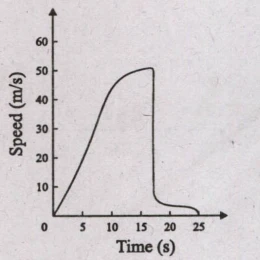
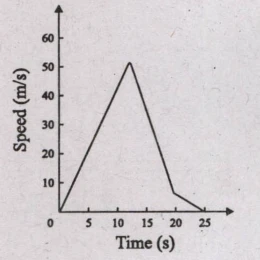
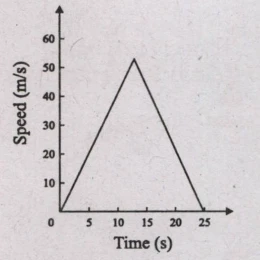
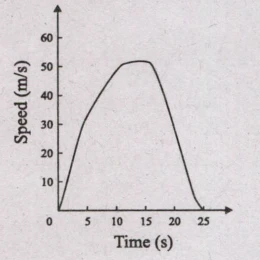
Which one among the following diagrams may correctly represent the motion of a skydiver during a jump ?

Option (a): a speed-time graph, speed (m/s) from 0 to 60 in steps of 10 on the vertical axis and time (s) from 0 to 25 in steps of 5 on the horizontal axis. A smooth curve rises from 0, bending over, to about 50 m/s at about 16 s, then drops almost vertically to about 5 m/s at about 17 s, and then declines slowly to about 2 m/s by 25 s.
Option (b): a speed-time graph with the same axes. A straight line rises from 0 to a peak of about 51 m/s at about 12 s, then a straight line falls steeply to about 7 m/s at about 20 s, and a shallower straight line then falls to 0 at about 25 s.
Option (c): a speed-time graph with the same axes. A straight line rises from 0 to a peak of about 53 m/s at about 13 s, then a straight line falls back to 0 at 25 s, forming a triangle.
Option (d): a speed-time graph with the same axes. A curve rises steeply from 0 to about 30 m/s at about 4 s, then more gently to about 51 m/s at about 12 s, stays nearly level at about 51 m/s until about 16 s, then falls steeply to about 5 m/s at about 24 s and reaches 0 at 25 s.
Options
Show answer & solution

Option A

Figure (a)

Why

A skydiver speeds up fast at first. As speed grows, air drag grows, so the speed rises more and more slowly towards a top (terminal) speed. When the parachute opens, drag jumps, and the speed falls sharply within a second or two. It then settles at a new, low terminal speed for the rest of the fall. Only figure (a) shows the sharp drop followed by a low, nearly steady speed.

Exam-hall approach

A straight-line rise means constant acceleration, which drag rules out: this strikes B and C. A parachute descent lasts at a low steady speed, not a long slide to zero.

Proof

Terminal velocity: drag grows with speed until it equals weight. NCERT Class 11 Physics, Ch. 9 (Mechanical Properties of Fluids), Terminal Velocity

About the other options

Option B

Straight-line rise means constant acceleration with no drag. Speed then falls to zero instead of settling at a low steady speed.

Option C

A triangle: constant acceleration up, then a steady slowdown to zero. It shows neither terminal speed nor a parachute opening.

Option D

The level part looks like terminal speed, but after the parachute opens the speed keeps falling for 8 s straight to zero. There is no low steady speed under the parachute.

Ideal time: about 45 s
71Physics • System of Particles and Rotational Motion • Levers and Simple Machines
Easy

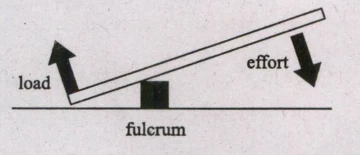
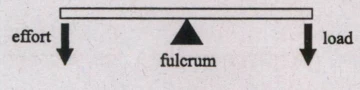
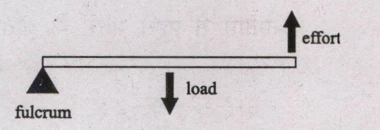
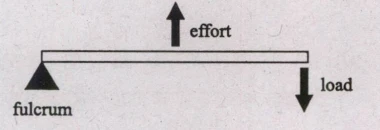
Which one of the following sketches correctly describes a lever of second class ?

Option (a): a bar tilted up to the right, resting on a black fulcrum block under it near its middle, labelled fulcrum. A thick arrow at the lower-left end points upwards, labelled load. A thick arrow at the raised right end points downwards, labelled effort.
Option (b): a horizontal bar with a triangular fulcrum under its middle, labelled fulcrum. A downward arrow at the left end is labelled effort, and a downward arrow at the right end is labelled load.
Option (c): a horizontal bar with a triangular fulcrum under its left end, labelled fulcrum. A downward arrow under the middle of the bar is labelled load, and an upward arrow at the right end is labelled effort.
Option (d): a horizontal bar with a triangular fulcrum under its left end, labelled fulcrum. An upward arrow at the middle of the bar is labelled effort, and a downward arrow at the right end is labelled load.
Options
Show answer & solution

Option C

Figure (c)

Why

In a second-class lever, the load is between the fulcrum and the effort. Examples: a wheelbarrow and a nutcracker.

Exam-hall approach

Remember the middle thing: class I fulcrum, class II load, class III effort. Only (c) has the load in the middle.

Proof

Classes of levers by the middle element: I fulcrum, II load, III effort. Selina Concise Physics Class 10, Ch. 3 (Machines)

About the other options

Option A

Fulcrum in the middle: a first-class lever, like a see-saw.

Option B

Fulcrum in the middle: a first-class lever, like a pair of scissors.

Option D

Effort in the middle: a third-class lever, like tongs or the human forearm.

Ideal time: about 22 s
72Physics • Electricity • Resistance and Combination of Resistors
Easy

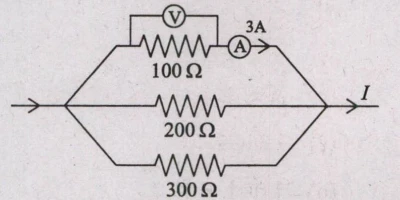
For an electric circuit given below, the correct combination of voltage (V) and current (I) is

Three branches in parallel between a left junction and a right junction. The current I enters at the left (arrow pointing in) and leaves at the right (arrow pointing out, labelled I). Top branch: a 100Ω resistor with a voltmeter V connected across it, in series with an ammeter A that reads 3A. Middle branch: a 200Ω resistor. Bottom branch: a 300Ω resistor.
Options
Show answer & solution

Option B

V = 300 V; I = 5.5 A

Why

Ohm's law, . The three branches are in parallel, so all have the same voltage. The total current is the sum of the branch currents.

Exam-hall approach

The total current must be more than the 3 A in one branch alone: this strikes C and D. The voltmeter is across the 100 Ω resistor, so V = 3 × 100 = 300 V: this strikes A.

Proof

V; A

About the other options

Option A

Takes for the voltmeter's resistor: V. The current 18 A follows from no correct step.

Option C

Takes for the voltmeter's resistor: V. 1 A is only the current in the branch.

Option D

The voltage is right, but 2 A is less than the 3 A in one branch alone. The total must be 5.5 A.

Ideal time: about 1 min
73History • Mahajanapadas and the Mauryas
Easy

Taxila was the capital of which one among the following Mahajanapadas of ancient India ?

Options
Show answer & solution

Option C

Gandhar

Why

Taxila (Takshashila) was the capital of Gandhara, in the north-west, in present-day Pakistan. It was also a famous centre of learning.

Proof

Lucent's General Knowledge, Ancient History: the sixteen Mahajanapadas and their capitals

About the other options

Option A

Kuru's capital was Indraprastha, near present-day Delhi.

Option B

Kasi's capital was Varanasi.

Option D

Avanti's capital was Ujjayini (Ujjain), with Mahishmati in the south.

Ideal time: about 12 s
74History • Post-Independence India
Moderate

Who among the following was the last Governor-General of India before the office was permanently abolished ?

Options
Show answer & solution

Option B

Chakravarti Rajagopalachari

Why

C. Rajagopalachari was Governor-General from June 1948 to 26 January 1950. He was the first and only Indian to hold the post. The office ended when the Constitution came into force and the President became head of state.

Proof

C. Rajagopalachari, Governor-General 1948–1950; the office ended on 26 January 1950. NCERT Class 12 Politics in India since Independence, Ch. 1

About the other options

Option A

Lord Mountbatten was the last Viceroy and the first Governor-General of free India (1947–48). Hook: Mountbatten first, Rajaji last.

Option C

Lord Wavell was Viceroy from 1943 to 1947, before independence.

Option D

Lord Linlithgow was Viceroy from 1936 to 1943, the longest-serving Viceroy.

Ideal time: about 21 s
75Economy • Economic Planning
Easy

Which among the following is/are the objective(s) of setting up of Planning Commission in the 1950s in India ?

1
To increase production and offering opportunities to all for employment
2
To make assessment of all resources of the country

Select the answer using the code given below :

Options
Show answer & solution

Option C

Both 1 and 2

Why

1 — Correct. The 1950 resolution aimed to raise living standards by increasing production and offering everyone opportunities for employment. 2 — Correct. The Commission's first task was to assess the material, capital and human resources of the country.

About the other options

Option A

Leaves out statement 2, which is true: assessing the country's resources was its first listed task.

Option B

Leaves out statement 1, which is true: higher production and employment for all were named aims.

Option D

Both statements are aims named in the 1950 resolution that set up the Commission.

Ideal time: about 36 s
76Economy • Economic Planning • Five-Year Plans and their Themes
Moderate

Which among the following statements with regard to Five Year Plans in India is/are correct ?

1
The First and Ninth five year plans accorded high priority to agriculture
2
The Third Plan was based on the Harrod-Domar Model
3
Seventh Plan focused on food, work and productivity
4
The Ninth five year plan emphasized on massive investments in public sector

Select the answer using the code given below :

Options
Show answer & solution

Option B

1 and 3

Why

1 — Correct. The First Plan (1951–56) put agriculture first after the food shortages of partition. The Ninth Plan (1997–2002) gave priority to agriculture and rural development. 2 — Not correct. The First Plan was based on the Harrod-Domar model. The Second Plan used the Mahalanobis model. 3 — Correct. The Seventh Plan (1985–90) had the slogan "food, work and productivity". 4 — Not correct. Heavy public-sector investment marks the Second Plan. The Ninth Plan came after the 1991 reforms and gave more room to the private sector.

Exam-hall approach

Harrod-Domar is the First Plan's model, a common fact: 2 is false, which strikes D. The Ninth Plan came after the 1991 reforms, so 4 is false: this strikes C. "Food, work and productivity" for the Seventh Plan then decides between A and B.

About the other options

Option A

Leaves out statement 3, which is true: "food, work and productivity" was the Seventh Plan's focus.

Option C

Contains statement 4, which is false: massive public-sector investment marks the Second Plan.

Option D

Contains statements 2 and 4, which are false: Harrod-Domar is the First Plan's model, and public-sector stress marks the Second.

Ideal time: about 1 min
77Economy • Economic Planning
Moderate

Before the inception of the First Five year Plan, which among the following Plans were initiated in India ?

1
Bombay Plan
2
Peoples Plan
3
Sarvodaya Plan
4
Gandhian Plan

Select the answer using the code given below :

Options
Show answer & solution

Option D

1, 2, 3 and 4

Why

1 — Correct. The Bombay Plan was put forward by leading industrialists in 1944. 2 — Correct. The People's Plan was drawn up by M.N. Roy in 1945. 3 — Correct. The Sarvodaya Plan was put forward by Jayaprakash Narayan in January 1950. 4 — Correct. The Gandhian Plan was drawn up by S.N. Agarwal in 1944. The First Five Year Plan began in 1951, after all four.

Exam-hall approach

Bombay, Gandhian and People's Plans all came in the 1940s, which strikes A, B and C, since each leaves out at least one of them.

About the other options

Option A

Leaves out the Sarvodaya Plan (1950) and the Gandhian Plan (1944), both before 1951.

Option B

Leaves out the People's Plan (1945) and the Gandhian Plan (1944), both before 1951.

Option C

Leaves out the Bombay Plan (1944) and the People's Plan (1945), both before 1951.

Ideal time: about 48 s
78Geography • Agriculture in India • Land Resources and Land-Use Categories
Easy

Any land that is left fallow for more than five years is termed as

Options
Show answer & solution

Option C

Culturable waste land

Why

Land left uncultivated for more than five years is culturable waste land. It could be farmed after it is improved.

Proof

NCERT Class 12 India: People and Economy, Land Resources and Agriculture: "Any land which is left fallow (uncultivated) for more than five years is included in this category."

About the other options

Option A

Current fallow is land left uncultivated for one year or less.

Option B

Fallow other than current fallow is land left uncultivated for one to five years. More than five years makes it culturable waste land.

Option D

Barren and waste land cannot be farmed at all with present technology, such as bare rock or desert. It is not about how long the land lay fallow.

Ideal time: about 17 s
79Geography • Physiography of India
Easy

Which statement is NOT correct with reference to Andaman and Nicobar Islands ?

Options
Show answer & solution

Option B

Maximum rainfall occurs between March and April

Why

The Andaman and Nicobar Islands get most of their rain from the south-west monsoon (May to September) and more from the north-east monsoon (October to December). March and April are the driest months.

Exam-hall approach

Indian rainfall peaks with the monsoon, not in March and April. The other three are standard facts about the islands.

Proof

NCERT Class 11 India: Physical Environment, Climate: rainfall seasons of India

About the other options

Option A

Correct, so not the answer: the islands are near the equator and surrounded by sea, so the climate is hot and humid.

Option C

Correct, so not the answer: the Ten Degree Channel, about 150 km wide, separates Little Andaman from Car Nicobar.

Option D

Correct, so not the answer: the Jarawa, Onge, Sentinelese and Great Andamanese are Negrito tribes.

Ideal time: about 41 s
80Geography • Atmosphere, Weather and Climate • Winds, Pressure Belts and the Coriolis Force
Easy

Which one among the following local winds is NOT related to Mediterranean Sea ?

Options
Show answer & solution

Option A

Harmattan

Why

The Harmattan is a dry, dusty wind from the Sahara that blows south-west to the Guinea coast of West Africa. It is called the "doctor" there because it brings relief from humid heat. It does not blow to or from the Mediterranean.

Proof

G.C. Leong, Certificate Physical and Human Geography: local winds

About the other options

Option B

Khamsin is a hot, dusty wind blowing from the Sahara across Egypt towards the Mediterranean.

Option C

Sirocco is a hot wind from the Sahara that crosses the Mediterranean to Italy and Sicily.

Option D

Mistral is a cold wind blowing down the Rhone valley in France to the Mediterranean coast.

Ideal time: about 16 s