Skip to content

General Ability Test 2023 (II)

Set A

Questions 101–120 of 150

101History • Vijayanagara and Bahmani Kingdoms
Moderate

Consider the following statements regarding the royal center in Vijayanagara Empire :

1
The royal center was located in the south-western part of the settlement
2
It included over 60 temples
3
About 30 building complexes at the site have been identified as palaces

Which of the statements given above is/are correct ?

Options
Show answer & solution

Option C

1, 2 and 3

Why

1 — Correct. The royal centre lay in the south-western part of the settlement. 2 — Correct. Though called the royal centre, it included over 60 temples. 3 — Correct. About 30 building complexes there have been identified as palaces.

Exam-hall approach

All three are the opening lines of one NCERT section. A candidate who knows any two of them still needs the third, since every option leaving one out is a different code.

Proof

NCERT Class 12 Themes in Indian History Part II, An Imperial Capital: Vijayanagara (The Royal Centre)

About the other options

Option A

Leaves out statements 2 and 3, which are also correct.

Option B

Leaves out statements 1 and 3, which are also correct.

Option D

Leaves out statement 3. About 30 complexes have been identified as palaces.
Ideal time: about 53 s
102Geography • Political Geography of India • States and their Boundaries
Easy

Which one of the following statements is NOT correct ?

Options
Show answer & solution

Option A

Area wise Madhya Pradesh is the fourth largest state in India

Why

By area Madhya Pradesh is the second largest state of India, after Rajasthan. So calling it the fourth largest is not correct.

Exam-hall approach

The Hornbill festival of Nagaland and Telangana's Deccan location are well known, so B and D are true. Madhya Pradesh is famous as the second largest state, which makes A the false one.

Proof

Census of India, area of states: Rajasthan, Madhya Pradesh, Maharashtra, Uttar Pradesh in order

About the other options

Option B

Correct: the Hornbill festival is held in Nagaland every December.

Option C

Correct as an approximate figure: Gujarat's share of national GDP is about 8 per cent.

Option D

Correct: Telangana lies on the Deccan plateau in the middle of the peninsula.

Ideal time: about 34 s
103Geography • Soils and Natural Vegetation of India • Soil Types of India
Very easy

Which one of the following soils is ideal for growing cotton ?

Options
Show answer & solution

Option A

Regur soil

Why

Regur is the black soil of the Deccan lava plateau. It holds moisture well and is rich in lime, potash and magnesium, so it is called black cotton soil.

Proof

NCERT Class 10 Contemporary India II, Resources and Development (Black soil)

About the other options

Option B

Laterite soil is leached and poor; it suits cashew, tea and coffee.

Option C

Desert soil is sandy and holds little water; it suits crops only with irrigation.

Option D

Mountain soil suits tea, coffee, spices and fruit on slopes.

Ideal time: about 13 s
104History • Buddhism, Jainism and Other Sects
Moderate

Where is Central Institute of Buddhist Studies situated ?

Options
Show answer & solution

Option A

Leh

Why

The Central Institute of Buddhist Studies is at Choglamsar, near Leh in Ladakh. It is a deemed university under the Ministry of Culture.

Proof

Central Institute of Buddhist Studies, Choglamsar, Leh (Ministry of Culture)

About the other options

Option B

Kullu in Himachal Pradesh is not the site; Himachal's best-known Tibetan centre is Dharamshala.

Option C

Almora in Uttarakhand has no such institute.

Option D

Gangtok has the Namgyal Institute of Tibetology, which is a different body.

Ideal time: about 11 s
105Geography • Physiography of India
Moderate

Consider the following statements about physical features of India :

1
The southern point of the Peninsular Plateau is formed by the Nilgiri Hills where the Eastern and the Western Ghats meet
2
The Cardamom Hills may be regarded as a continuation of the Eastern Ghats

Which of the statements given above is/are correct ?

Options
Show answer & solution

Option D

Neither 1 nor 2

Why

1 — Not correct. The Eastern and Western Ghats do meet at the Nilgiri Hills, but the plateau runs further south. Its southern end is the Cardamom Hills. 2 — Not correct. The Cardamom Hills are a continuation of the Western Ghats, not the Eastern Ghats. The key turns on 'southern point' in statement 1, so it is contestable for a candidate who reads it as the meeting point of the Ghats.

Exam-hall approach

The Cardamom Hills lie in Kerala, along the west coast, so they belong with the Western Ghats. That makes 2 false and strikes B and C. Statement 1 then decides between A and D.

Proof

NCERT Class 11 India: Physical Environment, Structure and Physiography (The Peninsular Plateau)

About the other options

Option A

Statement 1 is half right: the Ghats meet at the Nilgiris, but the plateau extends south to the Cardamom Hills.

Option B

Contains statement 2. The Cardamom Hills continue the Western Ghats.

Option C

Contains statement 2, which is false.

Ideal time: about 44 s
106Geography • Physiography of India
Easy

Which one of the following is the narrow belt parallel to the Shiwalik foothills where streams and rivers coming from the mountains deposit heavy materials of rocks and boulders ?

Options
Show answer & solution

Option C

Bhabar

Why

Bhabar is a narrow belt, about 8–16 km wide, along the foot of the Shiwaliks. Rivers coming down from the mountains drop their pebbles and boulders here, and the streams sink and disappear into it.

Proof

NCERT Class 9 Contemporary India I, Physical Features of India (The Northern Plains)

About the other options

Option A

The Tarai lies just south of the Bhabar. There the streams come up again and form a wet, marshy, forested belt.

Option B

Bhangar is the older alluvium of the plains, lying above the flood level of the rivers.

Option D

Khadar is the newer alluvium on the floodplains, renewed each year by floods.

Ideal time: about 21 s
107Geography • World Economic Geography
Easy

Which of the following statements about Suez Canal is/are correct ?

1
Suez is a man-made navigation canal
2
Suez links Mediterranean Sea and the Red Sea
3
The economic significance of Suez Canal is less than that of Panama Canal

Select the correct answer using the code given below :

Options
Show answer & solution

Option B

1 and 2 only

Why

1 — Correct. The Suez Canal was dug by people; it opened in 1869. 2 — Correct. It joins the Mediterranean Sea at Port Said with the Red Sea at Port Suez. 3 — Not correct. The Suez Canal is more important to world trade; NCERT says the Panama Canal's economic significance is relatively less than that of Suez.

Proof

NCERT Class 12 Fundamentals of Human Geography, Transport and Communication (Shipping canals)

About the other options

Option A

Leaves out statement 2. The canal does link the Mediterranean and the Red Sea.

Option C

Contains statement 3. The Suez Canal is more important to world trade than the Panama Canal.

Option D

Contains statement 3, which is false.

Ideal time: about 48 s
108Physics • Properties of Matter • Buoyancy and Archimedes' Principle
Easy

An iron nail sinks in water whereas an iron ship floats. Which of the following statements is correct in this regard ?

1
Average density of ship is greater than that of the water
2
Average density of iron nail is greater than that of the water
3
Average density of the ship is less than that of the water
4
Average density of the ship is equal to that of the water

Select the correct answer using the code given below :

Options
Show answer & solution

Option B

2 and 3

Why

1 — Not correct. If the ship's average density were greater than water's, it would sink. 2 — Correct. Iron is about 7.8 times as dense as water, so the solid nail sinks. 3 — Correct. The ship is hollow and mostly air inside, so its average density is less than water's and it floats. 4 — Not correct. Equal density would leave the ship fully under water, just hanging there, not floating at the surface.

Proof

NCERT Class 9 Science, Gravitation (Archimedes' principle; relative density)

About the other options

Option A

Contains statement 1. A ship denser on average than water would sink.

Option C

Contains statement 4. A body of the same average density as water stays fully under water.

Option D

Contains statements 1 and 4, both false.

Ideal time: about 1 min
109Physics • Electricity • Resistance and Combination of Resistors
Easy

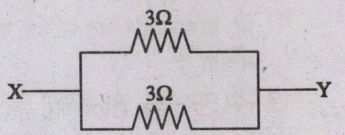
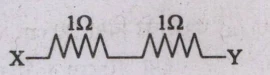
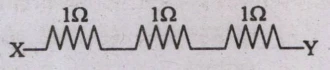
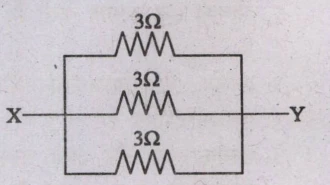
Which of the following arrangement of resistors offers minimum effective resistance between points X and Y ?

The circuit printed as option (a). Terminal X on the left and terminal Y on the right. Between them, three resistors, each labelled 3Ω, are connected in parallel (three separate branches between the same two junctions).
The circuit printed as option (b). Terminal X on the left and terminal Y on the right. Between them, two resistors, each labelled 3Ω, are connected in parallel (two branches between the same two junctions).
The circuit printed as option (c). Terminal X on the left and terminal Y on the right. Two resistors, each labelled 1Ω, are connected in series between X and Y.
The circuit printed as option (d). Terminal X on the left and terminal Y on the right. Three resistors, each labelled 1Ω, are connected in series between X and Y.
Options
Show answer & solution

Option A

Circuit (a)

Why

Resistors in series add: . Equal resistors in parallel give . Circuit (a) gives , (b) , (c) and (d) .

Exam-hall approach

A series total is at least as large as one resistor, so (c) and (d) give at least 2 ohms. Between the parallel pairs, three branches beat two, since more paths mean less resistance.

Proof

, , ,

About the other options

Option B

Two in parallel give , more than the three in parallel.

Option C

Two in series give . Small resistors, but series adds them.

Option D

Three in series give , the largest of the four.

Ideal time: about 40 s
110Physics • Magnetism and Electromagnetism • Magnetic Effects of Electric Current
Easy

What will happen if a collection of positive and negative charges are passed at a high speed through a magnetic field which is perpendicular to the direction of motion of the charges ? (Assume that both kind of charges are NOT going to recombine)

Options
Show answer & solution

Option B

Positive charges and negative charges will separate out

Why

A charge moving across a magnetic field feels a force , at right angles to both the motion and the field. Its direction depends on the sign of . So positive charges are pushed one way and negative charges the other, and the two kinds separate.

Proof

NCERT Class 12 Physics, Moving Charges and Magnetism (Magnetic force on a moving charge)

About the other options

Option A

The magnetic force is at right angles to the motion, so it changes the direction, not the speed. Nothing stops.

Option C

The force acts on both kinds of charge. It does not stop either.

Option D

A field perpendicular to the motion does deflect the charges. They would move on undisturbed only in a field parallel to their motion.

Ideal time: about 42 s
111Physics • Motion, Force and Laws of Motion • Newton's Laws and Conservation of Momentum
Easy

The motion of a particle of mass is described by the relation, , where is the initial velocity of the particle. The force acting on the particle is

Options
Show answer & solution

Option D

Why

Force is mass times acceleration, and acceleration is the second derivative of position. Here is measured upward and is a constant initial velocity. So and , giving : the weight, acting downward.

Exam-hall approach

The relation is the motion of a body thrown upward, so the only force is its weight, downward. With upward positive, that force is negative.

Proof

About the other options

Option A

is a constant, the initial velocity, so and this gives no force at all.

Option B

Has the right size but the wrong sign. With y measured upward, the downward weight is negative.

Option C

is the momentum, not the force. Force needs one more derivative.

Ideal time: about 42 s
112Physics • Properties of Matter • Thrust and Pressure
Easy

A block of wood (dimensions : 40 cm × 20 cm × 10 cm) is kept on a tabletop in three different positions : (a) with its side of dimensions 20 cm × 10 cm; (b) with its side of dimensions 10 cm × 40 cm; and (c) with its side of dimensions 40 cm × 20 cm. The pressure exerted by the wooden block on the tabletop in these positions is represented by PA, PB and PC, respectively. The pressure follows the trend

Options
Show answer & solution

Option A

PA > PB > PC

Why

Pressure is force divided by area, . The weight is the same in every position, so the pressure is largest where the area in contact is smallest.

Exam-hall approach

The face in (a) is the smallest and the face in (c) the largest. The block presses hardest on the smallest face, so the pressures run (a) > (b) > (c).

Proof

, so

About the other options

Option B

Inverts the relation: it takes pressure to grow with area. Pressure falls as the area grows.

Option C

Ignores the area. The weight is the same, but it is spread over different areas.

Option D

Faces (b) and (c) have different areas, 400 and 800 square centimetres, so their pressures cannot be equal.

Ideal time: about 1 min
113Chemistry • Metals and Metallurgy • Occurrence and Extraction of Metals
Easy

Which one of the following metals can be extracted using carbon as reducing agent ?

Options
Show answer & solution

Option A

Zinc

Why

Zinc is in the middle of the activity series. Its oxide is reduced to zinc by heating with carbon (coke). Metals at the top, like aluminium, are too reactive for carbon to reduce, and metals at the bottom, like silver and gold, need no reduction by carbon.

Proof

NCERT Class 10 Science, Metals and Non-metals (Extracting metals in the middle of the activity series)

About the other options

Option B

Silver is low in the activity series. It is found free or extracted from its ores without carbon reduction.

Option C

Gold is found free in nature, as a native metal.

Option D

Aluminium is more reactive than carbon. It is extracted by electrolysis of molten alumina.

Ideal time: about 16 s
114Chemistry • States of Matter • Mixtures, Solutions and Colloids
Moderate

Which among the following is NOT true with respect to colloidal solution ?

Options
Show answer & solution

Option B

Colloidal solution is homogenous in nature

Why

A colloid is a heterogeneous mixture. It looks homogeneous because its particles are too small to see, but they are bigger than in a true solution. So calling it homogeneous is not true.

Proof

NCERT Class 9 Science, Is Matter Around Us Pure? (Colloidal solution)

About the other options

Option A

True: NCERT says the particles of a colloid are uniformly spread throughout the solution.

Option C

True: the particles are big enough to scatter a beam of light, which is the Tyndall effect.

Option D

True: colloids are stable and do not settle when left undisturbed.

Ideal time: about 24 s
115Chemistry • States of Matter • Mixtures, Solutions and Colloids
Easy

Kerosene and petrol mixture can be best separated by

Options
Show answer & solution

Option C

Fractional distillation

Why

Kerosene and petrol mix completely and boil at temperatures not far apart. Mixed liquids whose boiling points differ by less than 25 K are separated by fractional distillation.

Proof

NCERT Class 9 Science, Is Matter Around Us Pure? (Fractional distillation)

About the other options

Option A

Sublimation separates a solid that turns straight to vapour, like camphor or ammonium chloride.

Option B

A separating funnel separates liquids that do not mix, like kerosene and water. Kerosene and petrol do mix.

Option D

Compressing and cooling turns gases into liquids, as in separating the gases of air.

Ideal time: about 15 s
116Chemistry • Atomic Structure • Atomic Models
Moderate

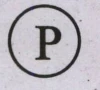
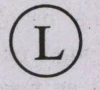
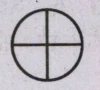
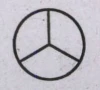
As proposed by Dalton, which of the following symbol represents phosphorus ?

The symbol printed as option (a): a circle with the capital letter P inside it.
The symbol printed as option (b): a circle with the capital letter L inside it.
The symbol printed as option (c): a circle divided into four equal parts by a vertical and a horizontal line crossing at the centre (a circle with a plus sign inside).
The symbol printed as option (d): a circle divided into three equal parts by three lines running from the centre to the circumference (a Y-shaped, three-spoke wheel).
Options
Show answer & solution

Option D

Symbol (d)

Why

Dalton drew each element as a circle with its own mark. His symbol for phosphorus is a circle cut into three parts by lines from the centre, like a three-spoke wheel. That is symbol (d).

Exam-hall approach

Dalton used letters inside circles only for metals: L is lead and P is platinum. That strikes (a) and (b). The circle with a cross is sulphur, which leaves (d).

Proof

NCERT Class 9 Science, Atoms and Molecules (Symbols for some elements as proposed by Dalton)

About the other options

Option A

A circle with P is Dalton's symbol for platinum, not phosphorus.

Option B

A circle with L is Dalton's symbol for lead.

Option C

A circle with a cross inside is Dalton's symbol for sulphur.

Ideal time: about 18 s
117Chemistry • Carbon and its Compounds • Covalent Bonding and Properties of Carbon Compounds
Easy

Which among the following statements with respect to carbon is/are correct ?

1
Carbon forms the basis for all living organisms and many things we use
2
Carbon shows tetra-valency and the property of catenation
3
Carbon forms covalent bonds with itself and other elements
4
Carbon forms compounds containing triple and tetra bonds between carbon atoms

Select the correct answer using the code given below :

Options
Show answer & solution

Option C

1, 2 and 3

Why

1 — Correct. Carbon compounds form the basis of all living things and of food, fuels, clothes and medicines. 2 — Correct. Carbon has a valency of four (tetravalency) and links to other carbon atoms in long chains (catenation). 3 — Correct. Carbon shares electrons, forming covalent bonds with itself and with hydrogen, oxygen, nitrogen and other elements. 4 — Not correct. Carbon atoms form single, double and triple bonds, but never a quadruple ('tetra') bond.

Exam-hall approach

A 'tetra bond' between two carbon atoms is the odd claim; triple is the highest. Striking 4 removes D, and 1, 2 and 3 are textbook lines.

Proof

NCERT Class 10 Science, Carbon and its Compounds (Versatile nature of carbon)

About the other options

Option A

Leaves out statements 2 and 3, which are also correct.

Option B

Leaves out statement 3. Carbon does form covalent bonds with itself and other elements.

Option D

Contains statement 4. Carbon forms at most triple bonds, never tetra (quadruple) bonds.

Ideal time: about 58 s
118History • Harappan Civilisation • Agriculture and Irrigation in the Harappan Civilisation
Easy

Consider the following statements :

1
Terracotta models of the plough have been found at sites in Cholistan and at Banawali (Haryana).
2
There is evidence of a ploughed field at Kalibangan associated with the mature phase of the Harappan civilization.
3
The ploughed field at Kalibangan had two sets of furrows crossing at right angles to each other suggesting two different crops were grown together in it.

Which of the statements given above are correct ?

Options
Show answer & solution

Option C

1 and 3 only

Why

1 — Correct. Terracotta models of the plough have been found in Cholistan and at Banawali in Haryana. 2 — Not correct. The ploughed field at Kalibangan belongs to the Early Harappan levels, not the mature phase. 3 — Correct. Its two sets of furrows cross at right angles, which suggests two crops were grown together.

Exam-hall approach

Statements 1 and 3 are the textbook lines about the plough and the furrows. Holding either as true strikes D, and then statement 2 alone decides between A and C.

Proof

NCERT Class 12 Themes in Indian History Part I, Bricks, Beads and Bones (Agricultural technologies)

About the other options

Option A

Contains statement 2. The Kalibangan field is Early Harappan, not mature Harappan.

Option B

Contains statement 2, which is false, and leaves out statement 1, which is correct.

Option D

Statements 1 and 3 are both correct.

Ideal time: about 54 s
119History • World History • Industrial Revolution
Moderate

Which of the following statements about the technological innovations during the Industrial Revolutions are correct ?

1
Mule was the nickname for a machine invented in 1779, that allowed the spinning of strong and fine yarn.
2
Water Frame, invented in 1769 by Richard Arkwright, made it possible to weave pure cotton clothes.
3
Power loom, invented by Edmund Cartwright in 1787, could be used to weave any kind of materials.

Select the correct answer using the code given below :

Options
Show answer & solution

Option B

1, 2 and 3

Why

1 — Correct. Samuel Crompton's 'mule' of 1779 spun thread that was both strong and fine. 2 — Correct. Richard Arkwright's water frame of 1769 made a much stronger thread, so pure cotton cloth could be woven. 3 — Correct. Edmund Cartwright's power loom of 1787 was easy to use and could weave any kind of material.

Exam-hall approach

All three statements give the inventor and year exactly as the textbook does. A candidate sure of any two still needs the third, since each option leaving one out is a different code.

Proof

NCERT Class 11 Themes in World History, The Industrial Revolution (Cotton spinning and weaving)

About the other options

Option A

Leaves out statement 3. Cartwright's power loom could weave any material.

Option C

Leaves out statement 1. Crompton's mule of 1779 spun strong, fine yarn.

Option D

Leaves out statements 1 and 2, which are also correct.

Ideal time: about 55 s
120Economy • Economic Planning
Easy

Who among the following is known as the architect of Indian planning ?

Options
Show answer & solution

Option C

P.C. Mahalanobis

Why

P.C. Mahalanobis is called the architect of Indian planning. He built the model on which the Second Five Year Plan was based.

Proof

NCERT Class 11 Indian Economic Development, Indian Economy 1950–1990 (box on Mahalanobis)

About the other options

Option A

V.K.R.V. Rao was an economist known for the first estimates of India's national income.

Option B

Sukhamoy Chakravarty was an economist and member of the Planning Commission in the 1970s and 1980s.

Option D

John Mathai was India's Finance Minister who presented the first Budget of the Republic in 1950.

Ideal time: about 14 s