Skip to content

General Ability Test 2023 (II)

Set A

Questions 41–60 of 150

41English • Vocabulary • Antonyms
Moderate

Directions : Each item in this section consists of a sentence with an underlined word followed by four words. Select the option that is opposite in meaning to the underlined word and mark your response in your Answer Sheet accordingly.

Many metals are malleable in nature and property.

Options
Show answer & solution

Option A

hard

Why

Malleable, said of metals, means able to be hammered or pressed into shape without breaking: soft and workable. The opposite is hard, unable to be shaped.

Proof

Many metals are hard in nature and property.

About the other options

Option B

strong: not easily broken. A malleable metal can also be strong, so this is not its opposite.

Option C

tender: soft; closer to a synonym than an opposite.

Option D

weak: easily broken; malleability is about shaping, not weakness.
Ideal time: about 14 s
42English • Vocabulary • Antonyms
Very easy

Same directions as Q41

To neglect a warning is to invite danger.

Options
Show answer & solution

Option C

regard

Why

Neglect here means to pay no attention to a warning. The opposite is regard, to pay attention to it.

Proof

To regard a warning is to avoid danger.

About the other options

Option A

disregard: a synonym of the word, not its opposite.

Option B

ignore: a synonym of the word, not its opposite.

Option D

overlook: a synonym of the word, not its opposite.

Ideal time: about 9 s
43English • Vocabulary • Antonyms
Moderate

Same directions as Q41

His ostentatious behaviour surprised everyone.

Options
Show answer & solution

Option B

modest

Why

Ostentatious means showy, done to attract attention and impress others. The opposite is modest, not showing off.

Proof

His modest behaviour surprised everyone.

About the other options

Option A

tawdry: cheap and showy; a near synonym of the word, not its opposite.

Option C

gaudy: too bright and showy; a synonym of the word, not its opposite.

Option D

apparent: clearly seen; related to 'showing', not the opposite.

Ideal time: about 8 s
44English • Vocabulary • Antonyms
Easy

Same directions as Q41

The experience of Covid Pandemic was excruciating for much of the population.

Options
Show answer & solution

Option D

mild

Why

Excruciating means extremely painful. The opposite is mild, gentle and not severe.

Proof

The experience of Covid Pandemic was mild for much of the population.

About the other options

Option A

gnawing: causing steady pain or worry; a synonym of the word, not its opposite.

Option B

gruelling: very tiring and hard; a synonym of the word, not its opposite.

Option C

harrowing: very distressing; a synonym of the word, not its opposite.

Ideal time: about 10 s
45English • Vocabulary • Antonyms
Very easy

Same directions as Q41

A trip to the hills was refreshing.

Options
Show answer & solution

Option B

wearying

Why

Refreshing means giving new energy. The opposite is wearying, making one tired.

Proof

A trip to the hills was wearying.

About the other options

Option A

conniving: secretly planning something wrong; unrelated.

Option C

revivifying: giving new life; a synonym of the word, not its opposite.

Option D

rejuvenating: making one feel young again; a synonym of the word, not its opposite.

Ideal time: about 9 s
46English • Reading Comprehension • Stated Detail
Easy

Directions : Carefully read the given passage and answer the questions that follow. You are required to select your answers solely based on the contents of the passage and the opinion of the author only.

People by and large are concerned with and pursue self-interest. They are unlikely to be motivated to use renewable resources in a prudent and sustainable fashion. They are unlikely to be motivated under the following conditions : if their resource catchments are vast, so that degradation of any particular portion affects them very little; or if they have open before them possibilities of substitution as any one resource element is depleted; or if their control over the resource base is tenuous, so that others may, at any time, deplete a resource they value, even if they use it in a restrained fashion. Indeed, exhaustive use is highly likely when any one of these three conditions obtains. It is only when people perceive their resource catchments as limited, possibilities of substitution of exhausted resource elements as not readily feasible, and their own control over the resource base as secure, will they be motivated to use the resources in a prudent fashion. People, rooted in a locality, and retaining control over their resource base are most likely to fulfil all three prerequisites for sustainable resource use; and therefore to behave in ways conducive to the conservation of biodiversity within their localities.

Why, according to the writer can’t people be motivated to use a resource prudently ?

1
They feel that others may overuse the resource
2
It is possible to substitute the resource
3
Abundance of the resource availability

Select the correct answer using the code given below :

Options
Show answer & solution

Option D

1, 2 and 3

Why

The passage names three conditions under which people are not motivated to use a resource prudently (carefully). 1. True: control is 'tenuous' (weak), so others may deplete it. 2. True: 'possibilities of substitution' are open. 3. True: the 'resource catchments are vast', which means the resource is abundant.

Proof

if their resource catchments are vast, so that degradation of any particular portion affects them very little; or if they have open before them possibilities of substitution as any one resource element is depleted; or if their control over the resource base is tenuous, so that others may, at any time, deplete a resource they value

About the other options

Option A

Leaves out 2 and 3, which the passage also states.

Option B

Leaves out 1 and 3, which the passage also states.

Option C

Leaves out 1: the passage says others may deplete a resource whose control is weak.

Ideal time: about 34 s
47English • Reading Comprehension • Stated Detail
Easy

Same directions as Q46

When do people use resources exhaustively ?

Options
Show answer & solution

Option C

When the resources use has little impact

Why

The passage says exhaustive use is likely when any one of three conditions holds. The first is a vast catchment, where damage to one part 'affects them very little'. C says the same: their use has little impact on them.

Proof

if their resource catchments are vast, so that degradation of any particular portion affects them very little … Indeed, exhaustive use is highly likely when any one of these three conditions obtains

About the other options

Option A

NGOs are not mentioned in the passage. ('Felicitated' here means 'facilitated'.)

Option B

The passage never speaks of a resource about to expand.

Option D

A desire for sustainable development leads to careful use, the opposite of exhaustive use.

Ideal time: about 27 s
48English • Reading Comprehension • Inference
Hard

Same directions as Q46

The self-interest of people affects the use of renewable resources

Options
Show answer & solution

Option B

erratically

Why

The passage says self-interest makes people careless with resources under some conditions and careful under others. So its effect is not fixed in one direction, and erratically (irregularly, not in one steady way) is the closest option. The key is contestable: the passage makes the effect depend on clear conditions, which is not quite random.

Proof

They are unlikely to be motivated to use renewable resources in a prudent and sustainable fashion … Indeed, exhaustive use is highly likely when any one of these three conditions obtains … will they be motivated to use the resources in a prudent fashion

About the other options

Option A

The passage says people pursuing self-interest are 'unlikely' to use resources prudently, so the effect is not simply positive.

Option C

Affirmatively means the same as positively here; it fails for the same reason.

Option D

Indifferently means without interest or effect. The passage says self-interest drives use both towards waste and towards care, so it does affect it.

Ideal time: about 30 s
49English • Reading Comprehension • Stated Detail
Easy

Same directions as Q46

People rooted in a locality

Options
Show answer & solution

Option C

believe in conservation and reproduction of resources

Why

The passage says people rooted in a locality are most likely to meet all three conditions for sustainable use, and so to act in ways that conserve biodiversity. C is the only option about conservation.

Proof

People, rooted in a locality, and retaining control over their resource base are most likely to fulfil all three prerequisites for sustainable resource use; and therefore to behave in ways conducive to the conservation of biodiversity within their localities.

About the other options

Option A

The passage says the opposite: they are most likely to conserve resources.

Option B

The passage says nothing about people generating resources.

Option D

Free consumption is what the passage links to vast catchments and weak control, not to rooted people.

Ideal time: about 22 s
50English • Reading Comprehension • Vocabulary in Context
Easy

Same directions as Q46

Which among the following is closest in meaning with the word ‘deplete’ ?

Options
Show answer & solution

Option A

exhaust

Why

In the passage, to deplete a resource is to use it up so that little or none is left. Exhaust means the same.

Proof

others may, at any time, deplete a resource they value

About the other options

Option B

complete: finish or make whole; finishing a task is not using up a resource.

Option C

replete: full, well supplied; nearly the opposite, and it only looks like 'deplete'.

Option D

desperate: in great need or without hope.

Ideal time: about 16 s
51Physics • Light and Optics • Dispersion and Scattering of Light
Easy

The streaming of light beams coming from the Sun through trees is said to have suggested that light travels in straight line. The particles on the path of light beams are visible to us because

Options
Show answer & solution

Option B

dust particles in the air scatter light into our eyes

Why

Tiny dust and smoke particles in the air scatter light sideways, so some of it reaches our eyes and the beam becomes visible. This is the Tyndall effect.

Exam-hall approach

The light goes off in all directions from each particle, not back in one direction as from a mirror. That rules out reflection and leaves scattering.

Proof

NCERT Class 10 Science, The Human Eye and the Colourful World (Scattering of Light, Tyndall effect)

About the other options

Option A

Reflection sends light back in one definite direction, as a mirror does. Tiny particles send it in all directions: that is scattering.

Option C

Refraction is the bending of light as it passes from one medium into another, as at a lens or a glass slab.

Option D

Polarisation restricts the direction in which light vibrates. It does not make a beam visible.

Ideal time: about 34 s
52Physics • Oscillations, Waves and Sound • Propagation of Sound
Very easy

The flash of lightning is seen before the thunderstorm is heard. It verifies that

Options
Show answer & solution

Option B

light travels much faster than sound

Why

Light travels at about 300,000 km per second, sound in air at about 340 metres per second. Both start together, so the flash arrives almost at once and the thunder seconds later.

Proof

NCERT Class 9 Science, Sound (Propagation of Sound)

About the other options

Option A

The reverse is true: light is almost a million times faster than sound in air.

Option C

If both had the same speed, the flash and the thunder would arrive together.

Option D

Brightness does not decide when the signal arrives. Only the speed does.

Ideal time: about 21 s
53Physics • Electricity • Electric Current and Circuits
Easy

The potential difference between the two end terminals of an electric heater is 220 V and the current through it is 0.5 A. What would be the current through the heater if the potential difference across the terminals of the heater is reduced to 120 V ?

Options
Show answer & solution

Option C

0.27 A

Why

By Ohm's law, . The heater's resistance stays the same, so the current falls in the same ratio as the voltage.

Exam-hall approach

The voltage drops, so the current must drop below 0.5 A. That strikes A and B. 120 V is a little more than half of 220 V, so the current is a little more than half of 0.5 A. Only C fits.

Proof

, so A

About the other options

Option A

Current rising with a fall in voltage would break Ohm's law. With a fixed resistance, a lower voltage gives a lower current.

Option B

Keeps the current unchanged, as though it did not depend on the voltage.

Option D

More than half of 0.5 A by too much: 0.7 A would need a resistance of only about 171 ohms at 120 V, not 440 ohms.

Ideal time: about 45 s
54Physics • Electricity • Heating Effect of Current and Electric Power
Easy

The heating element in an electric iron is usually made of

Options
Show answer & solution

Option C

Nichrome

Why

The element of an electric iron, toaster or heater is made of nichrome, an alloy of nickel and chromium. It has high resistivity, does not oxidise easily and melts only at a high temperature.

Proof

NCERT Class 10 Science, Electricity (Resistivity of materials; Heating Effect of Electric Current)

About the other options

Option A

Constantan, a copper-nickel alloy, is used in standard resistors because its resistance hardly changes with temperature.

Option B

Tungsten is the filament of an electric bulb: it glows white-hot and has a very high melting point.

Option D

Copper is a very good conductor with low resistance. It is used for connecting wires, so it produces little heat.

Ideal time: about 14 s
55Physics • Light and Optics • Reflection of Light and Mirrors
Easy

Sita, 1.5 m high, stands before a plane mirror fixed on a wall to view her full image. What should be the minimum height of the plane mirror so that Sita can view her image fully ?

Options
Show answer & solution

Option C

0.75 m

Why

To see your full image in a plane mirror, the mirror needs to be only half your height. Light from your feet reflects to your eyes from a point halfway down, and light from the top of your head from a point halfway up. This holds at any distance from the mirror.

Proof

m

About the other options

Option A

Takes one-third of the height: 1.5 divided by 3. The rule is one-half.

Option B

No rule gives 0.35 m. It is too short to show the whole image.

Option D

Takes one-sixth of the height. It would show only a small part of the image.

Ideal time: about 36 s
56Chemistry • Chemical Reactions and Equations • Corrosion and Rancidity
Very easy

Galvanization is a method of protecting iron from rusting by coating with a thin layer of

Options
Show answer & solution

Option C

Zinc

Why

Galvanisation is coating iron or steel with a thin layer of zinc. Zinc is more reactive than iron, so it corrodes first and protects the iron even where the coating is scratched.

Proof

NCERT Class 10 Science, Metals and Non-metals (Prevention of Corrosion)

About the other options

Option A

Gallium only sounds like 'galvanisation'. It is a soft metal that melts in the hand and is not used to coat iron.

Option B

Aluminium forms its own protective oxide layer, but coating iron with it is not galvanisation.

Option D

Silver is used for electroplating ornaments and cutlery, not to stop iron from rusting.

Ideal time: about 13 s
57Chemistry • Metals and Metallurgy • Alloys and their Composition
Easy

Which one of the following alloys contains a non-metal as one of its constituent ?

Options
Show answer & solution

Option D

Steel

Why

Steel is iron mixed with a small amount of carbon, and carbon is a non-metal. The other three alloys are made of metals only.

Proof

NCERT Class 10 Science, Metals and Non-metals (Alloys)

About the other options

Option A

Brass is copper and zinc: both metals.

Option B

Bronze is copper and tin: both metals.

Option C

An amalgam is mercury mixed with another metal. Mercury is a liquid, but it is a metal.

Ideal time: about 18 s
58Chemistry • Carbon and its Compounds • Allotropes of Carbon
Very easy

Buckminster fullerene, which looks like a football, is an allotropic form of

Options
Show answer & solution

Option C

Carbon

Why

Buckminsterfullerene, C60, is a form of carbon whose 60 atoms are arranged like a football. Diamond and graphite are the other well-known allotropes of carbon.

Proof

NCERT Class 10 Science, Carbon and its Compounds (Allotropes of carbon)

About the other options

Option A

Phosphorus has its own allotropes, white and red phosphorus, but none is shaped like a football.

Option B

Sulphur's allotropes are rhombic and monoclinic sulphur.

Option D

Tin's allotropes are white tin and grey tin.

Ideal time: about 12 s
59Physics • Electronics and Communication • Intrinsic and Extrinsic Semiconductors
Moderate

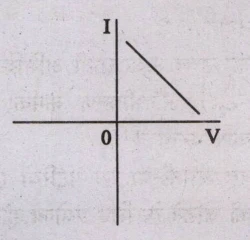
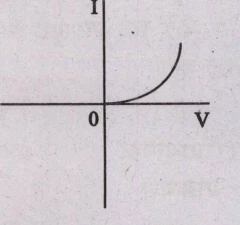
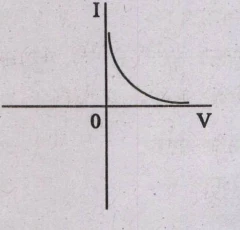
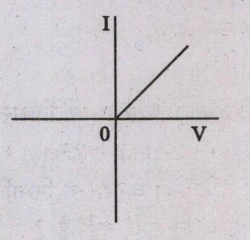
Which one of the following graphs correctly represents the current (I) – voltage (V) variation for a rectangular piece of a semiconductor wafer ?

The graph printed as option (a). Axes I (vertical) and V (horizontal) cross at the origin labelled 0. A straight line rises from the origin up and to the right, through the first quadrant only; nothing is drawn for negative V.
The graph printed as option (b). Axes I (vertical) and V (horizontal) cross at the origin labelled 0. A straight line starts high on the I axis in the second quadrant (negative V, positive I), passes through the origin and descends to the right into the fourth quadrant (positive V, negative I).
The graph printed as option (c). Axes I (vertical) and V (horizontal) cross at the origin labelled 0. A curve starts at the origin, nearly flat along the V axis, and bends steeply upward to the right, in the first quadrant only; nothing is drawn for negative V.
The graph printed as option (d). Axes I (vertical) and V (horizontal) cross at the origin labelled 0. A curve starts high on the I axis just right of the origin and falls steeply, then flattens out towards the V axis as V increases, in the first quadrant only; nothing is drawn for negative V.
Options
Show answer & solution

Option A

Graph (a)

Why

A uniform rectangular piece of semiconductor has no p-n junction. It behaves as an ordinary resistor: the current is proportional to the voltage, so the I–V graph is a straight line through the origin. Graph (a) is that straight line. A curve that is flat and then rises steeply, as in graph (c), belongs to a p-n junction diode, not a plain wafer.

Exam-hall approach

Graphs (b) and (d) show the current falling as the voltage rises, which no passive conductor does. That leaves (a) and (c). The word 'diode' is not in the question, so the junction curve (c) does not apply.

Proof

NCERT Class 12 Physics, Current Electricity (Ohm's law) and Semiconductor Electronics (p-n junction diode characteristics)

About the other options

Option B

A line through the origin with negative slope means the current flows against the applied voltage. No piece of material behaves like that.

Option C

This is the forward characteristic of a p-n junction diode. A plain wafer has no junction, so it does not show this curve.

Option D

A current that falls as the voltage rises does not describe a uniform piece of semiconductor.

Ideal time: about 37 s
60Environment and Ecology • Ecology and Ecosystems
Moderate

The green plants in a terrestrial ecosystem absorbs sunlight that falls on their leaves and convert it into food energy. The percentage of solar radiation absorbed by all green plants for the process of photosynthesis is about

Options
Show answer & solution

Option A

1%

Why

Green plants in a land ecosystem capture only about 1% of the sunlight that falls on their leaves and turn it into food energy.

Exam-hall approach

The ten per cent law is about energy passed from one trophic level to the next, not about sunlight captured by plants. Keeping these apart rules out D.

Proof

NCERT Class 10 Science, Our Environment (Ecosystem: flow of energy)

About the other options

Option B

Far more than plants actually capture. Most sunlight is reflected, passes through, or is lost as heat.

Option C

Also too high. The NCERT figure is about 1%.

Option D

10% is the share of energy passed from one trophic level to the next (the ten per cent law), not the share of sunlight captured by plants.

Ideal time: about 23 s