Skip to content

General Ability Test 2018 (II)

Set A

Questions 101–120 of 150

101Geography • Transport and Communication in India • Ports of India
Easy

Match List-I with List-II and select the correct answer using the code given below the Lists :

List-I (Major Port)

A
Kolkata
B
Mormugao
C
Visakhapatnam
D
Paradip

List-II (Location)

1
Landlocked area
2
In the delta region
3
On the riverside
4
On the entrance of the estuary
Options
ABCD
Show answer & solution

Option B

A3B4C1D2

Why

Kolkata is a river port on the Hooghly. Mormugao stands at the entrance of the Zuari estuary in Goa. Visakhapatnam is the deepest landlocked and well-protected port in India. Paradip stands in the Mahanadi delta.

Exam-hall approach

Visakhapatnam as the landlocked harbour is the best-known pair. It strikes A and D. Kolkata as a river port on the Hooghly settles B.

Proof

A–3, B–4, C–1, D–2

About the other options

Option A

Calls Mormugao landlocked and Visakhapatnam an estuary port. Visakhapatnam is the landlocked port; Mormugao is at the Zuari estuary.

Option C

Puts Kolkata in the delta and Paradip on the riverside. Kolkata is a river port; Paradip is in the Mahanadi delta.

Option D

Makes Mormugao landlocked and Kolkata a delta port. Both are wrong.
Ideal time: about 42 s
102Geography • Rocks, Landforms and Geomorphic Processes • Minerals, Rocks and the Rock Cycle
Easy

Which one of the following is not an agent of metamorphism?

Options
Show answer & solution

Option C

Decomposition

Why

Metamorphism changes a rock without melting it. Its agents are heat, pressure (compression) and chemically active fluids, which act through solution. Decomposition is the breaking down of rock at the surface. It is a kind of weathering, not metamorphism.

Proof

NCERT Class 11 Fundamentals of Physical Geography, Ch. 5 (Minerals and Rocks)

About the other options

Option A

Heat is an agent of metamorphism: it recrystallises minerals, as when limestone becomes marble.

Option B

Compression (pressure) is an agent of metamorphism: it squeezes rock, as when shale becomes slate.

Option D

Solution is an agent: hot fluids dissolve and redeposit minerals in the rock.

Ideal time: about 13 s
103Chemistry • Acids, Bases and Salts • pH and its Applications
Easy

The solution of which one of the following will have pH less than 7?

Options
Show answer & solution

Option C

FeCl3

Why

is the salt of a strong acid (HCl) and a weak base (). In water it hydrolyses and leaves the solution acidic, so its pH is below 7.

Proof

NCERT Class 10 Science, Ch. 2 (Acids, Bases and Salts)

About the other options

Option A

NaOH is a strong base. Its solution has pH above 7.

Option B

KCl is the salt of a strong acid and a strong base. Its solution is neutral, pH 7.

Option D

NaCl is the salt of a strong acid and a strong base. Its solution is neutral, pH 7.

Ideal time: about 16 s
104Chemistry • Redox Reactions and Electrochemistry
Easy

Which one of the following is an oxidation-reduction reaction?

Options
Show answer & solution

Option C

2Mg + O2 → 2MgO

Why

In a redox reaction, oxidation states change. Here magnesium goes from 0 to +2 (oxidised) and oxygen from 0 to −2 (reduced). In the other three reactions, no element's oxidation state changes.

Exam-hall approach

Any reaction with a free element, like Mg or O2, on one side and a compound on the other is redox. Only C has one.

Proof

Mg: 0 → +2 (oxidised). O: 0 → −2 (reduced). NCERT Class 10 Science, Ch. 1 (Chemical Reactions and Equations)

About the other options

Option A

A neutralisation: an acid and a base give salt and water. Na stays +1, Cl −1, H +1, O −2.

Option B

A combination reaction, but not redox. Ca stays +2, O −2 and H +1.

Option D

A double displacement (precipitation) reaction: the ions swap partners. No oxidation state changes.

Ideal time: about 30 s
105Chemistry • Industrial Chemistry • Chemical Fertilizers
Easy

Which one of the following is not used as fertilizer?

Options
Show answer & solution

Option B

Ammonium sulphide

Why

Ammonium sulphide is unstable and gives off poisonous, foul-smelling hydrogen sulphide. It is not used as a fertiliser. The other three are common nitrogen fertilisers.

Proof

NCERT Class 8 Science, Ch. 1 (Crop Production and Management)

About the other options

Option A

Ammonium nitrate is a nitrogen fertiliser.

Option C

Ammonium phosphate is a fertiliser that supplies both nitrogen and phosphorus.

Option D

Ammonium sulphate is a nitrogen fertiliser; it also supplies sulphur.

Ideal time: about 14 s
106Chemistry • Acids, Bases and Salts • Important Salts and their Uses
Easy

Which one of the following is the chemical formula of gypsum?

Options
Show answer & solution

Option A

CaSO4·2H2O

Why

Gypsum is calcium sulphate dihydrate, . Heated to 373 K, it loses water and becomes Plaster of Paris, .

Proof

NCERT Class 10 Science, Ch. 2 (Acids, Bases and Salts)

About the other options

Option B

is dicalcium silicate, a part of cement.

Option C

is Plaster of Paris, made by heating gypsum.

Option D

is anhydrous calcium sulphate (anhydrite), which has no water.

Ideal time: about 16 s
107Chemistry • Some Basic Concepts of Chemistry • Laws of Chemical Combination
Very easy

Which one of the following statements about the law of conservation of mass is correct?

Options
Show answer & solution

Option C

Matter can neither be created nor destroyed.

Why

The law of conservation of mass, stated by Lavoisier, says mass is neither created nor destroyed in a chemical reaction. The total mass of the products equals the total mass of the reactants.

Proof

NCERT Class 11 Chemistry, Ch. 1 (Some Basic Concepts of Chemistry), Laws of Chemical Combination

About the other options

Option A

This is the law of definite (constant) proportions, given by Proust.

Option B

This is Gay-Lussac's law of gaseous volumes. The law needs the gases at the same temperature and pressure, not room temperature.

Option D

This is Avogadro's law.

Ideal time: about 31 s
108Physics • Magnetism and Electromagnetism • Electromagnetic Waves and Spectrum
Easy

The wavelength of X-rays is of the order of

Options
Show answer & solution

Option A

1 Å

Why

X-rays have wavelengths from about 10 nm down to about nm. A typical X-ray wavelength is about 0.1 nm, which is 1 ångström ( m).

Exam-hall approach

X-rays have shorter wavelengths than visible light (about 0.5 µm). B, C and D are all equal to or longer than that.

Proof

NCERT Class 12 Physics, Ch. 8 (Electromagnetic Waves)

About the other options

Option B

1 µm is in the infrared, just beyond red light.

Option C

1 mm lies at the border of microwaves and far infrared.

Option D

1 cm is a microwave wavelength, as used in radar.

Ideal time: about 13 s
109Physics • Motion, Force and Laws of Motion • Kinematics
Very easy

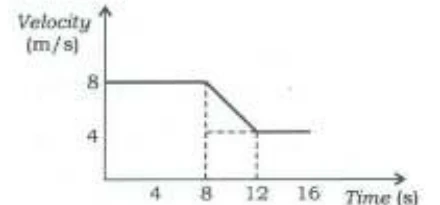
Consider the following velocity and time graph :

A velocity–time graph. The vertical axis is labelled Velocity (m/s) with tick marks at 4 and 8. The horizontal axis is labelled Time (s) with tick marks at 4, 8, 12 and 16. The plotted line is horizontal at 8 m/s from time 0 to 8 s, falls in a straight line to 4 m/s at 12 s, then stays horizontal at 4 m/s until about 16 s. Dashed guide lines run vertically from the point (8 s, 8 m/s) down to the time axis at 8, and from the point (12 s, 4 m/s) down to the time axis at 12; a dashed horizontal line at 4 m/s joins the 8 s vertical to the 12 s point.

Which one of the following is the value of average acceleration from 8 s to 12 s?

Options
Show answer & solution

Option D

-1 m/s2

Why

Average acceleration is the change in velocity divided by the time taken. From 8 s to 12 s, velocity falls from 8 m/s to 4 m/s.

Exam-hall approach

The velocity falls from 8 s to 12 s, so the acceleration is negative. Only D is negative.

Proof

m/s

About the other options

Option A

8 is the velocity in m/s at 8 s, not an acceleration.

Option B

12 is the time in seconds at the end of the interval, not an acceleration.

Option C

Divides the starting velocity by the interval, , and loses the sign.

Ideal time: about 32 s
110Physics • Light and Optics • Refraction by Lenses
Easy

If the focal length of a convex lens is 50 cm, which one of the following is its power?

Options
Show answer & solution

Option A

+2 dioptre

Why

Power of a lens is , with in metres. A convex lens has a positive focal length, so its power is positive.

Exam-hall approach

A convex lens has positive power, which strikes C. A focal length shorter than 1 m gives a power above 1 D, which strikes B and D.

Proof

D

About the other options

Option B

Uses in centimetres: .

Option C

Has the wrong sign: a convex lens has positive power. It also forgets to take the reciprocal.

Option D

Forgets the reciprocal: takes .

Ideal time: about 29 s
111Physics • Motion, Force and Laws of Motion • Kinematics
Easy

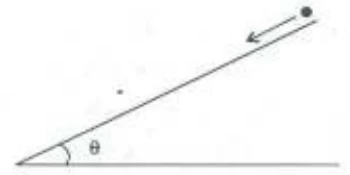
A ball is released from rest and rolls down an inclined plane, as shown in the following figure, requiring 4 s to cover a distance of 100 cm along the plane :

An inclined plane drawn as a straight line rising to the right from a point on a horizontal base line; the angle between the base line and the incline at the lower left is marked θ with a small arc. A ball (a filled dot) sits on the incline near its upper right end, with an arrow beside it pointing down along the incline toward the lower left.

Which one of the following is the correct value of angle θ that the plane makes with the horizontal? (g = 1000 cm/s2)

Options
Show answer & solution

Option C

θ = sin-1(1/80)

Why

Starting from rest, distance is . This gives the acceleration along the plane. On a smooth plane, . A real rolling ball speeds up a little more slowly; a solid ball has . The question gives no shape for the ball, so it means the simple . On the rolling reading no option fits, so the key rests on that intended reading.

Proof

cm/s;

About the other options

Option A

Mixes in m/s, although the question fixes cm/s.

Option B

Uses instead of : cm/s, so .

Option D

Would need cm/s. No standard working gives that.

Ideal time: about 1 min
112Physics • Heat and Thermodynamics • Thermal Expansion
Easy

The coefficient of areal expansion of a material is 1.6×10⁻⁵ K-1. Which one of the following gives the value of coefficient of volume expansion of this material?

Options
Show answer & solution

Option B

2.4×10⁻⁵ K-1

Why

For a solid, areal expansion is twice the linear and volume expansion three times the linear: , . So .

Proof

;

About the other options

Option A

Is the linear coefficient , not the volume coefficient.

Option C

Takes .

Option D

Takes the given areal coefficient as linear: .

Ideal time: about 35 s
113Physics • Light and Optics • Refraction and Total Internal Reflection
Easy

The refractive indices of two media are denoted by n1 and n2, and the velocities of light in these two media are respectively v1 and v2. If n2/n1 is 1.5, which one of the following statements is correct?

Options
Show answer & solution

Option A

v1 is 1.5 times v2.

Why

Refractive index is , so light is slower in the medium with the larger index. Speed and index are in inverse ratio: .

Proof

About the other options

Option B

Inverts the ratio: takes speed proportional to . Medium 2 has the larger index, so light is slower there.

Option C

Speeds are equal only when the refractive indices are equal.

Option D

Doubles the ratio for no reason; the factor is 1.5, not 3.

Ideal time: about 47 s
114Environment and Ecology • Climate Change
Very easy

Which one of the following greenhouse gases is in largest concentration in the atmosphere?

Options
Show answer & solution

Option C

Carbon dioxide

Why

Of these four, carbon dioxide is by far the most abundant greenhouse gas in the air, at about 400 parts per million in 2018. Methane is under 2 parts per million. Water vapour is more abundant still, but it is not an option.

Proof

NCERT Class 11 Fundamentals of Physical Geography, Ch. 12 (World Climate and Climate Change)

About the other options

Option A

Chlorofluorocarbons are man-made and present only in parts per trillion. They are very strong per molecule.

Option B

Nitrous oxide is about 0.3 parts per million.

Option D

Methane is about 1.8 parts per million. It traps more heat per molecule, but there is far less of it.

Ideal time: about 13 s
115Geography • Atmosphere, Weather and Climate • Climatic Regions of the World
Easy

Match List-I with List-II and select the correct answer using the code given below the Lists :

List-I (Koppen’s Climatic Type)

A
Tropical wet
B
Mid-latitude desert
C
Mediterranean
D
Humid continental

List-II (Letter Code)

1
Af
2
Cs
3
Df
4
BWk
Options
ABCD
Show answer & solution

Option A

A1B4C2D3

Why

In Köppen's scheme, A is tropical, B dry, C warm temperate and D cold. Tropical wet is Af (f: no dry season). Mid-latitude desert is BWk (W: desert, k: cold). Mediterranean is Cs (s: dry summer). Humid continental is Df.

Exam-hall approach

Tropical climates start with A, so tropical wet is Af. That strikes C and D. A desert is B (dry), which settles A.

Proof

A–1, B–4, C–2, D–3

About the other options

Option B

Gives the desert Cs and the Mediterranean BWk. A desert is a B (dry) climate; the Mediterranean is Cs, a mild climate with dry summers.

Option C

Gives tropical wet Df. Tropical climates start with A, so it is Af.

Option D

Gives tropical wet Df and humid continental Af. They are the other way round.

Ideal time: about 35 s
116Geography • Transport and Communication in India • Indian Railways: Zones and Network
Easy

Match List-I with List-II and select the correct answer using the code given below the Lists :

List-I (Railway Zone)

A
West Central
B
South East Central
C
East Central
D
North Eastern

List-II (Headquarters)

1
Jabalpur
2
Gorakhpur
3
Bilaspur
4
Hajipur
Options
ABCD
Show answer & solution

Option D

A1B3C4D2

Why

West Central Railway has its headquarters at Jabalpur. South East Central Railway is at Bilaspur. East Central Railway is at Hajipur. North Eastern Railway is at Gorakhpur.

Exam-hall approach

North Eastern Railway at Gorakhpur strikes A and C. South East Central at Bilaspur, in Chhattisgarh, strikes B.

Proof

A–1, B–3, C–4, D–2

About the other options

Option A

Gives West Central Railway Gorakhpur and North Eastern Railway Jabalpur. Gorakhpur is the North Eastern Railway's headquarters.

Option B

Swaps Bilaspur and Hajipur: South East Central is at Bilaspur and East Central at Hajipur.

Option C

Swaps both pairs: Jabalpur is West Central and Hajipur is East Central.

Ideal time: about 40 s
117Geography • Population and Settlements of India • Sex Ratio and Gender Composition
Easy

Which one of the following is the correct descending order of Indian States in terms of sex ratio as per Census 2011?

Options
Show answer & solution

Option C

Meghalaya—Manipur—Mizoram—Tripura

Why

Census 2011 sex ratios (females per 1,000 males): Meghalaya 989, Manipur 985, Mizoram 976, Tripura 960. Tripura has the lowest of the four.

Exam-hall approach

Tripura has the lowest sex ratio of the four. Only C puts it last.

Proof

Census of India 2011: Meghalaya 989, Manipur 985, Mizoram 976, Tripura 960

About the other options

Option A

Puts Mizoram first. Mizoram (976) is below both Meghalaya and Manipur.

Option B

Puts Tripura first, but Tripura (960) has the lowest sex ratio of the four.

Option D

Puts Tripura above Mizoram. Tripura (960) is below Mizoram (976).

Ideal time: about 34 s
118Geography • Atmosphere, Weather and Climate • Climatic Regions of the World
Easy

Steppe (temperate continental) climate is not experienced in which one of the following places?

Options
Show answer & solution

Option C

Perth

Why

Perth, in south-west Australia, has a Mediterranean climate: hot, dry summers and mild, wet winters. The other three lie in temperate grasslands with a steppe-type continental climate. The grassland is called the Veld near Pretoria, the Prairies in Saskatchewan and the Pampas near Buenos Aires.

Exam-hall approach

Each option is a temperate grassland city except one. Perth is the best-known example of a Mediterranean climate in Australia, so it stands out.

Proof

NCERT Class 7 Our Environment, Life in the Temperate Grasslands

About the other options

Option A

Pretoria lies in the Veld, the temperate grassland of South Africa.

Option B

Saskatchewan lies in the Prairies, the temperate grassland of North America.

Option D

Buenos Aires lies at the edge of the Pampas, the temperate grassland of Argentina.

Ideal time: about 21 s
119Geography • Rocks, Landforms and Geomorphic Processes • Weathering
Easy

Which one of the following is not a process of chemical weathering?

Options
Show answer & solution

Option D

Exfoliation

Why

Exfoliation is physical (mechanical) weathering. Outer layers of rock peel off like the skin of an onion, because of heating and cooling or the release of pressure. No new chemical substance forms. Solution, carbonation and oxidation all change the rock's chemistry.

Proof

NCERT Class 11 Fundamentals of Physical Geography, Geomorphic Processes

About the other options

Option A

Solution is chemical weathering: minerals such as rock salt dissolve in water.

Option B

Carbonation is chemical weathering: carbonic acid in rainwater dissolves limestone.

Option C

Oxidation is chemical weathering: iron in rock reacts with oxygen and rusts.

Ideal time: about 13 s
120Physics • Light and Optics • Reflection of Light and Mirrors
Very easy

Which one of the following statements is correct for a plane mirror?

Options
Show answer & solution

Option C

The image is virtual, erect and laterally inverted.

Why

A plane mirror forms an image that is virtual and erect. It is the same size as the object and as far behind the mirror as the object is in front. The image is also laterally inverted: left and right are swapped.

Proof

NCERT Class 10 Science, Light – Reflection and Refraction

About the other options

Option A

A plane mirror is a sphere of infinite radius, so its focal length is infinite, not zero.

Option B

The image in a plane mirror is exactly the same size as the object.

Option D

A plane mirror has no finite focal length; 200 cm would describe a curved mirror.

Ideal time: about 26 s