Skip to content

General Ability Test 2018 (II)

Set A

Questions 81–100 of 150

81Chemistry • Carbon and its Compounds • Allotropes of Carbon
Easy

Which one of the following statements is not correct?

Options
Show answer & solution

Option D

Graphite layers are held together by carbon-carbon single bond.

Why

In graphite, carbon atoms in each layer are bonded in hexagonal rings. The layers are held together only by weak van der Waals forces, not by covalent bonds. That is why the layers slide over each other and graphite is soft and slippery.

Exam-hall approach

B and D say opposite things about what holds the layers together, so one of them is the false statement. Graphite's slipperiness shows the forces are weak.

Proof

NCERT Class 10 Science, Ch. 4 (Carbon and its Compounds); NCERT Class 11 Chemistry, Ch. 11 (The p-Block Elements), Allotropes of carbon

About the other options

Option A

True. In diamond each carbon is joined to four others by single covalent bonds, in a rigid 3-D network.

Option B

True. Graphite's layers are held by weak van der Waals forces, which is why it is slippery.

Option C

True. Each graphite layer is a sheet of hexagonal carbon rings.
Ideal time: about 33 s
82Chemistry • Non-Metals and their Compounds • Common Gases and their Uses
Very easy

Which one of the following is called dry ice?

Options
Show answer & solution

Option A

Solid carbon dioxide

Why

Dry ice is solid carbon dioxide. It turns straight into gas without melting (it sublimes), so it leaves nothing wet behind.

Proof

NCERT Class 9 Science, Ch. 1 (Matter in Our Surroundings), Effect of change of pressure

About the other options

Option B

Liquid carbon dioxide is the same substance, but dry ice is the solid form.

Option C

Liquid nitrogen is a very cold liquid used to freeze things. It is not dry ice.

Option D

Liquid ammonia is used as a refrigerant and a solvent. It is not dry ice.

Ideal time: about 11 s
83Biology • Human Physiology • Digestive System
Moderate

The acidic semidigested food coming out of the stomach is neutralized by

Options
Show answer & solution

Option D

bile juice

Why

NCERT says the food coming from the stomach is acidic and must be made alkaline for the pancreatic enzymes to act; bile juice from the liver does this. Pancreatic juice also carries bicarbonate and helps neutralise the acid, so A can be defended. D is the answer the school textbook gives.

Proof

NCERT Class 10 Science, Ch. 6 (Life Processes), Nutrition in human beings

About the other options

Option A

Also defensible

Pancreatic juice does carry bicarbonate that neutralises acid, so it can be defended. But NCERT names bile for this job; pancreatic juice is named for digesting proteins, fats and starch.

Option B

The duodenum's own secretions are not named for this job in NCERT.

Option C

Food reaches the large intestine after digestion is over. Its secretions do not act on food from the stomach.

Ideal time: about 17 s
84Biology • Human Physiology • Blood and Circulatory System
Very easy

The oxygenated blood from the lungs is received by the

Options
Show answer & solution

Option A

left auricle

Why

Oxygen-rich blood comes from the lungs through the pulmonary veins into the left auricle (left atrium). From there it passes to the left ventricle, which pumps it to the body.

Exam-hall approach

Oxygen-rich blood is on the left side of the heart, which strikes C and D. Blood enters the heart at an auricle and leaves from a ventricle, which strikes B.

Proof

NCERT Class 10 Science, Ch. 6 (Life Processes), Our heart

About the other options

Option B

The left ventricle pumps the oxygen-rich blood out to the body. It receives blood from the left auricle, not from the lungs.

Option C

The right auricle receives deoxygenated blood from the body.

Option D

The right ventricle pumps deoxygenated blood to the lungs.

Ideal time: about 11 s
85Biology • Plant Physiology • Photosynthesis
Easy

The oxygen evolved during photosynthesis comes from splitting of

Options
Show answer & solution

Option A

water

Why

In the light reaction of photosynthesis, water molecules are split by light (photolysis). The oxygen given off comes from this water, not from carbon dioxide.

Proof

NCERT Class 11 Biology, Ch. 11 (Photosynthesis in Higher Plants)

About the other options

Option B

Carbon dioxide is the source of the carbon that ends up in sugar. Its oxygen goes into the sugar and water, not into the air.

Option C

Oxygen is the product here, not something that is split.

Option D

Light supplies the energy that splits water. Light itself is not split.

Ideal time: about 12 s
86Biology • Human Physiology • Nervous System and Reflex Action
Easy

Which one of the following depicts the correct circuit of a reflex arc?

Options
Show answer & solution

Option B

Receptor—sensory neuron—spinal cord—motor neuron—effector

Why

A reflex arc starts at a receptor, which senses the stimulus. A sensory neuron carries the signal to the spinal cord. A motor neuron carries the reply to an effector (a muscle or gland). The brain is not needed for the quick reflex.

Exam-hall approach

A and D put the parts in a jumbled order, which strikes them. Between B and C, the reflex is handled by the spinal cord.

Proof

NCERT Class 10 Science, Ch. 6 (Control and Coordination)

About the other options

Option A

Reverses the arc: the signal starts at the receptor and ends at the effector.

Option C

Right order, but a reflex arc runs through the spinal cord, not the brain. That is why a reflex is fast.

Option D

The receptor must come before the sensory neuron, and the motor neuron before the effector.

Ideal time: about 17 s
87Biology • Reproduction • Sexual Reproduction in Flowering Plants
Easy

If one set of chromosomes for a given plant is represented as N; in case of double fertilization, the zygote and the endosperm nucleus of a diploid plant would have how many sets of chromosomes respectively?

Options
Show answer & solution

Option D

2N and 3N

Why

In double fertilisation, one male gamete fuses with the egg (N + N), giving a diploid zygote, 2N. The other fuses with the two polar nuclei (N + N + N), giving the triploid primary endosperm nucleus, 3N. This second fusion is called triple fusion.

Exam-hall approach

A zygote is always two gametes joined, so it is 2N. That strikes A and C. The word triple fusion then gives 3N for the endosperm.

Proof

NCERT Class 12 Biology, Ch. 1 (Sexual Reproduction in Flowering Plants)

About the other options

Option A

N is a gamete, not a zygote. The endosperm is 3N, not 2N.

Option B

The zygote is 2N, but the endosperm gets three sets: one from the male gamete and two from the polar nuclei.

Option C

The endosperm is 3N, but the zygote is formed from two gametes, so it is 2N.

Ideal time: about 28 s
88Physics • Electricity • Resistance and Combination of Resistors
Moderate

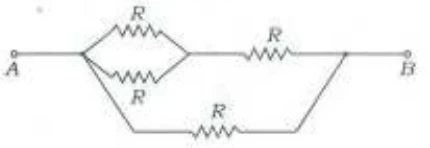
Consider the following circuit :

A circuit between terminal A on the left and terminal B on the right, every resistor labelled R. From A a wire reaches a left node. From that node two branches run side by side to a common node: the upper branch holds one resistor R and the lower branch holds one resistor R, so the two are in parallel. From the common node a wire continues right through one more resistor R to a junction on the wire leading to B. A third path leaves the left node, runs diagonally down to a bottom wire holding one resistor R, then rises diagonally to the same junction on the wire to B. So the series pair (the two parallel resistors R, then R) is in parallel with the single bottom resistor R.

Which one of the following is the value of the resistance between points A and B in the circuit given above?

Options
Show answer & solution

Option B

Why

Resistors in parallel add as reciprocals; resistors in series simply add. The two parallel resistors give . In series with the next this gives . This branch is in parallel with the bottom .

Exam-hall approach

The bottom is in parallel with the rest, so the answer is less than . That strikes C and D. A parallel pair is never less than half the smaller resistor, so the answer is at least . That strikes A.

Proof

About the other options

Option A

Too small. Two resistors and in parallel give at least half the smaller one, , and is below that.

Option C

Is the upper branch alone, . It forgets the bottom resistor in parallel.

Option D

Takes all four resistors in series: .

Ideal time: about 1 min
89Physics • Heat and Thermodynamics • Heat, Temperature and its Measurement
Very easy

The absolute zero temperature is 0 Kelvin. In °C unit, which one of the following is the absolute zero temperature?

Options
Show answer & solution

Option C

-273.15 °C

Why

Kelvin and Celsius degrees are the same size, and the scales differ by 273.15: . So 0 K is C.

Proof

C

About the other options

Option A

0 °C is the freezing point of water, which is 273.15 K.

Option B

-100 °C is 173.15 K, well above absolute zero.

Option D

-173.15 °C is 100 K. It comes from mixing up the offset by 100.

Ideal time: about 14 s
90Physics • Magnetism and Electromagnetism • Electromagnetic Waves and Spectrum
Easy

Consider the following statements about visible light, UV light and X-rays :

1
The wavelength of visible light is more than that of X-rays.
2
The energy of X-ray photons is higher than that of UV light photons.
3
The energy of UV light photons is less than that of visible light photons.

Which of the statements given above is/are correct?

Options
Show answer & solution

Option B

1 and 2 only

Why

1 — Correct. Visible light has wavelengths of about 400–700 nm. X-rays are far shorter, below about 10 nm. 2 — Correct. Photon energy rises as wavelength falls. X-rays have shorter wavelengths than UV, so their photons carry more energy. 3 — Incorrect. UV has a shorter wavelength than visible light, so UV photons have more energy, not less. That is why UV causes sunburn and visible light does not.

Exam-hall approach

The order radio, microwave, infrared, visible, UV, X-ray, gamma runs from long to short wavelength and from low to high energy. It makes 1 and 2 true and 3 false.

About the other options

Option A

Contains statement 3, which is false: UV photons carry more energy than visible ones.

Option C

Contains statement 3, which is false, and leaves out statement 1, which is true.

Option D

Leaves out statement 2, which is true: X-ray photons carry more energy than UV photons.

Ideal time: about 45 s
91Physics • Oscillations, Waves and Sound • Oscillations and the Simple Pendulum
Easy

The time period of oscillation of a simple pendulum having length L and mass of the bob m is given as T. If the length of the pendulum is increased to 4L and the mass of the bob is increased to 2m, then which one of the following is the new time period of oscillation?

Options
Show answer & solution

Option B

2T

Why

The period of a simple pendulum is . It depends on the length, not on the mass of the bob. Four times the length gives times the period. Doubling the mass changes nothing.

Proof

About the other options

Option A

Would be right only if the mass mattered and cancelled the longer length. The period does not depend on the mass.

Option C

Forgets the square root: takes , so 4 times the length gives .

Option D

Inverts the ratio: takes .

Ideal time: about 47 s
92Physics • Magnetism and Electromagnetism • Domestic Electric Circuits
Easy

The connecting cable of electrical appliances like electric iron, water heater or room heater contains three insulated copper wires of three different colours—red, green and black. Which one of the following is the correct colour code?

Options
Show answer & solution

Option C

Red—live wire, Green—ground wire, Black—neutral wire

Why

In the older Indian colour code, the live wire has red insulation, the neutral wire black, and the earth (ground) wire green. The earth wire carries any leaking current safely to the ground.

Exam-hall approach

Red is live, which strikes B and D. Green is earth, which strikes A.

Proof

NCERT Class 10 Science, Ch. 12 (Magnetic Effects of Electric Current), domestic electric circuits

About the other options

Option A

Green is the earth wire, not the neutral wire. Black is the neutral.

Option B

Red is the live wire, not the neutral. Black is the neutral.

Option D

Red is the live wire, and green is the earth wire, not the live wire.

Ideal time: about 28 s
93Physics • Electricity • Resistance and Combination of Resistors
Easy

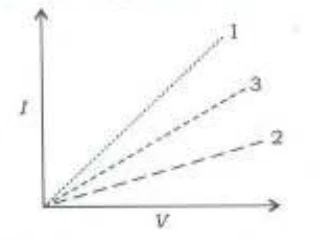
The graphs between current (I) and voltage (V) for three linear resistors 1, 2 and 3 are given below :

A graph with current I on the vertical axis and voltage V on the horizontal axis, both axes with arrowheads, no scale or numbers. Three straight lines start together at the origin and rise to the right, each labelled with its resistor number at its upper right end. Line 1, drawn dotted, is the steepest and ends highest. Line 3, drawn with short dashes, lies in the middle. Line 2, drawn with long dashes, has the smallest slope and ends lowest.

If R1, R2 and R3 are the resistances of these resistors, then which one of the following is correct?

Options
Show answer & solution

Option B

R1 < R3 < R2

Why

By Ohm's law, . So the slope of an – graph is . The steepest line has the smallest resistance. Line 1 is steepest, line 3 is in the middle and line 2 is the flattest, so .

Exam-hall approach

With current on the vertical axis, a steeper line means more current for the same voltage, so less resistance. is the smallest, which strikes A, C and D.

Proof

; slopes , so

About the other options

Option A

Says is the largest, but line 1 is the steepest, so is the smallest.

Option C

Puts below , but line 3 is less steep than line 1, so is larger.

Option D

Puts above , but line 2 is the flattest, so is the largest.

Ideal time: about 51 s
94Physics • Light and Optics • Optical Instruments
Moderate

Consider the following statements about a microscope and a telescope :

1
Both the eyepiece and the objective of a microscope are convex lenses.
2
The focal length of the objective of a telescope is larger than the focal length of its eyepiece.
3
The magnification of a telescope increases with the increase in focal length of its objective.
4
The magnification of a microscope increases with the increase in focal length of its objective.

Which of the statements given above are correct?

Options
Show answer & solution

Option D

1, 2 and 3

Why

1 — Correct. A compound microscope uses two convex lenses: a small objective and an eyepiece. 2 — Correct. A telescope's objective has a long focal length and its eyepiece a short one. 3 — Correct. A telescope's magnifying power is , so it grows as grows. 4 — Incorrect. A microscope's magnification goes roughly as . It increases when the objective's focal length decreases.

Exam-hall approach

A telescope wants a long objective and a microscope a short one. That makes 4 false, which strikes B and C. Statement 2 is the same fact about telescopes, so D.

About the other options

Option A

Leaves out statement 2, which is true: a telescope's objective has the longer focal length.

Option B

Contains statement 4, which is false: a microscope needs an objective of short focal length.

Option C

Contains statement 4, which is false, and leaves out statement 1, which is true.

Ideal time: about 59 s
95Physics • Gravitation • Acceleration due to Gravity, Mass and Weight
Easy

A planet has a mass M1 and radius R1. The value of acceleration due to gravity on its surface is g1. There is another planet 2, whose mass and radius both are two times that of the first planet. Which one of the following is the acceleration due to gravity on the surface of planet 2?

Options
Show answer & solution

Option C

g1/2

Why

Gravity at a planet's surface is . Doubling the mass doubles . Doubling the radius divides by . Together, becomes half.

Proof

About the other options

Option A

Misses the square on the radius: takes , so the 2s cancel.

Option B

Doubles for the mass but ignores the larger radius.

Option D

Applies for the radius but forgets that the mass also doubled.

Ideal time: about 49 s
96Geography • Rivers and Drainage of India • Ganga River System
Hard

Match List-I with List-II and select the correct answer using the code given below the Lists :

List-I (River Basin)

A
Bhagirathi
B
Alaknanda
C
Nayar
D
Ganga

List-II (Town)

1
Lansdowne
2
Narendra Nagar
3
Uttarkashi
4
Pauri
Options
ABCD
Show answer & solution

Option B

A3B4C1D2

Why

Uttarkashi stands on the Bhagirathi. Pauri overlooks the Alaknanda valley near Srinagar (Garhwal). Lansdowne lies in the Nayar basin, which drains to the Ganga. Narendra Nagar lies above Rishikesh, on the Ganga itself. The Pauri and Lansdowne pairs are the contestable part of this key: both towns are in Pauri Garhwal district, between the Alaknanda and the Nayar.

Exam-hall approach

Uttarkashi on the Bhagirathi is the best-known pair. It strikes C and D. A and B differ only on Pauri and Lansdowne. With no surer fact, it is a two-way guess, and worth taking under a one-third penalty.

Proof

A–3, B–4, C–1, D–2

About the other options

Option A

Gives Lansdowne to the Alaknanda and Pauri to the Nayar. Pauri overlooks the Alaknanda valley, and Lansdowne is the Nayar town.

Option C

Narendra Nagar is near Rishikesh on the Ganga, not on the Bhagirathi. Uttarkashi is the Bhagirathi town.

Option D

Swaps Uttarkashi and Narendra Nagar: Uttarkashi is on the Bhagirathi, Narendra Nagar on the Ganga.

Ideal time: about 44 s
97Geography • Atmosphere, Weather and Climate • Winds, Pressure Belts and the Coriolis Force
Moderate

Match List-I with List-II and select the correct answer using the code given below the Lists :

List-I (Local Wind)

A
Yamo
B
Black Roller
C
Bise
D
Haboob

List-II (Place)

1
Sudan
2
France
3
Japan
4
North America
Options
ABCD
Show answer & solution

Option C

A3B4C2D1

Why

Haboob is a dust storm of Sudan. Bise is a cold, dry north-east wind of France and Switzerland. Black Roller is a dust storm of the Great Plains of North America. Yamo is a warm, dry wind of Japan.

Exam-hall approach

Haboob–Sudan is the best-known pair, which strikes A and B. Bise–France then settles C.

Proof

A–3, B–4, C–2, D–1

About the other options

Option A

Puts the Haboob in Japan and the Yamo in Sudan. The Haboob is the Sudan dust storm.

Option B

Puts the Haboob in Japan and the Black Roller in France. The Black Roller blows over North America.

Option D

Swaps the Black Roller and the Bise: the Bise blows in France, the Black Roller in North America.

Ideal time: about 39 s
98Geography • Rivers and Drainage of India • Brahmaputra River System
Very easy

‘Majuli’, the river island, is located in which one of the following rivers?

Options
Show answer & solution

Option D

Brahmaputra

Why

Majuli is a large river island in the Brahmaputra, in Assam. It was declared a district of Assam in 2016.

Proof

NCERT Class 11 India Physical Environment, Ch. 3 (Drainage System)

About the other options

Option A

Jamuna is the name of the Brahmaputra in Bangladesh, after it leaves India. Majuli is in Assam, upstream, where the river is called the Brahmaputra.

Option B

Padma is the name of the Ganga in Bangladesh.

Option C

Majuli is in Assam; the Ganga does not flow through Assam.

Ideal time: about 12 s
99Geography • Population and Settlements of India • Population Distribution, Density and Growth
Easy

Which one of the following Indian States has recorded negative growth of population as per Census 2011?

Options
Show answer & solution

Option D

Nagaland

Why

Census 2011 showed a fall in Nagaland's population between 2001 and 2011. It was the only state with negative growth.

Proof

Census of India 2011: Nagaland decadal growth 2001–2011, −0.58 per cent

About the other options

Option A

Manipur grew in 2001–2011, by about 24 per cent.

Option B

Mizoram grew in 2001–2011, by about 23 per cent.

Option C

Tripura grew in 2001–2011, by about 15 per cent.

Ideal time: about 15 s
100Geography • Atmosphere, Weather and Climate • Humidity, Condensation and Precipitation
Moderate

Which one of the following types of cloud is characterized by continuous precipitation?

Options
Show answer & solution

Option C

Nimbostratus

Why

Nimbostratus is a thick, dark, grey layer cloud at low to middle height. It brings steady rain or snow that lasts for hours. 'Nimbo' means rain and 'stratus' means layer.

Proof

NCERT Class 11 Fundamentals of Physical Geography, Ch. 11 (Water in the Atmosphere)

About the other options

Option A

Cirrocumulus is a high, thin cloud of small white patches. It gives no rain.

Option B

Cumulus is a fair-weather heap cloud, like cotton wool. It gives little or no rain.

Option D

Cumulonimbus is a tall thunder cloud. It gives heavy rain, but in short, intense showers, not continuous rain.

Ideal time: about 14 s