Skip to content

Elementary Mathematics 2018 (II)

Set A

Questions 81–100 of 100

81Mensuration • Solids • Cube
EasyIdeal time: about 55 s

If the diagonal of a cube is of length , then the total surface area of the cube is

Options
Show answer & solution

Option D

Approach

Express the cube's edge through its space diagonal, then substitute into .

Step-by-step solution

  1. 1
    For a cube of edge , a face diagonal is , and the space diagonal is the hypotenuse of a right triangle with legs and : .

    Why: Pythagoras is applied twice - once in a face, once in the vertical plane through that face diagonal.

  2. 2

    Why: Only is needed, so the surd never has to be carried further.

  3. 3
    Total surface

    Why: A cube has six congruent square faces.

Common mistakes

Option A

Used the face diagonal in place of the space diagonal, giving and a surface of .

Option B

Carries a stray ; the surface area of a cube is a rational multiple of , never a surd one.

Option C

Carries a stray for the same reason.

Skills used
82Mensuration • Plane Figures
ModerateIdeal time: about 1.5 min

An equilateral triangle, a square and a circle have equal perimeter. If T, S and C denote the area of the triangle, area of the square and area of the circle respectively, then which one of the following is correct ?

Options
Show answer & solution

Option A

T S C

Approach

Put all three areas in terms of the one quantity they share - the common perimeter - and compare the coefficients.

Step-by-step solution

  1. 1
    Triangle: side , so

    Why: Writing every area over the same is what makes the three comparable at all.

  2. 2
    Square: side , so

    Why: The square's area in terms of its perimeter is directly.

  3. 3
    Circle: gives , so

    Why: The in the circumference and the in the area partly cancel, leaving .

  4. 4
    , so .

    Why: Comparing three decimals settles the order without any of the ever being evaluated.

Shortcut

For a fixed perimeter, the more sides a regular figure has the more area it encloses, and the circle is the limit - so at sight.

Common mistakes

Option B

Interchanged the triangle and the square, comparing the coefficients and without first dividing the perimeter into sides.

Option C

Reversed the rule, assuming a shape with fewer sides encloses more area for the same perimeter.

Option D

Puts the circle in the middle, which no comparison of the three coefficients supports.

Skills used

83Geometry • Triangle • Similarity
ModerateIdeal time: about 1.5 min

The areas of two similar triangles are cm and cm respectively. The ratio of their corresponding sides is

Options
Show answer & solution

Option A

Approach

Areas of similar figures scale as the square of the sides, so take the square root of the area ratio - and both surds denest.

Step-by-step solution

  1. 1
    For similar triangles the ratio of areas is the square of the ratio of corresponding sides, so that ratio is .

    Why: The question gives areas and asks for sides, so a square root has to be taken somewhere.

  2. 2
    and likewise

    Why: Looking for with gives , , so both surds are perfect squares in disguise.

  3. 3
    Ratio of sides

    Why: Both and are positive, so no sign question arises.

  4. 4
    Rationalise:

    Why: The denominator , so the answer is simply the numerator squared.

Common mistakes

Option B

No denesting or rationalisation produces from the given areas.

Option C

No step produces ; it is roughly , far from a ratio of two very unequal areas.

Option D

No step produces , and a ratio bigger than contradicts the first area being the smaller.

Skills used

84Geometry • Circle • Chords
ModerateIdeal time: about 1.5 min

The chord of a circle is times its radius. The angle subtended by this chord at the minor arc is times the angle subtended at the major arc. What is the value of ?

Options
Show answer & solution

Option B

Approach

Get the central angle from the chord length, halve it for the angle in the major segment, then use the cyclic quadrilateral for the minor one.

Step-by-step solution

  1. 1
    Let the radius be and the chord be . The perpendicular from the centre bisects , so in the right triangle it makes, .

    Why: The perpendicular from the centre to a chord bisects it, which is what turns the chord length into an angle.

  2. 2
    , so the central angle is .

    Why: is the sine of .

  3. 3
    A point on the major arc sees at half the central angle: .

    Why: The angle at the centre is twice the angle at the circumference on the remaining arc.

  4. 4
    A point on the minor arc, together with , and the major-arc point, forms a cyclic quadrilateral, so its angle is .

    Why: Angles in opposite segments are supplementary, which is the quickest way from one arc to the other.

  5. 5

    Why: The question asks for the minor-arc angle as a multiple of the major-arc one, in that order.

Shortcut

A chord of always subtends at the centre, hence in the major segment and in the minor, so .

Common mistakes

Option C

Divided the major-arc angle by the minor-arc angle, the wrong way round.

Option A

No pair of segment angles on this chord is in the ratio .

Option D

The reciprocal of A, and equally unreachable.

Skills used

85Geometry • Triangle • Angle Bisector
ModerateIdeal time: about 1.5 min

In a triangle ABC, the sides AB, AC are produced and the bisectors of exterior angles of and intersect at D. If , then is equal to

Options
Show answer & solution

Option B

Approach

Work inside triangle : each exterior bisector meets at minus half a base angle.

Step-by-step solution

  1. 1
    The exterior angle at is , so its bisector makes with .

    Why: is produced, so the exterior angle at sits on the straight line through and and is .

  2. 2
    In the same way .

    Why: is produced too, so the configuration at is the mirror image of the one at .

  3. 3

    Why: Closing the angle sum in makes the two cancel against the .

  4. 4
    , so - equivalently .

    Why: Only the sum of the base angles is needed, which is why alone determines the answer.

Common mistakes

Option A

Used , which is the angle at the incentre, where the INTERNAL bisectors meet, not the external ones.

Option D

Used instead of , forgetting to halve.

Option C

No combination of with the bisector angles gives .

Skills used

86Mensuration • Solids • Cone
EasyIdeal time: about 45 s

Two cones have their heights in the ratio . If the radii of their bases are in the ratio , then the ratio of their volumes will be

Options
Show answer & solution

Option C

Approach

Name the heights and radii with a common factor, then form the ratio of twice.

Step-by-step solution

  1. 1
    Let the heights be and , and the radii and , in that order.

    Why: A ratio fixes the quantities only up to a common factor, and those factors will cancel.

  2. 2

    Why: The radius enters squared and the height only to the first power, so the two ratios do not simply cancel.

  3. 3
    The ratio of volumes is .

    Why: The cone with the wider base wins, because squaring the radius ratio beats the height ratio.

Common mistakes

Option A

Cancelled the ratios and against each other, forgetting that the radius is squared.

Option D

Used the squared radius ratio alone and ignored the heights.

Option B

No weighting of the two ratios gives .

Skills used

87Geometry • Line • Angles at a Point
Very easyIdeal time: about 35 s

If two lines AB and CD intersect at O such that , then the four angles at O are

Options
Show answer & solution

Option B

Approach

and are a linear pair, so they add to ; vertically opposite angles then repeat them.

Step-by-step solution

  1. 1
    , , lie on one straight line, so .

    Why: is a line through , and stands on it, making the two angles a linear pair.

  2. 2
    and

    Why: Substituting the given relation turns the linear pair into one equation in one unknown.

  3. 3
    and , so the four angles are .

    Why: Where two lines cross, each angle is repeated by the one vertically opposite it.

Common mistakes

Option D

Solved instead of , giving and .

Option A

Gives , which matches no reading of the ratio.

Option C

Breaks the vertically-opposite pairing altogether, with four unequal angles.

Skills used

88Geometry • Circle • Locus
ModerateIdeal time: about 1.5 min

If a point P moves such that the sum of the squares of its distances from two fixed points A and B is a constant, then the locus of the point P is

Options
Show answer & solution

Option B

A circle

Approach

Put and symmetrically on an axis; the condition then collapses to a constant distance from their midpoint.

Step-by-step solution

  1. 1
    Take and , so the midpoint of is the origin, and let .

    Why: Choosing the axes along and through its midpoint costs nothing and makes the two distances symmetric in .

  2. 2

    Why: The two cross terms cancel, which is exactly why the midpoint was chosen as origin.

  3. 3
    Setting this equal to a constant gives , itself a constant.

    Why: is fixed because and are fixed, so the whole right-hand side is a number.

  4. 4
    So keeps a fixed distance from the midpoint of : the locus is a circle centred at that midpoint.

    Why: A constant distance from a fixed point is the definition of a circle - provided , so the constant is positive.

Common mistakes

Option A

Confused the condition with 'the DIFFERENCE of the squares of the distances is constant', which is the one that gives a straight line.

Option C

Read the condition as , which is the perpendicular bisector.

Option D

The condition is a clean quadratic in and , so the locus is never arbitrary.

Skills used

89Geometry • Triangle • Pythagoras Theorem
ModerateIdeal time: about 1.5 min

If ABC is a right-angled triangle with AC as its hypotenuse, then which one of the following is correct ?

Options
Show answer & solution

Option B

AC AB BC

Approach

Multiply the Pythagorean relation through by and compare the two products term by term.

Step-by-step solution

  1. 1
    is the hypotenuse, so .

    Why: This is the only relation the right angle gives, so it has to be the starting point.

  2. 2
    Each leg is strictly shorter than the hypotenuse: gives , and likewise .

    Why: Both legs are positive, so dropping either one strictly decreases the sum.

  3. 3

    Why: Multiplying the identity by and then replacing each factor by the smaller leg makes the right-hand side strictly smaller.

Common mistakes

Option A

Assumed the cube relation reverses the square one, as if raising the power flipped the inequality.

Option C

Took the inequality in the wrong direction and then hedged it with equality.

Option D

The weak form is also true, since implies , but equality never occurs, so is the statement the question is after.

Skills used

90Mensuration • Plane Figures • Composite and Shaded Regions
Very easyIdeal time: about 40 s

The area of the region bounded externally by a square of side cm and internally by the circle touching the four sides of the square is

Options
Show answer & solution

Option A

Approach

The circle touching all four sides has the side as its diameter; subtract its area from the square's.

Step-by-step solution

  1. 1
    Square of side : area

    Why: The side is given as , not , which is what makes the answer come out without fractions.

  2. 2
    The circle touches all four sides, so its diameter is the side and its radius is : area .

    Why: A circle touching all four sides of a square is its inscribed circle, whose diameter equals the side.

  3. 3
    Region between them

    Why: 'Bounded externally by the square and internally by the circle' is the square with the circle removed.

Common mistakes

Option C

Removed only a semicircle: .

Option B

Subtracts the square from the circle and uses a radius that is not the one the touching condition gives.

Option D

Half of B, and unreachable for the same reason.

Skills used
91Mensuration • Plane Figures • Composite and Shaded Regions
HardIdeal time: about 2 min

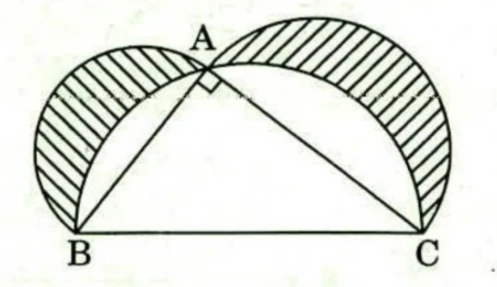
In the figure given below, ABC is a right-angled triangle where , AB cm and AC cm. On the three sides as diameters semicircles are drawn as shown in the figure. The area of the shaded portion, in square cm, is

Right-angled triangle ABC with the right angle at A marked by a small square; B is at the bottom left and C at the bottom right, with A above the segment BC. A large semicircle is drawn on BC as diameter, arching upward and enclosing the triangle. Semicircles are also drawn outward on AB and on AC as diameters. The two crescent-shaped lune regions lying inside the semicircles on AB and AC but outside the large semicircle on BC are hatched.
Options
Show answer & solution

Option D

Approach

Since the big semicircle passes through ; add the two small semicircles to the triangle and take the big one away, and every cancels.

Step-by-step solution

  1. 1
    gives ; and an angle in a semicircle is a right angle, so the semicircle on passes exactly through .

    Why: That is what makes the two shaded crescents well defined: their inner boundary is the arc of the big semicircle.

  2. 2
    Semicircle on : ; on : ; on : .

    Why: Each semicircle has the side as its diameter, so the radius is half the side in every case.

  3. 3
    Shaded

    Why: The big semicircle covers the triangle together with the two regions that are NOT shaded, so adding the triangle back and removing the big semicircle leaves exactly the two crescents.

  4. 4

    Why: The three terms cancel precisely because of Pythagoras, leaving the area of the triangle alone.

Shortcut

These are the lunes of Hippocrates: whenever semicircles are drawn on all three sides of a right triangle, the two crescents together equal the triangle, so the answer is .

Common mistakes

Option A

Used for the area of the right triangle instead of .

Option B

Answered with the semicircle on , taking rather than cancelling the circular parts.

Option C

Twice B, with the semicircle treated as a full circle as well.

Skills used

92Geometry • Circle • Tangents
EasyIdeal time: about 1 min

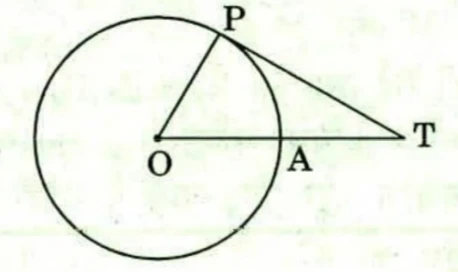
In the figure given below, the radius of the circle is cm and AT cm. The length of tangent PT is

A circle with centre O marked by a dot. P is a point on the upper right of the circle and T is an external point to the right of the circle. The radius OP is drawn, and the segment PT is drawn from P to T. A straight segment runs from O through the circle to T, cutting the circle at A; A lies between O and T, so OA is a radius along OT and AT is the part of OT outside the circle. Triangle OPT is thereby formed.
Options
Show answer & solution

Option B

cm

Approach

Build from the radius and , then use the right angle between a tangent and the radius at its point of contact.

Step-by-step solution

  1. 1
    lies on the circle and on the segment , so is a radius and cm.

    Why: The figure shows between and , so the two pieces simply add.

  2. 2
    is a tangent at , so it is perpendicular to the radius : .

    Why: This is the one fact that turns the figure into a right triangle, and without it nothing can be computed.

  3. 3
    cm

    Why: In right triangle the hypotenuse is , so the tangent length is the remaining leg.

Common mistakes

Option A

Answered with the radius, taking because both run from the circle.

Option D

Answered with , the hypotenuse, instead of the tangent.

Option C

Would need , which the given and do not produce.

Skills used

93Mensuration • Plane Figures • Circle
ModerateIdeal time: about 1.5 min

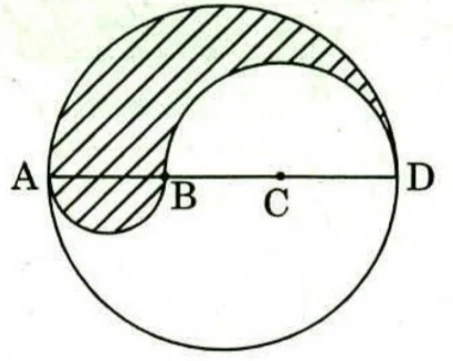
In the figure given below, ABCD is the diameter of a circle of radius cm. The lengths AB, BC and CD are equal. Semicircles are drawn on AB and BD as diameters as shown in the figure. What is the area of the shaded region ?

A circle whose horizontal diameter is the segment ADCD read left to right as A, B, C, D, where C is the centre (marked by a dot) and AB = BC = CD. A semicircle on BD as diameter is drawn above the diameter line, and a semicircle on AB as diameter is drawn below the diameter line. The hatched region is the part of the upper half of the big circle that lies outside the semicircle on BD, together with the semicircle on AB below the line.
Options
Show answer & solution

Option B

Approach

Split the shaded region into the upper half of the big circle less the semicircle on , plus the semicircle on below the line.

Step-by-step solution

  1. 1
    is a diameter of length cm and , so each part is cm and cm.

    Why: The three equal parts fix every radius in the figure from the single given radius of cm.

  2. 2
    Upper half of the big circle

    Why: The diameter cuts the big circle into two equal halves, and the shading above the line sits inside the upper one.

  3. 3
    Semicircle on (radius ) ; semicircle on (radius )

    Why: The semicircle on is the hole in the upper crescent; the one on is the extra piece shaded below the line.

  4. 4
    Shaded

    Why: The two halves combine to before the semicircle is taken out.

Common mistakes

Option C

Mixed up which semicircle is removed, taking out from the upper half instead of .

Option D

Answered with the whole circle, .

Option A

Too small by a factor of three; no combination of the three semicircles gives .

Skills used

94Geometry • Circle • Chords
ModerateIdeal time: about 1.5 min

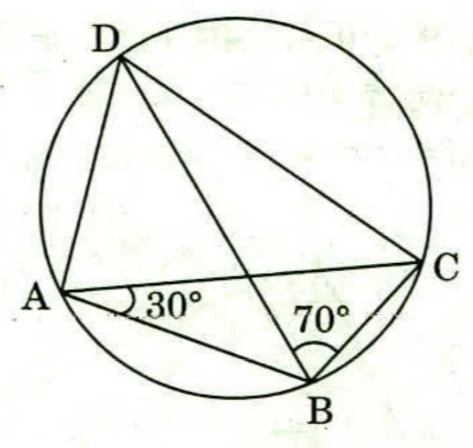
In the figure given below, what is equal to ?

A circle with four points on it: D at the top left, C at the right, B at the bottom and A at the left. The chords DA, DB, DC, AC and BC are drawn, so that AC and DB cross inside the circle. The angle at A between AC and AB is marked 30^\circ, and the angle at B between BD and BC is marked 70^\circ.
Options
Show answer & solution

Option C

Approach

Move the from to using angles in the same segment, then close the angle sum in .

Step-by-step solution

  1. 1
    The figure marks (at , between and ) and (at , between and ).

    Why: Both marked angles stand on chords of the circle, which is the only way the data can be used.

  2. 2
    and both stand on the chord , with and on the same arc, so .

    Why: Angles in the same segment are equal - the corollary that carries a marked angle to a vertex where it is useful.

  3. 3
    In :

    Why: Both other angles of that triangle are now known, so the third closes immediately.

Common mistakes

Option A

Copied the marked straight into the answer without moving the to .

Option D

Assumed is a diameter, which would make a right angle; nothing in the figure marks it as one.

Option B

Would need the two angles at and to sum to , which neither marked value supports.

Skills used

95Geometry • Circle • Chords
HardIdeal time: about 2.5 min

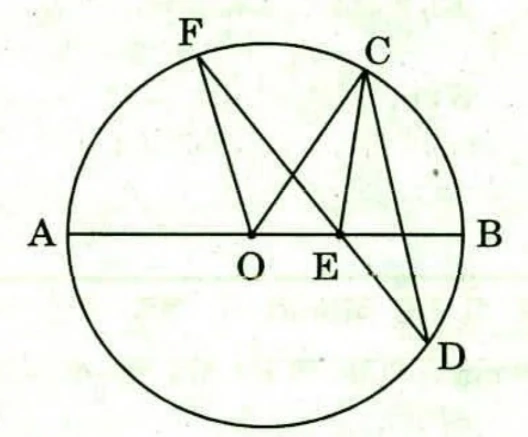
In the figure given below, AB is the diameter of the circle whose centre is at O. Given that , then and respectively are

A circle with horizontal diameter AB, A at the left and B at the right, and centre O marked on it. F is a point on the circle at the top left and C is a point on the circle at the top right. D is a point on the circle at the lower right. E is a point on the diameter AB between O and B. The segments drawn are FO, FE, CO, CE and CD, so that FE and CO cross between O and E; C, E and D are collinear along the chord CD which crosses AB at E.
Options
Show answer & solution

Option B

Approach

, , lie on one chord, so is an exterior angle of ; and is an inscribed angle standing on the chord .

Step-by-step solution

  1. 1
    In the figure the chord meets the diameter at ; the other segments drawn are the radii and and the chords and . So , , form a genuine triangle with .

    Why: Reading the collinear triple correctly is the whole of the setup: it is , , that are in a line, not , , .

  2. 2
    and are angles on the straight line at , so is the exterior angle of at : .

    Why: An exterior angle equals the sum of the two remote interior angles, which avoids computing at all.

  3. 3
    is the same angle as , because lies on ; it is an angle at the circumference standing on the chord .

    Why: is on the circle, so once is identified the chord is the one it subtends.

  4. 4
    The angle at the centre on that same chord is twice it: . So the two angles are and .

    Why: is the centre and , are on the circle, so the doubling applies directly.

Common mistakes

Option A

Took , copying one base angle instead of adding the two remote interior angles.

Option D

Got correctly but halved at the centre instead of doubling, giving for .

Option C

Copied the given into both blanks, missing both the exterior-angle sum and the doubling at the centre.

Skills used

96Geometry • Triangle • Similarity
EasyIdeal time: about 1 min

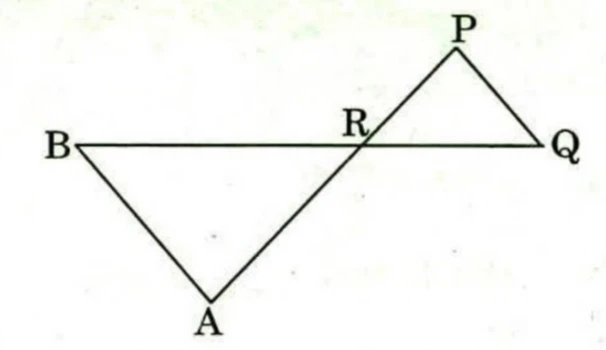
In the figure given below, ABR PQR. If PQ cm, AB cm, BR cm and PR cm, then QR and AR are respectively

Two triangles in a bow-tie arrangement sharing the vertex R. A horizontal line runs from B at the left to Q at the right, with R marked on it nearer to Q. Below the line, A is joined to B and to R, forming triangle ABR. Above the line and to the right, P is joined to R and to Q, forming triangle PQR. The points A, R and P are collinear, so the two triangles meet at R with vertically opposite angles.
Options
Show answer & solution

Option D

cm, cm

Approach

Read the correspondence off the similarity statement, fix the scale factor from and , then scale the other two pairs.

Step-by-step solution

  1. 1
    pairs with , with and with , so .

    Why: The order of the letters in a similarity statement is what fixes which side matches which; nothing else does.

  2. 2
    , so is twice .

    Why: One matched pair of sides is enough to pin the scale factor.

  3. 3
    corresponds to : cm

    Why: belongs to the smaller triangle, so the known length is divided, not multiplied.

  4. 4
    corresponds to : cm

    Why: belongs to the larger triangle, so here the known length is multiplied.

Common mistakes

Option A

Copied into without halving, while scaling correctly.

Option C

Scaled in the wrong direction on both: halved to and left itself as .

Option B

Pairs the correct with an of , which matches no side of either triangle.

Skills used

97Geometry • Triangle • Similarity
EasyIdeal time: about 1 min

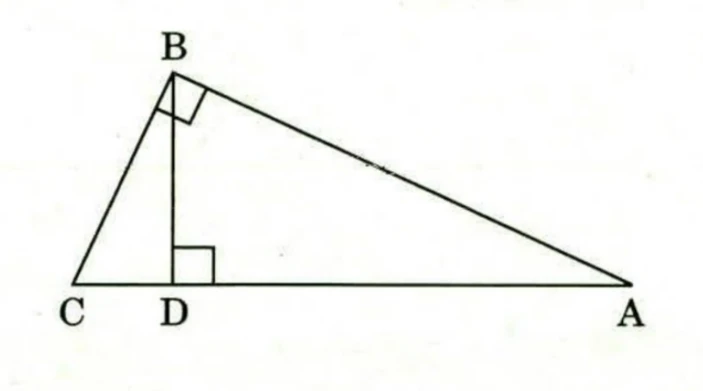
In the figure given below, ABC is a triangle with AB perpendicular to BC. Further BD is perpendicular to AC. If AD cm and DC cm, then what is the length of BD ?

Triangle ABC drawn with the long side CA horizontal at the bottom, C at the left and A at the right, and the vertex B above the left part of that side. The angle at B is marked with a small square showing AB is perpendicular to BC. D is the foot of the perpendicular from B to CA, marked with a small square at D; D lies on CA between C and A, close to C.
Options
Show answer & solution

Option D

cm

Approach

The altitude to the hypotenuse of a right triangle is the geometric mean of the two pieces it cuts.

Step-by-step solution

  1. 1
    and , so in and the angle at is right and (both complete to ). By AA, .

    Why: The altitude from the right angle always creates two triangles similar to the original and to each other; that is the fact this question is built on.

  2. 2
    Corresponding sides give , so .

    Why: and are the legs about in the first triangle, and the matching legs in the second.

  3. 3
    cm

    Why: Only the positive root is a length.

Shortcut

For the altitude to the hypotenuse, cm.

Common mistakes

Option B

Used , confusing the altitude relation with .

Option C

Took to be half the hypotenuse, , which is the MEDIAN from , not the altitude.

Option A

The reciprocal of B, with the quantities inverted as well.

Skills used

98Mensuration • Plane Figures • Circle
HardIdeal time: about 2.5 min

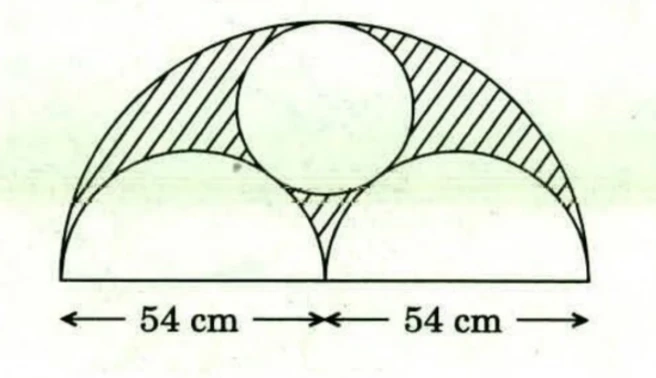
In the figure given below, the diameter of bigger semicircle is cm. What is the area of the shaded region ?

A large semicircle standing on a horizontal diameter, with the diameter divided at its mid-point into two equal parts each marked 54 cm by arrowed dimension lines below. On each 54 cm part a smaller semicircle is drawn upward, the two of them sitting side by side inside the large one. A full circle rests in the space above the two small semicircles, touching both of them and the large semicircular arc. The region inside the large semicircle but outside the two small semicircles and outside the circle is hatched.
Options
Show answer & solution

Option C

cm

Approach

Find the top circle's radius from the two touching conditions, then take the big semicircle less the two small semicircles and that circle.

Step-by-step solution

  1. 1
    The big semicircle has radius . Each small semicircle has diameter , so radius , with centres cm either side of the mid-point of the big diameter.

    Why: The two marked cm pieces fix every radius on the base line.

  2. 2
    Let the top circle have radius , with its centre on the vertical through at height (by symmetry). Touching the big arc from inside gives ; touching a small semicircle from outside gives .

    Why: Touching internally puts the centres apart; touching externally puts them apart, and that second distance is a hypotenuse.

  3. 3

    Why: The terms cancel on both sides, leaving a linear equation.

  4. 4
    Shaded cm

    Why: The hatching is the part of the big semicircle left after the two small semicircles and the full circle are removed.

Common mistakes

Option D

Removed only one of the two small semicircles: .

Option A

Would need the removed parts to total , which no combination of the three circles gives.

Option B

A decimal multiple of that no combination of radii , and produces.

Skills used

99Geometry • Triangle • Similarity
ModerateIdeal time: about 2 min

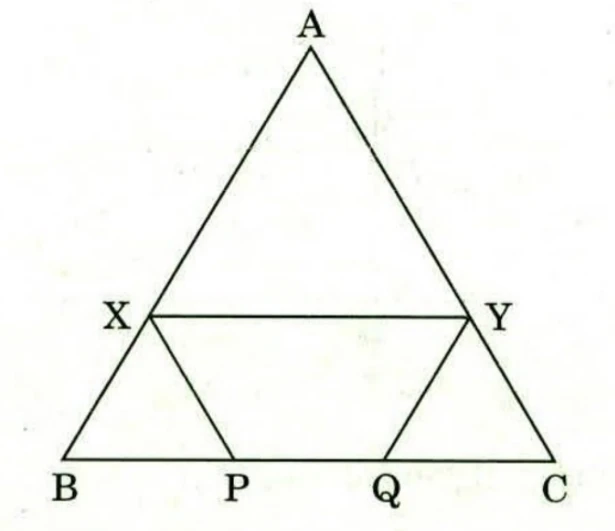
In the figure given below, ABC is an equilateral triangle with each side of length cm. XY is parallel to BC, XP is parallel to AC and YQ is parallel to AB. If XY XP YQ is cm, then the value of PQ is

Equilateral triangle ABC with apex A at the top, B at the bottom left and C at the bottom right. X lies on AB and Y lies on AC, with the segment XY drawn parallel to BC. P and Q lie on BC with P to the left of Q. The segment XP is drawn parallel to AC and the segment YQ is drawn parallel to AB, so that XBP and YQC are small triangles and XYQP is a parallelogram.
Options
Show answer & solution

Option D

cm

Approach

Each of the three small triangles cut off is equilateral; name and everything in the sum is written in terms of .

Step-by-step solution

  1. 1
    , so , and too: is equilateral, giving . Call this common length .

    Why: A line parallel to one side of an equilateral triangle cuts off another equilateral triangle, because all the angles are .

  2. 2
    In the same way makes equilateral: . Call this .

    Why: The same argument at the other end of , with .

  3. 3
    makes equilateral, so . Since and , this forces and .

    Why: and must be at equal distances from for to be parallel to , which is what ties the two ends together.

  4. 4

    Why: Two of the three lengths are and the third is , so the sum is linear in and the falls out.

  5. 5
    cm

    Why: and both lie on with , , , in that order, so the three pieces add to .

Common mistakes

Option C

Halved the side of the triangle, as if and were fixed independently of the given sum of .

Option B

No value of makes equal to while .

Option A

Would need , which contradicts .

Skills used

100Mensuration • Plane Figures • Composite and Shaded Regions
EasyIdeal time: about 1.5 min

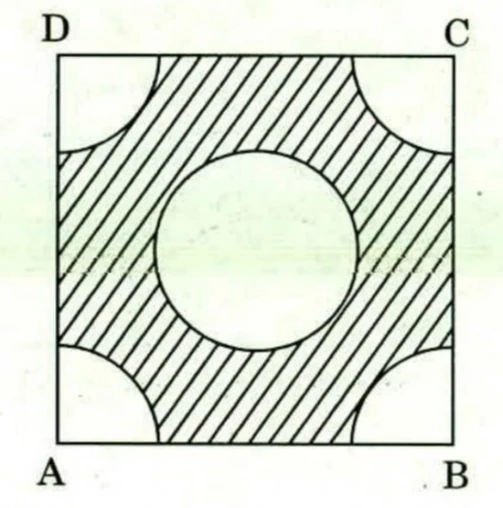
In the figure given below, ABCD is a square of side cm. Quadrants of a circle of diameter cm are removed from the four corners and a circle of diameter cm is also removed. What is the area of the shaded region ?

A square with D at the top left, C at the top right, A at the bottom left and B at the bottom right. A quarter-circle of radius 1 cm is removed at each of the four corners, leaving rounded notches. A full circle of diameter 2 cm is removed from the centre of the square. The remaining region of the square is hatched with diagonal lines.
Options
Show answer & solution

Option C

cm

Approach

The four corner quadrants make one whole circle; subtract that and the central circle from the square.

Step-by-step solution

  1. 1
    Square of side cm: area cm

    Why: This is the region before anything is removed.

  2. 2
    Each corner quadrant comes from a circle of diameter cm, so radius cm; four quadrants are four quarter-circles of the same radius, which together make one full circle of area cm.

    Why: Adding the four quarters first is quicker and safer than computing each one.

  3. 3
    The circle removed from the centre has diameter cm, so radius cm and area cm.

    Why: Same radius again, so the two removals are equal.

  4. 4
    Shaded cm

    Why: The options are given as mixed fractions with denominator or , which signals that is intended.

Common mistakes

Option D

Arithmetic slip in , writing as .

Option B

Would need about cm to be removed, which no combination of circles of radius gives.

Option A

Would need about cm removed, far more than the three circles' worth that are drawn.

Skills used