Skip to content

Mathematics 2020 (I & II)

Set A

Questions 1–20 of 120

1Matrices and Determinants • Types of Matrices
Moderate

If matrix where , then which one of the following is correct ?

Options
Show answer & solution

Option C

is hermitian

Approach

Find the conjugate transpose , compare it with and , then test .

Step-by-step solution

  1. 1
    , so

    Why: Change every to , then swap rows and columns.

  2. 2
    and

    Why: The diagonal entry is neither real nor purely imaginary. A Hermitian matrix needs a real diagonal, and a skew-Hermitian one a purely imaginary diagonal, so is neither.

  3. 3

    Why: Add entry by entry.

  4. 4
    Conjugate: ; transpose: , the same matrix. So is Hermitian

    Why: This had to happen: is Hermitian for every square matrix .

Common mistakes

Option A

Checks only the off-diagonal pair: does equal . But the diagonal entry is not real, so .

Option B

Skew-Hermitian needs a diagonal that is or purely imaginary; has the real part .

Option D

Mixes up with , which is the skew-Hermitian one. The sum has diagonal entries , which are real, so it is not skew-Hermitian.

Skills used
Ideal time: about 2 min
2Algebra • Binomial Theorem
Easy

The term independent of in the binomial expansion of is equal to

Options
Show answer & solution

Option A

Approach

Write the general term, set the power of to , and evaluate that term.

Step-by-step solution

  1. 1

    Why: General term with and . Keep the minus sign with .

  2. 2

    Why: Independent of means the power of is .

  3. 3

    Why: , and .

Common mistakes

Option B

No natural slip gives . The term with is .

Option C

Raises to the power but leaves the in unpowered: . The whole fraction is raised to the power .

Option D

No natural slip gives .

Skills used

Ideal time: about 1.5 min
3Algebra • Binomial Theorem
Easy

If , then what is equal to ?

Options
Show answer & solution

Option B

Approach

The alternating sum is the value of the expression at .

Step-by-step solution

  1. 1
    is the right-hand side at

    Why: At , even powers give and odd powers give , so the signs alternate.

  2. 2

    Why: Put in the bracket; , so gives .

  3. 3

Common mistakes

Option A

Takes the power as : . The power is .

Option C

No natural slip gives .

Option D

Drops the minus signs: and . At , and .

Skills used

Ideal time: about 1 min
4Algebra • Permutations and Combinations
Easy

If , then what is equal to ?

Options
Show answer & solution

Option C

Approach

Equal combinations with different lower numbers must have lower numbers adding up to the top number.

Step-by-step solution

  1. 1
    , so needs

    Why: : choosing things leaves behind, so two different lower numbers give equal values only when they add up to .

  2. 2

Common mistakes

Option A

Sets , as if the coefficient were . Then the other side is .

Option B

Not possible: is more than , so does not exist.

Option D

Gives the value of , not of .

Skills used

Ideal time: about 51 s
5Matrices and Determinants • Determinants
Easy

For how many values of , is the matrix singular ?

Options
Show answer & solution

Option D

Infinite

Approach

Expand the determinant in terms of and see for which it is .

Step-by-step solution

  1. 1

    Why: Expand along the first row, with signs . The first entry is , so its term drops.

  2. 2
    and
  3. 3

    Why: The determinant is whatever is.

  4. 4
    Singular for every real : infinitely many values

    Why: A matrix is singular when its determinant is .

Shortcut

Row 1 plus row 2 is , which is row 3. So gives a row of zeros, and the determinant is for every .

Common mistakes

Option A

Forgets the minus sign on the middle term: , which is only at .

Option B

No natural slip gives exactly two values; the determinant is for every .

Option C

No natural slip gives four values; the determinant is for every .

Skills used

Ideal time: about 1.5 min
6Algebra • Binary and Other Number Systems
Easy

The number can be written in decimal system as

Options
Show answer & solution

Option C

Approach

Change each binary number to decimal by place values, then add.

Step-by-step solution

  1. 1

    Why: From the right the places are worth ; add those that carry a .

  2. 2
  3. 3

Common mistakes

Option A

Drops the units place in both numbers: .

Option B

Drops the units place in one number: .

Option D

No natural slip gives .

Skills used

Ideal time: about 1.5 min
7Algebra • Logarithms
Very easy

What is the value of ?

Options
Show answer & solution

Option A

Approach

Write and as powers, bring the powers down, then combine the logs.

Step-by-step solution

  1. 1

    Why: ; the power law brings the down.

  2. 2

    Why: and .

  3. 3

    Why: A difference of logs is the log of the quotient.

  4. 4

Common mistakes

Option B

Reads as , so the first two terms seem to cancel and only the last term, , is left.

Option C

Takes as instead of : .

Option D

No natural slip gives .

Skills used

Ideal time: about 1.5 min
8Algebra • Logarithms
Easy

If , , , then which of the following is correct ?

Options
Show answer & solution

Option C

Approach

Write each as a single log of , then turn each reciprocal into a log with base .

Step-by-step solution

  1. 1

    Why: Write as , then use the product law.

  2. 2

    Why: Swapping the base and the number of a log turns it into its reciprocal.

  3. 3
    In the same way, and
  4. 4
    Sum

Common mistakes

Option A

Mixes this up with . Here each log has a product inside: with , and .

Option B

No natural slip leads here. With , .

Option D

Squares the reciprocals, but the identity is for the first powers. With the sum is .

Skills used

Ideal time: about 1.5 min
9Matrices and Determinants • Matrix Operations
Easy

Let , and . If , then what is the value of the determinant of the matrix ?

Options
Show answer & solution

Option B

Approach

Multiply by the column , equate with to find and , then find .

Step-by-step solution

  1. 1

    Why: is and is , so is . Each entry is a row of times the column .

  2. 2
    and

    Why: Equal matrices have equal entries.

  3. 3
    Subtract: ; then
  4. 4
  5. 5

Common mistakes

Option A

Writes only the second product, .

Option C

Stops at the first product, , and forgets to subtract .

Option D

Adds the second product instead of subtracting it: .

Skills used

Ideal time: about 2 min
10Algebra • Linear Inequalities
Easy

If , then which one of the following is correct ?

Options
Show answer & solution

Option D

Approach

The interval runs exactly from one root of the product to the other, so find the sign between the roots and at the ends.

Step-by-step solution

  1. 1
    at and at

    Why: These are the two ends of the given interval.

  2. 2
    For : and , so the product is negative

    Why: Between the roots the two factors have opposite signs.

  3. 3
    At and the product is

    Why: The interval includes its ends, so the answer must allow .

  4. 4
    So for every with

Common mistakes

Option A

Reverses the sign: the product is positive only outside the roots, for or .

Option B

Forgets the ends: at the product is , which is not .

Option C

Reverses the sign: at the product is , which is not .

Skills used

Ideal time: about 1 min
11Algebra • Relations and Functions
Easy

Let . A relation on is defined by if when . Then the relation is

Options
Show answer & solution

Option C

transitive only

Approach

Turn into a plain comparison of and , then test the three properties.

Step-by-step solution

  1. 1

    Why: With a base less than , a logarithm reverses order: is greater than .

  2. 2
    So means , for in

    Why: The paper prints 'on ', but compares two numbers of , so is a relation on . The answer does not depend on this.

  3. 3
    Reflexive? is never true: not reflexive
  4. 4
    Symmetric? but not : not symmetric
  5. 5
    Transitive? and give : transitive

Common mistakes

Option A

is false for every , so is not reflexive. Reading as would make it reflexive, but the paper prints a strict .

Option B

holds but does not, so is not symmetric.

Option D

Accepts symmetry without testing a pair: does not give .

Skills used

Ideal time: about 1.5 min
12Matrices and Determinants • Determinants
Easy

What is the value of the determinant where ?

Options
Show answer & solution

Option D

Approach

Reduce the powers of , make zeros with a column operation, then expand.

Step-by-step solution

  1. 1

    Why: Powers of repeat every : , , , , , .

  2. 2
    : column 1 becomes

    Why: Adding one column to another does not change the determinant, and here it makes two zeros.

  3. 3

    Why: Expand along column 1. The entry is in row 2, column 1, a place with a minus sign.

  4. 4
  5. 5

Common mistakes

Option A

Takes columns 1 and 3 as equal. They are not: and differ in sign in two places.

Option B

No natural slip gives .

Option C

Forgets the minus sign of the place (row 2, column 1) when expanding: .

Skills used

Ideal time: about 2 min
13Matrices and Determinants • Matrix Operations
Very easy

Let and , then what is equal to ?

Options
Show answer & solution

Option C

Approach

Find the order of , then multiply each row of by the column .

Step-by-step solution

  1. 1
    is and is , so is

    Why: The result has one row for each row of and one column for each column of : it is a column.

  2. 2
    Row 1: ; row 2: ; row 3:

    Why: Each entry is a row of times the column , entry by entry, added.

Common mistakes

Option A

Multiplies only the first row of and copies and from . Every row of must be multiplied.

Option B

Multiplies only the first two rows of and copies from .

Option D

Writes the result as a row. A matrix times a column is , a column.

Skills used

Ideal time: about 1 min
14Algebra • Permutations and Combinations
Very easy

What is the number of ways in which the letters of the word 'ABLE' can be arranged so that the vowels occupy even places ?

Options
Show answer & solution

Option B

Approach

Put the vowels in the even places first, then the consonants in the odd places, and multiply.

Step-by-step solution

  1. 1
    Vowels: . Consonants: . Even places: 2nd and 4th
  2. 2
    Vowels in places 2 and 4: ways

    Why: The two vowels can be in either order.

  3. 3
    Consonants in places 1 and 3: ways
  4. 4

    Why: The two choices are independent, so they multiply.

Common mistakes

Option A

Counts only the orders of the vowels and forgets that and can also swap.

Option C

No natural slip gives .

Option D

Also counts the vowels in the odd places. The question asks only for even places.

Skills used

Ideal time: about 59 s
15Algebra • Permutations and Combinations
Very easy

What is the maximum number of points of intersection of non-overlapping circles ?

Options
Show answer & solution

Option C

Approach

Two different circles meet in at most points, so count the pairs of circles and double.

Step-by-step solution

  1. 1
    Two different circles meet in at most points

    Why: 'Non-overlapping' is read as: no two circles lie on top of each other. For the maximum, every pair meets in points and no point is on three circles. If the word meant that no two circles share any inside region, circles could at most touch, and no option would fit.

  2. 2
    Number of pairs:
  3. 3

Common mistakes

Option A

Counts one point for each pair, as for lines. Two circles can meet in two points.

Option B

No natural slip gives .

Option D

No counting route gives .

Skills used

Ideal time: about 56 s
16Algebra • Sets
Very easy

Directions for the following three (03) items :

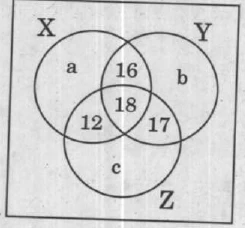
Consider the following Venn diagram, where , and are three sets. Let the number of elements in be denoted by which is equal to .

A rectangle containing three mutually overlapping circles labelled X (upper left), Y (upper right) and Z (lower). The region in X only is marked a, in Y only b, and in Z only c. The region in X and Y but not Z is marked 16, in X and Z but not Y is marked 12, in Y and Z but not X is marked 17, and the central region in all three is marked 18. The part of the rectangle outside the circles has no marking.

If the number of elements in and are in the ratio , then what is the value of ?

Options
Show answer & solution

Option C

Approach

Write from the regions of the diagram and use the ratio with .

Step-by-step solution

  1. 1

    Why: Circle holds four regions: , , and .

  2. 2
    , so
  3. 3

Common mistakes

Option A

is the centre region, in all three sets, not .

Option B

No natural slip gives .

Option D

Adds the three shared regions of as instead of : .

Skills used

Ideal time: about 1 min
17Algebra • Sets
Very easy

Same directions as Q16

What is the value of ?

Options
Show answer & solution

Option D

Approach

The expression is ; add every region inside the circles.

Step-by-step solution

  1. 1

    Why: This is the formula for the number of elements in a union of three sets.

  2. 2
    , so

    Why: Circle holds four regions.

  3. 3

    Why: The union is every region inside the circles, each counted once.

Common mistakes

Option A

Adds only the one-set regions , and , and leaves out the four shared regions, which hold .

Option B

Adds the shared regions but leaves out .

Option C

No natural slip gives .

Skills used

Ideal time: about 1 min
18Algebra • Sets
Very easy

Same directions as Q16

If the number of elements belonging to neither , nor , nor is equal to , then what is the number of elements in the complement of ?

Options
Show answer & solution

Option A

Approach

The complement of is every region outside circle , including the elements outside all circles.

Step-by-step solution

  1. 1
    , so

    Why: Circle holds four regions.

  2. 2
    Outside : the regions , , , and the elements in none of the sets
  3. 3

Common mistakes

Option B

No natural slip gives ; the regions and add to .

Option C

Uses , which is inside , instead of , which is outside it.

Option D

Uses , which is inside , and no natural slip gives .

Skills used

Ideal time: about 54 s
19Trigonometry • Compound and Multiple Angles
Easy

Directions for the following two (02) items :

Read the following information and answer the two items that follow :

Let , where and .

What is equal to ?

Options
Show answer & solution

Option B

Approach

Write in terms of , divide by , and solve for .

Step-by-step solution

  1. 1
    , with
  2. 2

    Why: Divide by ; allowed because .

  3. 3

    Why: Cross-multiply, then collect the terms on one side.

  4. 4

    Why: Dividing by is allowed because .

Common mistakes

Option A

Moves the across without changing its sign: .

Option C

No natural slip gives .

Option D

Gets both signs wrong when collecting terms, on the and on the .

Skills used

Ideal time: about 1.5 min
20Trigonometry • Compound and Multiple Angles
Easy

Same directions as Q19

For real values of , cannot lie between

Options
Show answer & solution

Option A

and

Approach

Express in terms of ; a real non-zero makes it positive, which limits .

Step-by-step solution

  1. 1

    Why: From with : , so .

  2. 2

    Why: is real and not , so its square is positive.

  3. 3
    or

    Why: A fraction is positive when top and bottom have the same sign; they differ only between and .

  4. 4
    So cannot lie between and

    Why: gives , which is excluded, and is excluded by the setup. Option B is also true, since every number between and is between and ; A is keyed because it names the whole range cannot take.

Common mistakes

Option B

Also defensible

Also true on a strict reading: every between and lies between and , so cannot be there either. It is not the key because it names only part of the range cannot take; A names all of it.

Option C

Too wide: lies between and , yet gives , a real .

Option D

Too wide: lies between and , yet gives , a real .

Skills used

Ideal time: about 1.5 min