Skip to content

Mathematics 2017 (II)

Set A

Questions 81–100 of 120

81Differential Equations • Order and Degree
Very easy

The order and degree of the differential equation

are respectively

Options
Show answer & solution

Option B

and

Approach

Order is the highest derivative present; degree is the power of that derivative once the equation is free of roots and fractions in the derivatives.

Step-by-step solution

  1. 1
    The highest derivative is , so the order is
  2. 2
    The equation is already a polynomial in the derivatives, and appears to the power , so the degree is

    Why: The power belongs to an expression in , which is a lower derivative; it does not decide the degree.

Common mistakes

Option A

Takes the power on the bracket as the order. The order is the highest derivative, .

Option C

Takes the degree from the largest power anywhere (, on the bracket in ) instead of the power of the highest derivative.

Option D

Takes the order from and the degree from the bracket's power : both read from the wrong term.

Skills used

Ideal time: about 48 s
82Differential Calculus • Derivatives
Easy

If , then is equal to

Options
Show answer & solution

Option A

for all

Approach

Put to turn the argument into , write as , and watch the range of .

Step-by-step solution

  1. 1
    , so
  2. 2
    For : , so

    Why: With , . For , is in , so .

  3. 3
    for
  4. 4
    For , is in and , so and . The same sign holds for

    Why: This rules out B: for the derivative is , not .

Common mistakes

Option B

Uses outside , where it does not hold. For the derivative is .

Option C

Drops the minus sign from .

Option D

Option A is true, so 'None of the above' is wrong.

Skills used

Ideal time: about 1.5 min
83Differential Calculus • Continuity and Differentiability
Easy

The set of all points, where the function is differentiable, is

Options
Show answer & solution

Option C

Approach

Away from the inside of the root is positive, so is differentiable; at compare the left and right derivatives.

Step-by-step solution

  1. 1
    for , so there exists

    Why: when . The square root is differentiable wherever its inside is positive.

  2. 2
    At : , and , so this is

    Why: Bring inside the root as , which is , not .

  3. 3
    with , so it tends to
  4. 4
    Right derivative , left derivative : not differentiable at

    Why: is for and for . Near the graph looks like , with a corner.

Common mistakes

Option A

Leaves out every negative . But is even, so it is differentiable at wherever it is at .

Option B

Assumes a combination of smooth functions is smooth everywhere and misses the corner at , where the inside of the root is .

Option D

No natural slip gives ; it includes and leaves out .

Skills used

Ideal time: about 1.5 min
84Trigonometry • Maximum and Minimum Values of Trigonometric Expressions
Very easy

Match List–I with List–II and select the correct answer using the code given below the lists :

List–I (Function)

A
B
C
D

List–II (Maximum value)

1
2
3
4

Code :

Options
ABCD
Show answer & solution

Option B

A2B3C4D1

Approach

The greatest value of is ; work it out for each function.

Step-by-step solution

  1. 1
    for a fixed angle , so its greatest value is

    Why: Writing it as one cosine shows it swings between and .

  2. 2
    A: (2). B: (3). C: (4). D: (1)
  3. 3
    The code is A-2, B-3, C-4, D-1

Common mistakes

Option A

Swaps the values of C and D: is for and for .

Option C

Swaps A with B and C with D.

Option D

Swaps A and B: is the maximum of , not of .

Skills used

Ideal time: about 1 min
85Differential Calculus • Continuity and Differentiability
Moderate

If , then is

Options
Show answer & solution

Option B

differentiable at

Approach

The domain is , so is an end point; judge continuity and the derivative there from the right, the only side the function has.

Step-by-step solution

  1. 1
    needs , so the domain is and is its left end

    Why: At an end of the domain there are no points on the other side to check.

  2. 2
    : continuous at
  3. 3

    Why: Cancel , then let . The limit is a finite number, .

  4. 4
    So exists, and is differentiable at

    Why: On a strict reading, B is correct. A is right only if one demands a left-hand derivative too; but then the same demand would also make not continuous at , which A asserts.

Common mistakes

Option A

Also defensible

Defensible on the reading that a derivative at a point needs both a left and a right derivative: there is no left side, so on that reading is not differentiable at . It is not the key because the same reading should apply to continuity, and A still calls continuous from one side.

Option C

Thinks the missing left side makes discontinuous. At an end of the domain, continuity is judged from the one side, where the limit equals .

Option D

B holds on a strict reading, so 'None of the above' is not needed.

Skills used

Ideal time: about 1.5 min
86Algebra • Functions
Very easy

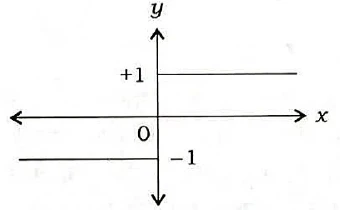
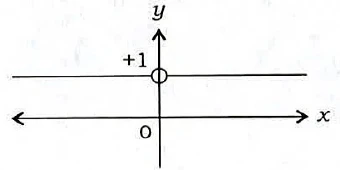
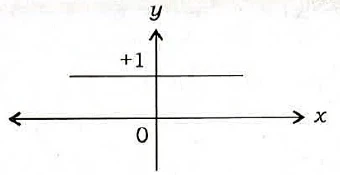
Which one of the following graphs represents the function , ?

The graph printed as option (a). Axes x and y cross at the point labelled 0; the x-axis has arrowheads at both ends and the y-axis has an arrowhead at the top only. One unbroken horizontal line at the height labelled +1 on the y-axis, running on both sides of the y-axis and crossing it. No open circle.
The graph printed as option (b). Axes x and y cross at the point labelled 0, each with arrowheads at both ends. For x > 0, a horizontal line at the height labelled +1, starting at the y-axis. For x < 0, a horizontal line at the height labelled -1, ending at the y-axis. No open circles.
The graph printed as option (c). Axes x and y cross at the point labelled 0; the x-axis has arrowheads at both ends and the y-axis has an arrowhead at the top only. A horizontal line at the height labelled +1 on both sides of the y-axis, with an open circle where it meets the y-axis.
Options
Show answer & solution

Option C

Graph (c)

Approach

Simplify to , but keep the condition : the graph is the line with the point at missing.

Step-by-step solution

  1. 1
    For :
  2. 2
    is not defined at , so the point is not on the graph

    Why: Cancelling does not give a value at .

  3. 3
    Graph (c) shows the line on both sides of the -axis with an open circle at

    Why: Graph (a) has no gap at ; graph (b) has for .

Common mistakes

Option A

Shows the full line , including . That forgets .

Option B

This is the graph of , which is for . Here the denominator is , not , so the value is on both sides.

Option D

Graph (c) is correct, so 'None of the above' is wrong.

Skills used

Ideal time: about 58 s
87Algebra • Functions
Very easy

Let , where denotes the integral part of . Then the value of is

Options
Show answer & solution

Option A

Approach

Each term is or ; count the for which reaches .

Step-by-step solution

  1. 1
    For : , so each is or

    Why: The integer part of a number from to is (below ) or (from up to ).

  2. 2
    when , that is
  3. 3
    : values

    Why: Both ends are included, so add to the difference.

  4. 4

Common mistakes

Option B

Counts , leaving out one end of the range.

Option C

No natural slip gives ; it would count only one term as .

Option D

Thinks is always below , missing that goes up to .

Skills used

Ideal time: about 1 min
88Integral Calculus • Indefinite Integrals
Easy

is equal to

Options
Show answer & solution

Option A

Approach

Integrate by parts with as the second function; the new integral is exactly the one being subtracted.

Step-by-step solution

  1. 1

    Why: Take as the first function and as the second, whose integral is .

  2. 2
  3. 3

    Why: The and cancel, and the two minus signs make a plus.

  4. 4

    Why: The second integral cancels.

Common mistakes

Option B

No natural slip gives ; its derivative, , is not the integrand.

Option C

No natural slip gives ; its derivative is .

Option D

No natural slip gives ; its derivative is .

Skills used

Ideal time: about 1.5 min
89Differential Calculus • Applications of Derivatives
Moderate

A cylindrical jar without a lid has to be constructed using a given surface area of a metal sheet. If the capacity of the jar is to be maximum, then the diameter of the jar must be times the height of the jar. The value of is

Options
Show answer & solution

Option B

Approach

Use the fixed surface area to write in terms of , make the volume a function of alone, and maximise it.

Step-by-step solution

  1. 1
    No lid: (one base and the curved surface), fixed.

    Why: A jar without a lid has only one circular end.

  2. 2
    , so

    Why: Use the fixed quantity to remove , so depends on only.

  3. 3
    gives
  4. 4
    , so this is a maximum
  5. 5
    gives , so the diameter and

    Why: Put back into the surface area.

Common mistakes

Option A

Uses a closed cylinder, . That gives , so diameter height and .

Option C

No natural slip gives ; it may come from , but is not the ratio of diameter to height.

Option D

No natural slip gives .

Skills used

Ideal time: about 2.5 min
90Integral Calculus • Definite Integrals
Moderate

The value of

is equal to

Options
Show answer & solution

Option D

Approach

Add the integrands into , then put , whose derivative is the numerator.

Step-by-step solution

  1. 1

    Why: The question asks for the sum, so add the integrands first.

  2. 2
    Put :

    Why: The numerator is the derivative of .

  3. 3
    , so

    Why: Squaring gives .

  4. 4
    Limits: gives ; gives . The integral is

    Why: .

  5. 5

Common mistakes

Option A

Treats the sum as if it were , as in the integrals of type.

Option B

Writes , dropping the ; the factor is lost and the answer becomes .

Option C

Puts the in the denominator instead of the numerator, as if .

Skills used

Ideal time: about 2 min
91Differential Calculus • Continuity and Differentiability
Moderate

Let be the greatest integer function. Then the function is discontinuous at

Options
Show answer & solution

Option D

all integers except

Approach

Check each integer : compare with the values of just to the left and just to the right of .

Step-by-step solution

  1. 1
    for every integer

    Why: At an integer, and is also an integer, so .

  2. 2
    Just right of : , , so

    Why: For a little more than , is a little more than , so both brackets keep their value at .

  3. 3
    Just left of : , , so

    Why: For a little less than , both and drop just below an integer, so each bracket falls by .

  4. 4
    only for . So is continuous at and discontinuous at

    Why: Continuity needs the left value, the right value and all equal to .

  5. 5
    At : for , and , so . Discontinuous at .

    Why: For negative , is positive, so must be checked on its own.

  6. 6
    At : just right of , and is just below , so . Discontinuous.

    Why: For negative , moving right makes smaller, so drops by .

  7. 7
    Among the integers, is discontinuous at every one except .

Common mistakes

Option A

Misses that at the left value matches , so is continuous at .

Option B

Checks only from the right, where . From the left , so is not continuous at .

Option C

Keeps as a point of continuity by checking it from the right only, and misses the continuity at . No single slip gives exactly this option.

Skills used

Ideal time: about 2 min
92Differential Equations • Formation of Differential Equations
Easy

The differential equation of minimum order by eliminating the arbitrary constants and in the equation is

Options
Show answer & solution

Option D

Approach

Two arbitrary constants, so differentiate twice and remove them.

Step-by-step solution

  1. 1
    has two constants, so the equation has order

    Why: Each differentiation gives one more equation; two constants need two.

  2. 2

    Why: Differentiate each term; and .

  3. 3

    Why: The bracket is the original one with a minus sign, so and both disappear.

  4. 4

Shortcut

, so , and any satisfies .

Common mistakes

Option A

No natural slip gives it. With , , ; at , and , so the left side is , not .

Option B

No natural slip gives it. With at : but .

Option C

No natural slip gives it. With at : but .

Skills used

Ideal time: about 1 min
93Differential Calculus • Applications of Derivatives
Easy

Consider the following statements :

Statement I
for all
Statement II
is an increasing function for all

Which one of the following is correct in respect of the above statements?

Options
Show answer & solution

Option A

Both Statement I and Statement II are true and Statement II is the correct explanation of Statement I

Approach

Test Statement II with the derivative, then see whether it proves Statement I.

Step-by-step solution

  1. 1
    ,

    Why: always.

  2. 2
    only at , single points; between them . So is increasing for : Statement II is true.

    Why: A derivative that is zero only at separate points does not stop the function rising.

  3. 3
    , so for , , that is : Statement I is true.

    Why: An increasing function that starts at is positive after the start.

  4. 4
    Statement I follows from Statement II, so II explains I.

    Why: Step 3 proves I using only II and .

Common mistakes

Option B

Sees both statements true but misses that II, with , directly proves I.

Option C

Calls II false because . A derivative zero at single points still leaves increasing.

Option D

No natural slip makes I false: for , (e.g. ), and for , with equality impossible.

Skills used

Ideal time: about 1.5 min
94Differential Equations • First-Order Equations
Hard

The solution of the differential equation

is

Options
Show answer & solution

Option D

Approach

Gather , which is the top of , and integrate.

Step-by-step solution

  1. 1

    Why: Cross-multiply to remove the fraction.

  2. 2

    Why: Put the terms with together; .

  3. 3
    , that is

    Why: Dividing by turns the left side into the differential of the quotient .

  4. 4

    Why: Integrate both sides.

  5. 5

Common mistakes

Option A

Swaps and when turning round.

Option B

Solves without a constant to get and adds at the end. The constant belongs where the integration happens, next to .

Option C

Attaches the constant to instead of to , the side that was integrated.

Skills used

Ideal time: about 2.5 min
95Algebra • Functions
Easy

If and , then what is the value of equal to?

Options
Show answer & solution

Option B

Approach

Find the inner value first, then put it into .

Step-by-step solution

  1. 1
    ,

    Why: Work out the top and bottom of separately.

  2. 2
    , so

    Why: , since .

  3. 3

    Why: means apply first, then .

Common mistakes

Option A

No natural slip gives .

Option C

Takes as (mixing it up with ), then .

Option D

No natural slip gives .

Skills used

Ideal time: about 1 min
96Matrices and Determinants • Determinants
Easy

The value of the determinant

is equal to

Options
Show answer & solution

Option B

Approach

Column operations turn the determinant into the standard form.

Step-by-step solution

  1. 1
    Each row adds to : . So gives first column .

    Why: Adding columns into one does not change the determinant.

  2. 2
    :

    Why: Adding one column to another leaves the value unchanged.

  3. 3

    Why: This is the standard form whose value is the product of the differences.

Common mistakes

Option A

Gets one factor's sign wrong: , so this is the negative of the value.

Option C

Uses the result for the determinant with columns , which has the extra factor .

Option D

Expects a column of zeros from the column operation. The columns combine into , not .

Skills used

Ideal time: about 1 min
97Matrices and Determinants • Adjoint and Inverse
Easy

The adjoint of the matrix

is

Options
Show answer & solution

Option B

Approach

Find the nine cofactors and write them in columns (the transpose of the cofactor matrix).

Step-by-step solution

  1. 1
    Row 1 cofactors: , ,

    Why: Each cofactor is the minor with the sign .

  2. 2
    Row 2: , ,
  3. 3
    Row 3: , ,
  4. 4

    Why: The cofactors of row become column of the adjoint.

Common mistakes

Option A

Has the right sizes but four signs wrong: the signs are misplaced on the cofactors.

Option C

No natural slip gives these entries.

Option D

No natural slip gives these entries.

Skills used

Ideal time: about 59 s
98Matrices and Determinants • Matrix Operations
Easy

If , then which one of the following is correct?

Options
Show answer & solution

Option B

Approach

Square and compare the result with .

Step-by-step solution

  1. 1

    Why: Each entry is a row of times a column of .

  2. 2

    Why: Every entry of is times the matching entry of .

Common mistakes

Option A

Takes only one product in each entry, getting instead of , so looks like .

Option C

No natural slip gives .

Option D

Drops the minus sign: , not .

Skills used

Ideal time: about 1 min
99Algebra • Complex Numbers
Easy

Geometrically , where and is the real part, represents

Options
Show answer & solution

Option C

rectangular hyperbola

Approach

Write , find the real part of , and name the curve.

Step-by-step solution

  1. 1

    Why: Expand with .

  2. 2
    , so

    Why: Subtracting changes only the imaginary part.

  3. 3
    , that is

    Why: Equal coefficients with opposite signs: a hyperbola with equal axes.

Common mistakes

Option A

Takes as , mixing up with .

Option B

No natural slip gives an ellipse; and have opposite signs.

Option D

Keeps only from and drops the .

Skills used

Ideal time: about 1 min
100Matrices and Determinants • Determinants
Moderate

If , then the determinant

equals

Options
Show answer & solution

Option A

Approach

Expand the determinant, then use when .

Step-by-step solution

  1. 1

    Why: Expand along the first row.

  2. 2

    Why: Collect the terms with and the terms with .

  3. 3
    and

    Why: Both sums of three are zero.

  4. 4

Common mistakes

Option B

No natural slip gives .

Option C

No natural slip gives .

Option D

No natural slip gives this; it also adds , which is .

Skills used

Ideal time: about 2 min