Skip to content

General Ability Test 2026 (I)

Set A

Questions 61–80 of 150

61Physics • Heat and Thermodynamics • Specific Heat and Calorimetry
Moderate

A 5 g piece of ice at −20 °C is put into m kg of water at 30 °C temperature. The heat is exchanged only between the ice and the water. The final temperature of the mixture is 0 °C in liquid phase. What is the value of m in kg?

Options
Show answer & solution

Option C

0.015

Why

Heat lost by the water equals heat gained by the ice. The ice first warms from C to C, then melts at C. The water cools from C to C. Use specific heat of ice , latent heat of fusion cal/g, specific heat of water (NCERT Class 11 Physics, Thermal Properties of Matter).

Exam-hall approach

Melting alone needs cal, so the water must give at least that: kg. That strikes B. The warming of the ice adds a little more, giving .

Proof

Ice: cal; water: cal; kg

About the other options

Option A

Would give cal, more than three times what the ice takes.

Option B

Would give only cal, not even enough to melt the ice ( cal).

Option D

A factor-of-ten slip: kg would give cal.
Ideal time: about 1.5 min
62Physics • Oscillations, Waves and Sound • Propagation of Sound
Moderate

A very large container consists of an ideal gas. The speed of sound in the gas is x. When the pressure of the gas is doubled while keeping the temperature constant, the speed of sound now becomes y. What is the ratio of x to y?

Options
Show answer & solution

Option A

Why

The speed of sound in a gas is (Laplace's formula). At constant temperature, doubling the pressure also doubles the density, since . So does not change: it depends on temperature, not pressure (NCERT Class 11 Physics, Waves).

Proof

, independent of at fixed ;

About the other options

Option B

Treats the density as fixed, so that , but density rises with pressure at constant temperature.

Option C

Takes ; no form of the formula gives this.

Option D

Takes ; no form of the formula gives this.

Ideal time: about 27 s
63Physics • Motion, Force and Laws of Motion • Newton's Laws and Conservation of Momentum
Very easy

A person jumps from a height on soft sand. Which one of the following is the correct reason for less likely injury to the person?

Options
Show answer & solution

Option C

The sand increases the impact time.

Why

The person's momentum must drop to zero on landing either way. Force equals the change in momentum divided by the time it takes. Soft sand stretches that time, so the force on the body is smaller (NCERT Class 9 Science, Force and Laws of Motion).

Proof

: the same over a longer gives a smaller .

About the other options

Option A

The sand must push back to stop the person; it just pushes less hard for longer.

Option B

The change in momentum is the same, from the landing momentum to zero, on any ground.

Option D

The momentum is set by the landing speed; the sand cannot add to it.

Ideal time: about 24 s
64Physics • Light and Optics • Reflection of Light and Mirrors
Moderate

An object is placed far beyond the centre of curvature of a concave mirror. The object then starts accelerating towards the mirror. Which one of the following is correct?

Options
Show answer & solution

Option A

The image will accelerate towards the centre of curvature.

Why

For an object far beyond , the image of a concave mirror forms just beyond . As the object comes in towards , the image moves out from towards . The image's speed is times the object's speed. Both and the object's speed grow as the object approaches, so the image speeds up.

Exam-hall approach

From the image table: object at infinity gives image at ; object at gives image at . So the image moves from to , away from the pole. That strikes B, C and D on direction alone.

Proof

About the other options

Option B

The image starts near and moves away from it.

Option C

The image moves away from the pole, from out towards .

Option D

Wrong direction, and the image's speed is not constant: it grows.

Ideal time: about 52 s
65Physics • Work, Energy and Power • Work Done by a Force
Easy

A particle is moved from point X to point Y under a force field. The work done depends only on the initial and final speeds. Which one of the following is correct?

Options
Show answer & solution

Option B

The net work equals the change in kinetic energy.

Why

This is the work-energy theorem. The net work done on a particle equals its change in kinetic energy, . So it depends only on the initial and final speeds, for any force (NCERT Class 11 Physics, Work, Energy and Power).

Proof

(work-energy theorem)

About the other options

Option A

A force is conservative when its work depends only on the start and end positions. Work depending on speeds is true of every force, friction included, so it proves nothing about the force.

Option C

The theorem holds for varying forces too.

Option D

The speed can fall; the work is then negative.

Ideal time: about 33 s
66Physics • Gravitation • Kepler's Laws of Planetary Motion
Easy

One year at a planet is 8 times as large as compared to the one year at the Earth. Which one of the following is correct about the planet’s orbit?

Options
Show answer & solution

Option D

The semimajor axis of the planet’s orbit is four times as compared to that of the Earth.

Why

Kepler's third law: the square of the orbital period is proportional to the cube of the semi-major axis, (NCERT Class 11 Physics, Gravitation).

Proof

About the other options

Option A

The same semi-major axis would give the same period, one Earth year.

Option B

Takes instead of : .

Option C

No form of the law gives 3: would need years.

Ideal time: about 51 s
67Physics • Electricity • Electric Charges and Fields
Easy

A lightning rod with sharp tip reduces damage risk. Which one of the following is the primary reason for it?

Options
Show answer & solution

Option C

It enhances field and promotes continuous corona discharge.

Why

Charge crowds at the sharp points of a conductor, so the electric field there is very strong. The strong field ionises the air around the tip (corona discharge). Charge then leaks away steadily, which weakens the charge build-up, and if lightning does strike, the rod carries it safely to earth.

Proof

Action of points: the surface charge density, and so the field, is greatest where a conductor is most sharply curved.

About the other options

Option A

A popular idea, but the sharp tip's job is to leak charge away steadily, not to draw the strike.

Option B

Reversed: a sharp tip increases the local field.

Option D

The rod does not repel the cloud; the ions it sends up partly neutralise the cloud's charge.

Ideal time: about 25 s
68Physics • Light and Optics • Reflection of Light and Mirrors
Moderate

A periscope uses two plane mirrors inclined at 45°. If the tube of the periscope is filled with a complete transparent liquid of refractive index 1.5, then which one of the following is correct in respect of the image seen?

Options
Show answer & solution

Option A

The image will remain unchanged.

Why

Light enters and leaves the periscope through windows at right angles to the beam. A ray along the normal is not bent, so the liquid changes no direction. The laws of reflection hold in any medium, so the mirrors still turn the beam through each. The image stays upright and in the same direction. Strictly, the liquid makes the object look a little nearer, as a slab of water does, but none of the options is about that.

Proof

A ray along the normal passes into a new medium without bending; reflection obeys the same laws in any medium (NCERT Class 10 Science, Light – Reflection and Refraction).

About the other options

Option B

A lateral shift needs light to cross a slab at an angle. Here it crosses along the normal.

Option C

A liquid cannot add light, so the image cannot get brighter.

Option D

A completely transparent liquid absorbs no light, and brightness does not scale with the refractive index.

Ideal time: about 37 s
69Physics • Light and Optics • Reflection of Light and Mirrors
Easy

It has been observed that a mirror always forms the image between the pole and the focus, irrespective of the location of the object. Which one of the following is correct in respect of the nature of the mirror?

Options
Show answer & solution

Option B

It is a convex mirror.

Why

A convex mirror always forms a virtual, erect, smaller image behind the mirror, between the pole and the focus, wherever the object is (NCERT Class 10 Science, Light – Reflection and Refraction).

Proof

NCERT Class 10 Science, Light – Reflection and Refraction: image formed by a convex mirror

About the other options

Option A

A plane mirror forms the image as far behind the mirror as the object is in front, not between pole and focus.

Option C

A concave mirror's image moves with the object: from out to infinity for a real image, or behind the mirror and enlarged when the object is inside .

Option D

The focal length does not change this: a concave mirror's image depends on where the object is.

Ideal time: about 30 s
70Physics • Motion, Force and Laws of Motion • Newton's Laws and Conservation of Momentum
Easy

What is the upward force acting on a skydiver of mass 60 kg who is falling at a uniform speed of 2 m/s?

Options
Show answer & solution

Option C

588 N

Why

At uniform speed the acceleration is zero, so the net force is zero (Newton's first law). The upward air resistance must equal the weight, . The speed itself does not enter.

Proof

N

About the other options

Option A

The net force is zero, not the upward force: without drag the skydiver would speed up.

Option B

Takes the mass, 60 kg, as the force in newtons.

Option D

Adds to the weight; momentum is not a force.

Ideal time: about 30 s
71Physics • Magnetism and Electromagnetism • Electromagnetic Waves and Spectrum
Moderate

With respect to electromagnetic waves, the human eye is sensitive to

Options
Show answer & solution

Option B

electric field only

Why

Light acts on the eye by pushing on the charges in the light-sensitive molecules of the retina. The force of a light wave on a charge is almost all electric: the magnetic force is smaller by a factor , where is the charge's speed. So the eye responds to the electric field of light.

Proof

, since

About the other options

Option A

The magnetic field is present, but its force on the slow-moving charges in the eye is negligible.

Option C

Reversed: the magnetic force is the negligible one.

Option D

The eye sees visible light, about 400–700 nm. Infrared is felt as heat on the skin, not seen.

Ideal time: about 19 s
72Physics • Electricity • Resistance and Combination of Resistors
Easy

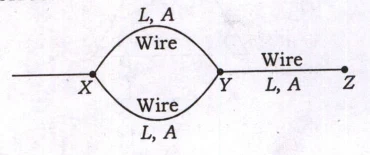
Three wires each of length L, cross-sectional area A and resistivity ρ are connected as shown in the figure. These are to be replaced by another wire of same resistivity such that the resistance between points X and Z does not change. If L1 is the length and A1 is the cross-sectional area of the new wire, then which one among the following is correct?

Three wires between points X, Y and Z, drawn left to right on one horizontal line. A lead runs in from the left to point X (a dot). Between X and Y (a dot) two wires bow apart and rejoin, in parallel: the upper one labelled Wire, with L, A above it; the lower one labelled Wire, with L, A below it. From Y a single straight wire, labelled Wire with L, A beneath, runs right to point Z (a dot). So the two parallel wires are in series with the third.
Options
Show answer & solution

Option A

L1 = 3L and A1 = 2A

Why

Each wire has . The two wires between and are in parallel, giving . That is in series with the third wire, . So . The new wire must have the same .

Exam-hall approach

Only the ratio matters, and it must be . B and D both give ; C gives ; only A gives .

Proof

;

About the other options

Option B

One of the original wires has resistance , not .

Option C

Inverts the ratio: gives .

Option D

Doubling both length and area leaves the resistance at .

Ideal time: about 1 min
73Physics • Light and Optics • Refraction and Total Internal Reflection
Moderate

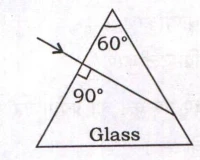
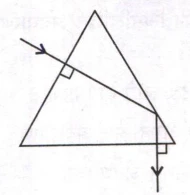
A light ray is falling on a face of an equilateral glass prism as shown in the figure :

An equilateral triangle labelled Glass, its apex at the top marked 60°. A ray with an arrowhead comes from the upper left and meets the left face about a third of the way down from the apex, a right-angle mark at that point labelled 90°: the ray strikes the left face along its normal. The ray continues straight inside the prism towards the right face.

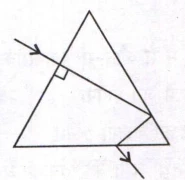
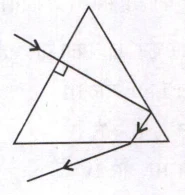
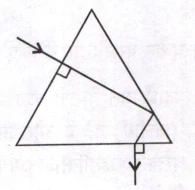
Which one of the following diagrams correctly shows the complete path of the ray through the glass prism?

Option (a): the same prism and incident ray, entering the left face along the normal (right-angle mark) and running straight to the right face. There it reflects down and to the left to the base, and leaves through the base bending away, travelling down and to the right (arrowhead below the base).
Option (b): the ray enters the left face along the normal (right-angle mark), runs straight to the right face, reflects down and to the left (arrowhead inside the prism) to the base, and leaves through the base travelling far to the lower left at a shallow angle to the base (arrowhead pointing left).
Option (c): the ray enters the left face along the normal (right-angle mark), runs straight to the right face, reflects down and to the left to the base, and leaves through the base along its normal, straight down (right-angle mark at the base, arrowhead pointing down).
Option (d): the ray enters the left face along the normal (right-angle mark), runs straight to the right face near its lower end, reflects vertically straight down to the base close to the right corner, and leaves through the base along its normal, straight down (right-angle mark at the base, arrowhead pointing down).
Options
Show answer & solution

Option D

Figure (d)

Why

The ray enters the left face along the normal, so it goes straight in without bending. It meets the right face at an angle of incidence equal to the prism angle, . For glass the critical angle is about , so the ray is totally reflected. Inside, the ray runs below the horizontal and the right face slopes below the horizontal. The reflected ray therefore runs straight down. It meets the horizontal base along the normal and leaves without bending. Only figure (d) shows this.

Exam-hall approach

A ray that leaves through the base without bending must meet the base along the normal, so it must be travelling straight down inside. Of the figures, only (d) has a vertical reflected ray; (c) has a slanting ray leaving along the normal, which cannot happen.

Proof

(total internal reflection); reflected direction below the horizontal

About the other options

Option A

Shows the ray reflected at a slant and bending as it leaves the base. The reflected ray is vertical, so it meets the base along the normal and does not bend.

Option B

Shows the ray reflected at a slant and leaving the base at a shallow angle. The reflected ray is vertical and leaves straight down.

Option C

Shows the ray reflected down and to the left but leaving the base along the normal. A slanting ray cannot meet the flat base along its normal, so these two parts cannot both be right.

Ideal time: about 1 min
74Physics • Light and Optics • Refraction and Total Internal Reflection
Moderate

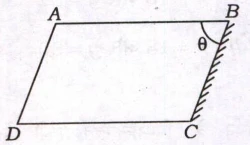
A glass slab of refractive index 1.5 is cut in the shape of a parallelepiped ABCD as shown in the figure. Surface BC is polished to form a perfect reflector. Light is incident at surface AB from inside at an angle π/3. Which one of the following is the correct angle ABC (θ) such that the reflected light retraces its path?

A parallelogram ABCD: A top left, B top right, C bottom right, D bottom left, with the top side AB and bottom side DC horizontal and the sides AD and BC slanting down to the left. Side BC is hatched on its outer side, marking it as the reflecting surface. The interior angle at B, between AB and BC, is marked θ with an arc. No ray is drawn.
Options
Show answer & solution

Option B

π/3

Why

For glass, , so the critical angle is about . The ray meets from inside at , more than the critical angle, so it is totally reflected. It leaves at to the normal, that is to the surface . To retrace its path it must strike the mirror along the normal. In the triangle formed by and the two points where the ray meets and , the angles are , and .

Proof

About the other options

Option A

Takes as the angle with the surface instead of with the normal. An angle of incidence is measured from the normal.

Option C

At the ray would meet off the normal and not come back along itself.

Option D

At the ray would meet off the normal and not come back along itself.

Ideal time: about 1 min
75Physics • Motion, Force and Laws of Motion • Newton's Laws and Conservation of Momentum
Easy

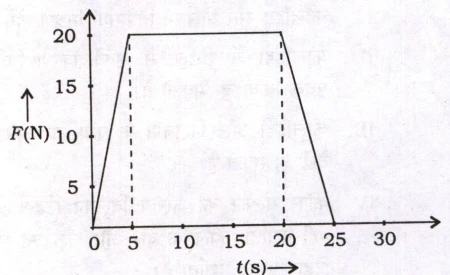
The force-time (F-t) graph of a 10 kg moving object is shown below :

A graph of force against time. Vertical axis F(N), marked 5, 10, 15, 20; horizontal axis t(s), marked 0, 5, 10, 15, 20, 25, 30. The force rises in a straight line from 0 at t = 0 to 20 at t = 5, stays at 20 until t = 20, then falls in a straight line to 0 at t = 25, making a trapezium. Dashed vertical lines drop from the corners at t = 5 and t = 20 to the time axis.

What is the final speed of the object?

Options
Show answer & solution

Option D

40 m/s

Why

The area under a force-time graph is the impulse, the change in momentum. The trapezium's area is N s, so the speed rises by m/s. The question does not give the starting speed. Taking the object to start from rest, the final speed is m/s; this is the only reading any option fits.

Proof

N s; m/s

About the other options

Option A

The force pushes one way throughout, so the impulse is not zero and the speed changes.

Option B

Reads the length of the flat part, 15 s, as a speed.

Option C

Counts only the flat part, N s, and drops the two triangles.

Ideal time: about 40 s
76Chemistry • Atomic Structure • Atomic Number, Mass Number, Isotopes and Isobars
Easy

If is the number of electrons and is the number of nucleons present in , then which one of the following is correct?

Options
Show answer & solution

Option C

and

Why

Sulphur has atomic number 16, so the atom has 16 protons and 16 electrons. The charge means it has gained 2 electrons: . Nucleons are protons plus neutrons, given by the mass number: . Charge changes only the electrons, never the nucleus (NCERT Class 9 Science, Structure of the Atom).

Proof

;

About the other options

Option A

Subtracts the 2 instead of adding: a 2− ion has gained electrons, not lost them.

Option B

Ignores the charge for electrons, and takes 2 off the mass number.

Option D

Right electrons, but takes 2 off the mass number. The charge does not touch the nucleus.

Ideal time: about 28 s
77Chemistry • Carbon and its Compounds • Allotropes of Carbon
Easy

Which one of the following forms of carbon is thermodynamically most stable?

Options
Show answer & solution

Option B

Graphite

Why

Graphite is the most stable form of carbon. It is the standard state of carbon: its standard enthalpy of formation is taken as zero, and every other form lies above it in energy (NCERT Class 11 Chemistry, Thermodynamics).

Proof

(graphite) ; (diamond) kJ/mol

About the other options

Option A

Coal is not a pure form of carbon; it is impure carbon with hydrogen, sulphur and other matter.

Option C

Diamond is slightly higher in energy than graphite. It lasts only because its change to graphite is extremely slow.

Option D

Fullerenes are curved cage molecules, strained and higher in energy than flat graphite sheets.

Ideal time: about 10 s
78Chemistry • States of Matter • Mixtures, Solutions and Colloids
Easy

Consider the following statements :

I
A colloid and a suspension are heterogeneous mixtures.
II
Colloids can be separated from the mixture by the process of centrifugation.
III
Particles of colloids and suspensions can be seen by naked eye.
IV
The aqueous solution of copper sulphate does not show Tyndall effect; however, the mixture of milk and water shows Tyndall effect.

Which of the statements given above is/are correct?

Options
Show answer & solution

Option D

I, II and IV

Why

I — Correct. Both are heterogeneous: their particles are not spread evenly at the molecular level. II — Correct. Colloidal particles pass through filter paper, but centrifugation separates them, as cream is separated from milk. III — Not correct. Suspension particles can be seen, but colloid particles are too small to see with the naked eye. IV — Correct. Copper sulphate in water is a true solution, too fine to scatter light. Milk in water is a colloid, and its particles scatter a beam: the Tyndall effect.

Exam-hall approach

III is false, since colloid particles cannot be seen; that strikes B and C. Between A and D, IV is the textbook Tyndall pair (a true solution against a colloid), so D.

Proof

NCERT Class 9 Science, Is Matter Around Us Pure? (solutions, suspensions and colloids)

About the other options

Option A

Leaves out II and IV, which are both true.

Option B

Contains III, which is false: colloid particles cannot be seen with the naked eye; and leaves out I.

Option C

Contains III, which is false: colloid particles cannot be seen with the naked eye.

Ideal time: about 1 min
79Chemistry • States of Matter • Mixtures, Solutions and Colloids
Very easy

A non-volatile solid solute may be separated from a solution by which of the following processes?

I
Evaporation
II
Crystallization

Select the correct answer using the code given below.

Options
Show answer & solution

Option C

Both I and II

Why

I — Correct. Evaporating the solvent leaves the non-volatile solid behind, as when dye is recovered from ink. II — Correct. Crystallisation also separates the solid, and gives it pure, as crystals; it is used to purify copper sulphate or salt.

Proof

NCERT Class 9 Science, Is Matter Around Us Pure? (evaporation and crystallisation)

About the other options

Option A

Leaves out crystallisation, which also separates the solid and gives it purer.

Option B

Leaves out evaporation, which separates a non-volatile solute simply by driving off the solvent.

Option D

Both processes work.

Ideal time: about 23 s
80Chemistry • Chemical Reactions and Equations • Types of Chemical Reactions
Easy

Which of the following are oxidation reactions?

I
Rusting of iron
II
Burning of fuel
III
Rancidity of oils and fats
IV
Browning of fruits

Select the correct answer using the code given below.

Options
Show answer & solution

Option D

I, II, III and IV

Why

I — Correct. Iron combines with oxygen and water to form hydrated iron oxide. II — Correct. Burning (combustion) is a reaction of the fuel with oxygen. III — Correct. Fats and oils turn rancid when they are oxidised by air, which is why chips are packed with nitrogen. IV — Correct. A cut apple browns when enzymes in it help air oxidise its phenol compounds.

Exam-hall approach

Rusting and burning are certain oxidations, so C goes. Rancidity is NCERT's own oxidation example, so B goes. A and D then turn on browning, which is also oxidation by air.

Proof

NCERT Class 10 Science, Chemical Reactions and Equations (corrosion and rancidity)

About the other options

Option A

Leaves out browning of fruits, which is also an oxidation by air.

Option B

Leaves out rancidity, which NCERT names as an oxidation.

Option C

Leaves out rusting and burning, the two best-known oxidations.

Ideal time: about 36 s