Skip to content

General Ability Test 2021 (II)

Set A

Questions 141–150 of 150

141Physics • Work, Energy and Power • Kinetic and Potential Energy
Very easy

An object of mass 2000 g possesses 100 J kinetic energy. The object must be moving with a speed of

Options
Show answer & solution

Option A

10.0 m/s

Why

Kinetic energy is , so . The mass must be in kilograms: 2000 g kg (NCERT Class 9 Science, Ch. 11, Work and Energy).

Proof

m/s

About the other options

Option B

11.1 m/s gives J, not 100 J.

Option C

11.2 is the escape speed from Earth in km/s, a familiar number with no link here. It gives J.

Option D

12.1 m/s gives J, not 100 J.

Ideal time: about 34 s
142Chemistry • Atomic Structure • Electronic Configuration and Valency
Easy

Which one of the following ions is not iso-electronic with F− ?

Options
Show answer & solution

Option D

N−

Why

Iso-electronic species have the same number of electrons. F has 9 electrons, so F− has 10. Count each option: electrons = atomic number − charge.

Exam-hall approach

F−, O2−, Na+ and Ne all have the neon arrangement 2, 8; this set of four is a standard textbook example. The odd one out is N−.

Proof

; ; ; ;

About the other options

Option A

has electrons, the same as .

Option B

has electrons, the same as .

Option C

Neon has 10 electrons. It is a neutral atom, not an ion, but it is still iso-electronic with F−.

Ideal time: about 32 s
143Chemistry • Chemical Bonding • Ionic and Covalent Bonding
Easy

What is the total number of covalent bonds in methanol ?

Options
Show answer & solution

Option C

5

Why

Methanol is . Carbon makes four single bonds: three to H and one to O. Oxygen makes one more bond, to H. All are covalent (NCERT Class 10 Science, Ch. 4, Carbon and its Compounds).

Proof

About the other options

Option A

Counts only the three C–H bonds.

Option B

Counts only carbon's four bonds and misses the O–H bond. Four is also the count for methane, .

Option D

Counts one bond too many, as if there were a double bond or a second O–H.

Ideal time: about 30 s
144Chemistry • Acids, Bases and Salts • Important Salts and their Uses
Easy

Which one of the following is the chemical formula of Plaster of Paris ?

Options
Show answer & solution

Option A

Why

Plaster of Paris is calcium sulphate hemihydrate: one water molecule for every two units of calcium sulphate. It is made by heating gypsum to 373 K (NCERT Class 10 Science, Ch. 2, Acids, Bases and Salts).

Proof

NCERT Class 10 Science, Ch. 2 (Acids, Bases and Salts), Plaster of Paris

About the other options

Option B

is gypsum, the raw material. Plaster of Paris sets back into gypsum when water is added.

Option C

Five waters of crystallisation is blue vitriol, , not a calcium salt.

Option D

No common calcium sulphate has four waters of crystallisation.

Ideal time: about 15 s
145Physics • Units, Measurement and Dimensions • SI Units and Standards of Measurement
Easy

The unit of the ratio between thrust and impulse is same as that of

Options
Show answer & solution

Option A

frequency

Why

Thrust is a force, in newtons. Impulse is force times time, in newton-seconds. Their ratio has the unit , the unit of frequency (hertz).

Proof

About the other options

Option B

Speed is m/s, . The ratio has no metres in it.

Option C

Wavelength is a length, in metres.

Option D

Acceleration is . This is force divided by mass, not by impulse.

Ideal time: about 36 s
146Physics • Light and Optics • Refraction and Total Internal Reflection
Easy

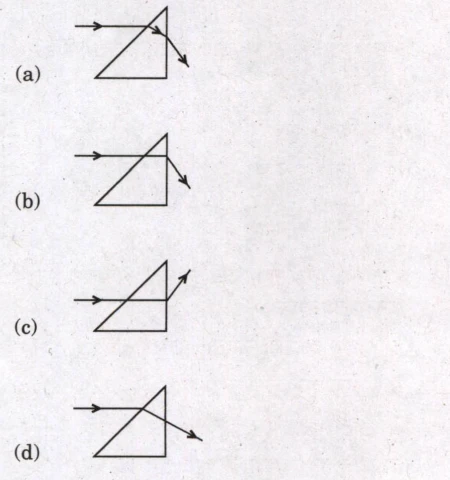
Which one of the following figures correctly shows the path of a ray of light through a glass prism ?

Four diagrams, each a right-angled triangular glass prism drawn in outline with the right angle at the bottom right, the vertical side on the right, the horizontal base at the bottom and the hypotenuse rising from bottom left to the top of the vertical side. A horizontal ray with a rightward arrowhead comes in from the left in each. (a): the ray enters the prism near the top, meets the hypotenuse, and leaves through the vertical side near its top, bending and heading down and to the right with an arrowhead. (b): the ray runs straight through the prism at mid-height with no bend inside, leaves the vertical side, and then bends downward to the right with an arrowhead. (c): the ray runs straight through the prism low down, meets the vertical side, and turns upward to the right with an arrowhead. (d): the ray enters the prism near the top, bends at the hypotenuse inside the prism, and runs downward to the right, leaving through the vertical side and continuing down and to the right with an arrowhead.
Options
Show answer & solution

Option D

Figure (d)

Why

Light bends at both faces of a prism. Entering the glass, it bends towards the normal. Leaving the glass, it bends away from the normal. So the ray must change direction at the face where it enters and again where it leaves, and it ends up bent towards the base of the prism (NCERT Class 10 Science, Ch. 10, refraction through a prism).

Exam-hall approach

Strike any figure where the ray goes straight through the glass after meeting a slanted face, and any figure where it bends towards the top. Only (d) bends at the slanted entry face and leaves heading towards the base.

Proof

NCERT Class 10 Science, Ch. 10 (The Human Eye and the Colourful World), refraction of light through a prism

About the other options

Option A

The ray in (a) bends only on its way out. A ray striking a slanted glass face must also bend as it enters.

Option B

The ray in (b) runs straight through the glass without bending at the slanted face it enters. It bends only at the exit.

Option C

The ray in (c) does not bend on entry, and on leaving it turns upward. A prism bends light towards its base, not its top.

Ideal time: about 39 s
147Physics • Light and Optics • Dispersion and Scattering of Light
Easy

When a light beam falls on a triangular glass prism, a band of colours is obtained. Which one of the following statements is correct in this regard ?

Options
Show answer & solution

Option C

Violet light bends the most, as the refractive index of glass for violet light is greatest.

Why

Glass has a larger refractive index for violet light than for red. A larger refractive index means more bending, so violet bends the most and red the least (NCERT Class 10 Science, Ch. 10, dispersion).

Exam-hall approach

At the bottom of the spectrum from a prism is violet, bent the most. That strikes A and B. More bending needs a larger refractive index, which strikes D.

Proof

NCERT Class 10 Science, Ch. 10 (The Human Eye and the Colourful World), dispersion of white light by a prism

About the other options

Option A

Red bends the least, not the most. Glass has its smallest refractive index for red.

Option B

A lowest refractive index means the least bending. The reason contradicts the claim.

Option D

Violet does bend the most, but a lowest refractive index would make it bend the least. Its index is the greatest.

Ideal time: about 39 s
148Physics • Light and Optics • Reflection of Light and Mirrors
Very easy

The image of an object formed by a plane mirror is

Options
Show answer & solution

Option B

erect, virtual and same size.

Why

A plane mirror forms an image that is upright, virtual (it cannot be caught on a screen), the same size as the object, and as far behind the mirror as the object is in front (NCERT Class 10 Science, Ch. 9, Light – Reflection and Refraction).

Proof

NCERT Class 10 Science, Ch. 9 (Light – Reflection and Refraction), image formed by a plane mirror

About the other options

Option A

A plane mirror does not magnify, and its image is virtual, not real.

Option C

The image is upright, though left and right are swapped. Lateral inversion is not the same as being upside down.

Option D

Inverted, real and smaller describes a concave mirror with the object beyond its centre of curvature.

Ideal time: about 15 s
149Physics • Work, Energy and Power • Work Done by a Force
Very easy

Which one of the following is not a conservative force ?

Options
Show answer & solution

Option A

Frictional force

Why

A force is conservative when the work it does depends only on where the motion starts and ends, not on the path. Friction always opposes motion and turns energy into heat, so the work against it grows with the path length. It is non-conservative (NCERT Class 11 Physics, Ch. 6, Work, Energy and Power).

Proof

NCERT Class 11 Physics, Ch. 6 (Work, Energy and Power), conservative forces

About the other options

Option B

The electric force between charges is conservative. It has an electric potential energy.

Option C

Gravity is the standard example of a conservative force. It has gravitational potential energy.

Option D

A spring force is conservative. It stores elastic potential energy.

Ideal time: about 12 s
150Physics • Work, Energy and Power • Work Done by a Force
Very easy

A negative work is done when an applied force F and the corresponding displacement S are

Options
Show answer & solution

Option C

anti-parallel to each other.

Why

Work is . It is negative when , and most negative when the force and displacement point in opposite directions, (NCERT Class 9 Science, Ch. 11, Work and Energy).

Proof

About the other options

Option A

Perpendicular means and : zero work.

Option B

Parallel means and : positive work.

Option D

Force and displacement are different quantities with different units. Their sizes being equal says nothing about the sign of the work.

Ideal time: about 16 s