Skip to content

General Ability Test 2019 (II)

Set A

Questions 61–80 of 150

61Chemistry • Chemical Bonding • Hydrogen Bonding and Intermolecular Forces
Very easy

Which one of the following statements about water is not true ?

Options
Show answer & solution

Option D

Water is a non-polar molecule.

Why

Water is a polar molecule. Its shape is bent, and oxygen pulls the shared electrons more strongly than hydrogen. So the oxygen end is slightly negative and the hydrogen ends slightly positive.

Proof

NCERT Class 11 Chemistry, Ch. 4 'Chemical Bonding and Molecular Structure': dipole moment

About the other options

Option A

True. The polar molecules attract each other through hydrogen bonds.

Option B

True. Hydrogen bonds must be broken to boil water, so its boiling point (100 °C) is far higher than that of similar molecules.

Option C

True. Hydrogen bonds hold ice together, so melting ice takes a lot of heat (about 80 cal per gram).

Ideal time: about 20 s
62Chemistry • Chemistry in Everyday Life • Soaps and Detergents
Easy

A sample of ‘soft soap’ contains

Options
Show answer & solution

Option B

Potassium

Why

Soaps are sodium or potassium salts of fatty acids. Potassium soaps are soft and are used in shaving creams and liquid soaps. Sodium soaps are hard.

Exam-hall approach

Calcium and magnesium are the hard-water metals that make soap scum, so C and D go. Of the two alkali metals left, soap is made from sodium or potassium, not caesium.

Proof

NCERT Class 12 Chemistry, Ch. 16 'Chemistry in Everyday Life': soaps

About the other options

Option A

Caesium is an alkali metal too, but caesium salts are not used to make soap.

Option C

Calcium soaps are the insoluble scum formed when soap meets hard water.

Option D

Magnesium soaps also form scum in hard water; they are not 'soft soap'.

Ideal time: about 11 s
63Physics • Motion, Force and Laws of Motion • Kinematics
Easy

If an object moves at a non-zero constant acceleration for a certain interval of time, then the distance it covers in that time

Options
Show answer & solution

Option A

depends on its initial velocity.

Why

With constant acceleration , the distance covered in time is . The term depends on the initial velocity , so the distance does too.

Proof

About the other options

Option B

Is true only when . In general the term remains.

Option C

Distance grows with when there is acceleration, not linearly with .

Option D

Distance covered is a change in position. Where the object starts does not affect how far it goes.

Ideal time: about 29 s
64Physics • System of Particles and Rotational Motion • Moment of Inertia and Rotational Kinetic Energy
Easy

A solid disc and a solid sphere have the same mass and same radius. Which one has the higher moment of inertia about its centre of mass ?

Options
Show answer & solution

Option A

The disc

Why

About an axis through its centre, a solid disc has and a solid sphere has . Since , the disc has the larger moment of inertia. The sphere's mass is bunched closer to the axis.

Proof

About the other options

Option B

Reverses the comparison: is less than .

Option C

Same mass and radius do not give the same moment of inertia. It depends on how the mass is spread about the axis.

Option D

Mass and radius are enough. For standard solid shapes, each has a fixed formula in M and R.

Ideal time: about 36 s
65Physics • Properties of Matter • Density and Relative Density
Moderate

Two substances of densities ρ1 and ρ2 are mixed in equal volume and their relative density is 4. When they are mixed in equal masses, relative density is 3. The values of ρ1 and ρ2 respectively are

Options
Show answer & solution

Option A

6, 2

Why

Equal volumes: the mixture's density is the simple average, . Equal masses: it is the harmonic mean, . These give and , so the densities are 6 and 2.

Exam-hall approach

Check only the simple average first: it must be 4, so the pair must sum to 8. That strikes C and D. Between A and B, the harmonic mean needs a product of 12: only A.

Proof

About the other options

Option B

Sums to 8, but ; equal masses would give , not 3.

Option C

Doubles each correct value: equal volumes would give , not 4.

Option D

Equal volumes would give , not 4.

Ideal time: about 1.5 min
66Physics • Motion, Force and Laws of Motion • Kinematics
Very easy

A car starts from Bengaluru, goes 50 km in a straight line towards south, immediately turns around and returns to Bengaluru. The time taken for this round trip is 2 hours. The magnitude of the average velocity of the car for this round trip

Options
Show answer & solution

Option A

is 0.

Why

Average velocity is total displacement divided by total time. The car ends where it started, so its displacement is zero. Its average velocity is therefore zero, whatever the time taken.

Proof

About the other options

Option B

This is the average speed: total distance over time, km/hr.

Option C

Takes the one-way distance over the whole time: km/hr.

Option D

Acceleration is not needed. Displacement and time alone fix the average velocity.

Ideal time: about 34 s
67Physics • Electricity • Kirchhoff's Laws
Easy

“The sum of emf’s and potential differences around a closed loop equals zero” is a consequence of

Options
Show answer & solution

Option D

Conservation of energy.

Why

This is Kirchhoff's loop rule. A charge carried round a closed loop returns to its starting potential. So the energy it gains from the cells must equal the energy it loses in the resistors. The rule is conservation of energy.

Proof

NCERT Class 12 Physics, Ch. 3 'Current Electricity': Kirchhoff's rules

About the other options

Option A

Ohm's law relates the current through a resistor to the voltage across it. It is used inside the loop rule, but is not its basis.

Option B

Conservation of charge is the basis of Kirchhoff's junction rule: the current into a junction equals the current out.

Option C

Momentum is not used in circuit laws.

Ideal time: about 17 s
68Physics • Units, Measurement and Dimensions • Least Count, Precision and Significant Figures
Moderate

A student measures certain lengths using a meter scale having least count equal to 1 mm. Which one of the following measurements is more precise ?

Options
Show answer & solution

Option C

0.925 m

Why

A scale with a least count of 1 mm reads lengths to the nearest millimetre, so every reading carries an uncertainty of 1 mm. 0.925 m (925 mm) and 910 mm are both readings of that kind. Of the two, 925 mm is the longer, so the same 1 mm is a smaller fraction of it. Its precision is greater, and its three significant figures are all certain. The key rests on relative precision; on absolute uncertainty, C and D tie.

Exam-hall approach

Convert every option to millimetres. A and B have digits beyond the millimetre, so this scale could not have given them. Between C and D, the longer length has the smaller relative error.

Proof

About the other options

Option A

0.50 mm reports hundredths of a millimetre. A scale that reads only to 1 mm cannot measure this.

Option B

29.07 cm is 290.7 mm. It reports tenths of a millimetre, finer than the scale can read.

Option D

A valid reading, but the same 1 mm uncertainty is a larger fraction of 910 mm than of 925 mm. Its final zero also leaves its significant figures unclear.

Ideal time: about 41 s
69Physics • Heat and Thermodynamics • Thermodynamic Processes
Easy

If the work done on the system or by the system is zero, which one of the following statements for a gas kept at a certain temperature is correct ?

Options
Show answer & solution

Option A

Change in internal energy of the system is equal to flow of heat in or out of the system.

Why

The first law of thermodynamics is . With no work done (), . All the heat that flows in raises the internal energy, and all that flows out lowers it.

Proof

About the other options

Option B

Would need some heat to go into work, but .

Option C

Would mean internal energy is created from nothing, which breaks energy conservation.

Option D

The first law settles it with no further data.

Ideal time: about 46 s
70Physics • Electricity • Resistance and Combination of Resistors
Easy

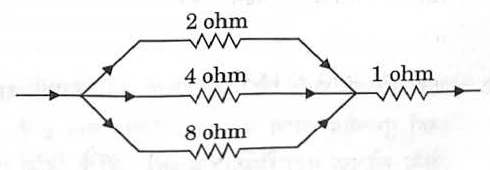
Consider the following part of an electric circuit :

Circuit diagram. Current enters from the left along a wire and splits at a junction into three parallel branches, each with an arrow pointing rightwards: top branch a 2 ohm resistor, middle branch a 4 ohm resistor, bottom branch an 8 ohm resistor. The three branches rejoin at a second junction, from which a single wire runs to the right through a 1 ohm resistor, in series with the parallel group, and exits with an arrow pointing rightwards.

The total electrical resistance in the given part of the electric circuit is

Options
Show answer & solution

Option B

ohm

Why

The 2, 4 and 8 ohm resistors are in parallel; their combination is in series with the 1 ohm resistor. For resistors in parallel, . Resistors in series add.

Exam-hall approach

Three resistors in parallel give less than the smallest, 2 ohm. Adding 1 ohm, the total lies between 1 and 3 ohm. That strikes C and D. A's 15/8 is the slip of not inverting.

Proof

ohm

About the other options

Option A

Forgets to invert the parallel sum: .

Option C

Takes all four resistors in series: .

Option D

Takes only 4 and 8 in parallel and adds 2 in series: .

Ideal time: about 40 s
71Physics • Light and Optics • Refraction by Lenses
Easy

Which one of the following statements regarding lenses is not correct ?

Options
Show answer & solution

Option B

A concave lens produces both real and virtual images.

Why

A concave lens spreads light out. For any real object, the image it forms is always virtual, erect and smaller than the object. It never forms a real image of a real object.

Proof

NCERT Class 10 Science, Ch. 9 'Light – Reflection and Refraction': images formed by lenses

About the other options

Option A

True. A convex lens forms a real image when the object is beyond its focus, and a virtual image when the object is within it.

Option C

True. A convex lens gives a smaller image beyond 2F, an equal one at 2F, and a larger one between F and 2F or within F.

Option D

True. A concave lens always gives a diminished image of a real object.

Ideal time: about 40 s
72Physics • Heat and Thermodynamics • Specific Heat and Calorimetry
Moderate

10 g of ice at – 10°C is mixed with 10 g of water at 0°C. The amount of heat required to raise the temperature of mixture to 10°C is

Options
Show answer & solution

Option C

1050 cal

Why

Three steps. Warm the ice from to , with the specific heat of ice cal/g per degree. Melt it, with latent heat of fusion cal/g. Then warm all 20 g of water from to , with specific heat cal/g per degree.

Exam-hall approach

Melting 10 g of ice alone takes 800 cal, which strikes A and B. The rest is small: a few hundred calories, which fits 1050 better than 1200.

Proof

cal

About the other options

Option A

Less than the 800 cal needed just to melt the ice; leaves out the latent heat.

Option B

Also less than the 800 cal needed just to melt the ice.

Option D

More than the three steps add up to. Even taking the specific heat of ice as 1 gives only 1100 cal.

Ideal time: about 1 min
73Chemistry • Acids, Bases and Salts • Important Salts and their Uses
Easy

Which one of the following does not represent the salt, Calcium carbonate ?

Options
Show answer & solution

Option A

Lime water

Why

Lime water is a solution of calcium hydroxide, , in water. It turns milky with precisely because it forms calcium carbonate.

Proof

NCERT Class 10 Science, Ch. 1 'Chemical Reactions and Equations' and Ch. 2 'Acids, Bases and Salts'

About the other options

Option B

Limestone is a natural form of calcium carbonate, .

Option C

Chalk is a soft, fine form of .

Option D

Marble is a hard, crystalline form of .

Ideal time: about 14 s
74Physics • Properties of Matter • Surface Tension
Easy

Soaps clean surfaces on the principle based on

Options
Show answer & solution

Option D

Surface tension

Why

Soap lowers the surface tension of water. The water then spreads and wets the cloth or surface better, and soap molecules can surround oily dirt so that water carries it away.

Proof

NCERT Class 11 Physics, Ch. 10 'Mechanical Properties of Fluids': surface tension and detergents

About the other options

Option A

Viscosity is a liquid's resistance to flow. Soap does not clean by changing it.

Option B

Flotation separates ore particles by making them float on froth. It is a mining process.

Option C

Elasticity is a solid's ability to regain its shape. It has nothing to do with cleaning.

Ideal time: about 12 s
75Chemistry • States of Matter • Mixtures, Solutions and Colloids
Very easy

Which one of the following substances is not a mixture ?

Options
Show answer & solution

Option A

Tin

Why

Tin is an element, a pure metal. A mixture contains two or more substances that keep their own properties.

Proof

NCERT Class 9 Science, Ch. 2 'Is Matter Around Us Pure'

About the other options

Option B

Sea water is a mixture of water and dissolved salts.

Option C

Soil is a mixture of rock particles, minerals, humus, water and air.

Option D

Air is a mixture of gases: nitrogen, oxygen, argon, carbon dioxide and others.

Ideal time: about 11 s
76Chemistry • Non-Metals and their Compounds • Common Gases and their Uses
Very easy

Which one of the following is termed as ‘Dry ice’ ?

Options
Show answer & solution

Option C

Solid state of carbon dioxide

Why

Dry ice is solid carbon dioxide. It turns directly into gas without melting, which is why it is called 'dry'. It is used to keep things very cold.

Proof

NCERT Class 9 Science, Ch. 1 'Matter in Our Surroundings'

About the other options

Option A

The ice in ice-cream is frozen water, which melts into liquid.

Option B

Antarctic ice is frozen water.

Option D

The ionosphere is a layer of charged gas high in the atmosphere. It holds no solid water.

Ideal time: about 14 s
77Biology • Cell Biology • Plasma Membrane, Diffusion and Osmosis
Very easy

Net movement of water from a dilute to a concentrated solution through a selectively permeable membrane is called

Options
Show answer & solution

Option C

Osmosis

Why

Osmosis is the net movement of water through a selectively permeable membrane, from a dilute solution (more water) to a concentrated one (less water).

Proof

NCERT Class 9 Science, Ch. 5 'The Fundamental Unit of Life': osmosis

About the other options

Option A

Diffusion is the spreading of any substance from high to low concentration. It needs no membrane. Osmosis is a special case of it, for water across a membrane.

Option B

Dispersion is the scattering of particles through a medium, or the splitting of light into colours.

Option D

Absorption is the general taking in of a substance, as roots absorb water. It does not name this process.

Ideal time: about 13 s
78Biology • Cell Biology • Animal Tissues
Easy

Blood is a type of

Options
Show answer & solution

Option D

Connective tissue

Why

Blood is a fluid connective tissue. Its liquid matrix, plasma, carries red cells, white cells and platelets, and it links all parts of the body by transport.

Proof

NCERT Class 9 Science, Ch. 6 'Tissues': connective tissue

About the other options

Option A

Epithelial tissue covers and lines organs, such as the skin and the lining of the gut.

Option B

Muscular tissue contracts to cause movement.

Option C

Nervous tissue carries messages as impulses.

Ideal time: about 10 s
79Biology • Cell Biology • Cell Organelles and their Functions
Easy

Mitochondria are able to produce their own

Options
Show answer & solution

Option B

Proteins

Why

Mitochondria have their own DNA and ribosomes. So they can make some of their own proteins. This is why they are called semi-autonomous organelles.

Proof

NCERT Class 9 Science, Ch. 5 'The Fundamental Unit of Life': mitochondria; NCERT Class 11 Biology, Ch. 8 'Cell: The Unit of Life'

About the other options

Option A

A mitochondrion has no nucleus, and it cannot make one. The nucleus belongs to the cell.

Option C

Chloroplasts are separate organelles found only in plant cells. Mitochondria do not make them.

Option D

Digestive enzymes are made on ribosomes of the cell and stored in lysosomes. Mitochondria do not make them.

Ideal time: about 12 s
80Biology • Cell Biology • Plant Tissues
Easy

Which one of the following statements is correct ?

Options
Show answer & solution

Option A

Xylem consists of tracheids, vessels, xylem parenchyma and xylem fibres.

Why

Xylem is a complex tissue with four kinds of elements: tracheids, vessels, xylem parenchyma and xylem fibres. Together they carry water and minerals and support the plant.

Proof

NCERT Class 9 Science, Ch. 6 'Tissues': complex permanent tissue

About the other options

Option B

Flexibility comes from collenchyma. Sclerenchyma has thick, dead walls and makes the plant hard and stiff.

Option C

Parenchyma cells are loosely packed and have large intercellular spaces.

Option D

Sieve tubes and companion cells make up phloem, which carries food. They are not part of xylem.

Ideal time: about 34 s