Skip to content

General Ability Test 2019 (I)

Set A

Questions 101–120 of 150

101Chemistry • Chemical Reactions and Equations • Corrosion and Rancidity
Easy

On exposure to moist air, copper gains a green coat on its surface due to formation of which one of the following compounds ?

Options
Show answer & solution

Option A

Copper carbonate

Why

Copper reacts slowly with moist carbon dioxide in air. It forms a green coat of basic copper carbonate, . NCERT Class 10 Science, Ch. 1 (Chemical Reactions and Equations) and Ch. 3 (Metals and Non-metals).

Proof

NCERT Class 10 Science, Ch. 3 (Metals and Non-metals), Corrosion

About the other options

Option B

Copper oxide: a black coat that forms when copper is heated in air. It is not green.

Option C

Copper sulphate: blue, and it does not form from moist air.

Option D

Copper nitrate: does not form from air, which has no nitrate source.

Ideal time: about 17 s
102Chemistry • Acids, Bases and Salts • Reactions of Acids and Bases
Easy

Which one of the following will NOT produce carbon dioxide on reacting with an aqueous solution of hydrochloric acid ?

Options
Show answer & solution

Option B

Quick Lime

Why

Limestone, chalk and marble are all calcium carbonate. With acid they give off carbon dioxide: . Quick lime is calcium oxide, which has no carbon: . NCERT Class 10 Science, Ch. 2 (Acids, Bases and Salts).

Exam-hall approach

Limestone, chalk and marble are three well-known forms of the same compound, calcium carbonate. Three options that must behave alike cannot hold the single exception.

Proof

NCERT Class 10 Science, Ch. 2 (Acids, Bases and Salts), How do Metal Carbonates react with Acids?

About the other options

Option A

Limestone: , which gives with acid.

Option C

Chalk: also .

Option D

Marble: also , the reason acid rain damages marble buildings.

Ideal time: about 18 s
103Chemistry • States of Matter • Mixtures, Solutions and Colloids
Very easy

Which one of the following substances is NOT a mixture ?

Options
Show answer & solution

Option A

Ice

Why

Ice is frozen water, a single compound, so it is a pure substance. Ice-cream, air and honey each contain several substances mixed in no fixed ratio. NCERT Class 9 Science, Ch. 2 (Is Matter Around Us Pure?).

Proof

NCERT Class 9 Science, Ch. 2 (Is Matter Around Us Pure?)

About the other options

Option B

Ice-cream: a mixture of milk fat, sugar, water and air.

Option C

Air: a mixture of nitrogen, oxygen, argon, carbon dioxide and other gases.

Option D

Honey: a mixture of sugars (mainly fructose and glucose) and water.

Ideal time: about 10 s
104Geography • Rocks, Landforms and Geomorphic Processes • Weathering
Easy

Which one of the following is an example of Salt-Crystal growth ?

Options
Show answer & solution

Option B

Physical weathering

Why

In salt weathering, salt in rock pores crystallises as water evaporates. The growing crystals push on the rock and break it apart. No new chemical is formed, so it is physical (mechanical) weathering. NCERT Class 11, Fundamentals of Physical Geography, Geomorphic Processes.

Proof

NCERT Class 11, Fundamentals of Physical Geography, Geomorphic Processes, Physical Weathering Processes: Salt Weathering

About the other options

Option A

Chemical weathering changes the rock's minerals, as in solution, oxidation and carbonation. Salt crystals only break the rock apart.

Option C

Biological weathering is done by living things, such as plant roots and burrowing animals.

Option D

Bio-chemical weathering is the chemical action of living things, such as acids from lichens.

Ideal time: about 15 s
105Geography • Minerals and Energy Resources of India • Distribution of Minerals in India
Moderate

Which one of the following is the correct sequence of proved coal reserves in the Indian States in decreasing order ?

Options
Show answer & solution

Option B

Jharkhand, Odisha, Chhattisgarh, West Bengal

Why

By the Geological Survey of India's coal inventory as of 1 April 2018, Jharkhand had the largest proved coal reserves, about 45 billion tonnes. Odisha came next, then Chhattisgarh, then West Bengal.

Exam-hall approach

Jharkhand is widely known as the leading coal state, which strikes C and D. A or B then turns on Odisha against Chhattisgarh.

Proof

Geological Survey of India, National Coal Inventory as of 1 April 2018: proved reserves, Jharkhand > Odisha > Chhattisgarh > West Bengal

About the other options

Option A

Swaps Odisha and Chhattisgarh. Chhattisgarh's proved reserves were about half of Odisha's.

Option C

Puts Odisha first and Jharkhand third. Jharkhand, with the Jharia and Bokaro fields, led India in proved reserves.

Option D

Puts Jharkhand last, though it held the largest proved reserves.

Ideal time: about 39 s
106Geography • Earth's Interior, Plate Tectonics, Earthquakes and Volcanoes • Earthquakes and Seismic Waves
Moderate

Consider the following statements relating to Richter scale :

1
It was devised in 1935 by Charles F. Richter
2
It describes the quantity of energy released by a single earthquake
3
Richter Scale has no upper limit

Which of the statements given above is/are correct ?

Options
Show answer & solution

Option D

1, 2 and 3

Why

1 — Correct. Charles F. Richter devised the scale in 1935 at Caltech. 2 — Correct. It measures magnitude, which is linked to the energy released by one earthquake. Each step up means about 32 times more energy. 3 — Correct. The scale is open-ended: no upper limit is fixed. The common '0 to 10' range describes the earthquakes we observe, not a limit of the scale.

Exam-hall approach

The scale is named after Richter, so statement 1 is true, which strikes C. Magnitude is about the energy of the quake, so statement 2 is true, which strikes A. B or D then turns on the upper limit.

About the other options

Option A

Leaves out statement 2. Magnitude is a measure of the energy released.

Option B

Leaves out statement 3. NCERT describes the scale as running from 0 to 10, which makes B tempting, but the scale has no fixed upper limit.

Option C

Leaves out statement 1, the date and the man who gave the scale its name.

Ideal time: about 39 s
107Geography • Oceans • Ocean Currents
Easy

Which one of the following ocean currents is NOT a cold ocean current ?

Options
Show answer & solution

Option C

Kuroshio current

Why

The Kuroshio is a warm current that flows north-east along the coast of Japan in the Pacific. The Canary, California and Oyashio currents are cold. NCERT Class 11, Fundamentals of Physical Geography, Movements of Ocean Water, Major Ocean Currents.

Exam-hall approach

Cold currents flow along the west coasts of continents in the tropics and subtropics, which places the Canary and California currents. Between the two Japanese currents, the Kuroshio comes from the tropics.

Proof

NCERT Class 11, Fundamentals of Physical Geography, Movements of Ocean Water: Major Ocean Currents

About the other options

Option A

Canary current: cold, flows south along north-west Africa.

Option B

California current: cold, flows south along the west coast of North America.

Option D

Oyashio current: cold, flows south from the Bering Sea and meets the warm Kuroshio off Japan.

Ideal time: about 15 s
108Geography • Oceans • Tides
Moderate

What is the time gap in occurrence of two successive tides at a given place on the ocean surface ?

Options
Show answer & solution

Option B

12 hours 26 minutes

Why

The Moon rises about 50 to 52 minutes later each day, so a place meets the same tidal bulge every 24 hours 52 minutes. There are two bulges, so a high tide comes about every 12 hours 26 minutes.

Exam-hall approach

A place gets two high tides a day, so the gap is near 12 hours, which strikes C and D. The Moon rises a little later each day, so the gap is a little more than 12 hours.

Proof

NCERT Class 11, Fundamentals of Physical Geography, Movements of Ocean Water, Tides

About the other options

Option A

12 hours would hold if the Moon stood still. It moves along its orbit, so each tide comes about 26 minutes later.

Option C

24 hours is a solar day, not linked to the Moon's daily delay.

Option D

24 hours 52 minutes is the gap between one high tide and the same bulge returning, that is, between alternate tides, not successive ones.

Ideal time: about 21 s
109Biology • Human Physiology • Digestive System
Easy

Tooth enamel is made up of which one of the following calcium compounds ?

Options
Show answer & solution

Option D

Calcium phosphate

Why

Tooth enamel is mostly hydroxyapatite, a form of calcium phosphate. It is the hardest substance in the body. Acids made by bacteria dissolve it and cause tooth decay. NCERT Class 10 Science, Ch. 2 (Acids, Bases and Salts), Tooth decay.

Proof

NCERT Class 10 Science, Ch. 2 (Acids, Bases and Salts), Tooth decay: enamel is calcium phosphate

About the other options

Option A

Calcium carbonate: makes up limestone, chalk, eggshells and sea shells, not enamel.

Option B

Calcium sulphate: gypsum and plaster of Paris.

Option C

Calcium hydroxide: slaked lime, used in whitewash.

Ideal time: about 13 s
110Physics • Gravitation • Acceleration due to Gravity, Mass and Weight
Moderate

Suppose there are two planets, 1 and 2, having the same density but their radii are R1 and R2 respectively, where R1 > R2. The accelerations due to gravity on the surface of these planets are related as

Options
Show answer & solution

Option A

g1 > g2

Why

, and . So . At equal density, is directly proportional to . NCERT Class 11 Physics, Gravitation.

Proof

About the other options

Option B

Uses with the mass held fixed. At equal density the mass grows as , which outweighs the .

Option C

Takes equal density to mean equal . The density is the same but the larger planet has more mass.

Option D

The data are enough: equal density turns into .

Ideal time: about 47 s
111Physics • Light and Optics • Refraction and Total Internal Reflection
Easy

The Sun is seen little before it rises and for a short while after it sets. This is because of

Options
Show answer & solution

Option B

atmospheric refraction

Why

Light from the Sun bends as it passes through layers of air of different density. When the Sun is just below the horizon, this bending brings its light to us, so we see it about 2 minutes before it actually rises and 2 minutes after it sets. NCERT Class 10 Science, Ch. 11 (The Human Eye and the Colourful World), Advance sunrise and delayed sunset.

Proof

NCERT Class 10 Science, Ch. 11 (The Human Eye and the Colourful World), Atmospheric Refraction

About the other options

Option A

Total internal reflection: causes the sparkle of a diamond and works in optical fibres. It needs light going from a denser to a rarer medium at a large angle.

Option C

The apparent shift of the Sun is the effect, not its cause. The shift happens because of atmospheric refraction.

Option D

Dispersion: splitting of white light into colours, as in a rainbow.

Ideal time: about 19 s
112Physics • Motion, Force and Laws of Motion • Kinematics
Moderate
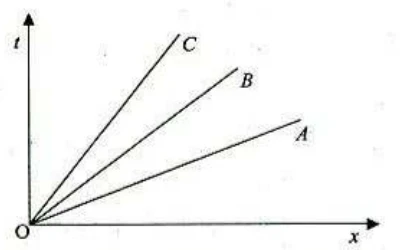
A graph with the vertical axis labelled t (time) and the horizontal axis labelled x (position), both with arrowheads, meeting at the origin O. Three straight lines rise from O into the first quadrant, each labelled at its upper end: line C is the steepest, line B is of middle slope and line A is the flattest.

The figure shown above gives the time (t) versus position (x) graphs of three objects A, B and C. Which one of the following is the correct relation between their speeds VA, VB and VC, respectively at any instant (t > 0) ?

Options
Show answer & solution

Option B

VA > VB > VC

Why

The graph is time against position. Its slope is , the inverse of speed. A steeper line means more time for the same distance, so a lower speed. C is steepest and A is flattest. NCERT Class 11 Physics, Motion in a Straight Line.

Proof

About the other options

Option A

Reads the graph as against , where a steeper line means faster. Here the axes are swapped, so the order reverses.

Option C

Straight lines give constant speeds, but their slopes differ, so the speeds differ.

Option D

Zero speed would be a line along the axis. These lines show growing with .

Ideal time: about 48 s
113Physics • Units, Measurement and Dimensions • SI Units and Standards of Measurement
Easy

1 dyne (a unit of force in CGS system) equals to

Options
Show answer & solution

Option D

10−5 kg m/s2

Why

A dyne is the force that gives a mass of 1 g an acceleration of , so dyne . Since kg and m, it equals , that is, N. NCERT Class 11 Physics, Units and Measurement.

Proof

About the other options

Option A

By definition a dyne is , not .

Option B

Also wrong in CGS units: a dyne is exactly . is the gram-to-kilogram factor alone.

Option C

Inverts the factor: dyne make one newton, so one dyne is N.

Ideal time: about 28 s
114Physics • Motion, Force and Laws of Motion • Kinematics
Easy
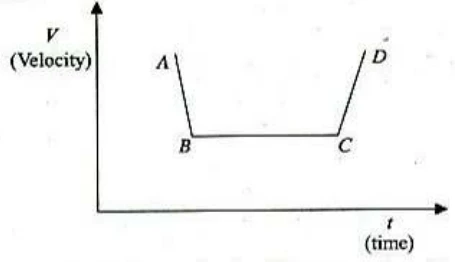
A graph of V (Velocity) on the vertical axis against t (time) on the horizontal axis, both with arrowheads. A line segment starts at a point A high on the left and slopes steeply down to a point B at a lower level. From B a horizontal segment runs to a point C at the same level. From C a segment slopes steeply up to a point D, at about the same height as A.

In the given velocity (V) versus time (t) graph, accelerated and decelerated motions are respectively represented by line segments

Options
Show answer & solution

Option C

CD and AB

Why

On a velocity-time graph, a rising line means speeding up (acceleration) and a falling line means slowing down (deceleration). A flat line means constant velocity. CD rises, AB falls and BC is flat. So the accelerated motion is CD and the decelerated motion is AB.

Proof

NCERT Class 9 Science, Ch. 8 (Motion), Velocity-time graphs

About the other options

Option A

BC is flat: constant velocity, no acceleration or deceleration.

Option B

BC is flat, so it is not accelerated motion; AB is the deceleration, so the second half is right.

Option D

Right segments in the wrong order: AB falls (deceleration) and CD rises (acceleration).

Ideal time: about 30 s
115Physics • Heat and Thermodynamics • Modes of Heat Transfer
Easy

Which one of the following statements regarding a thermos flask is NOT correct ?

Options
Show answer & solution

Option C

The surface of inner wall radiates good amount of heat and the surface of outer wall absorbs some of the heat that is radiated from the inner wall

Why

A thermos flask stops all three ways heat moves. The vacuum between the walls stops conduction and convection. The silvered (shiny) walls stop radiation: a shiny surface gives out little heat and reflects heat back. So the inner wall does not radiate much heat, and the outer wall reflects rather than absorbs it. Statement C is the reverse of this.

Proof

NCERT Class 11 Physics, Thermal Properties of Matter, Heat Transfer: conduction, convection and radiation

About the other options

Option A

True. The vacuum stops conduction and convection, and glass is a poor conductor.

Option B

True. The walls are silvered to cut down radiation.

Option D

True. The cork supports are poor conductors, so little heat leaks through them.

Ideal time: about 40 s
116Geography • Universe and Solar System
Very easy

‘Black hole’ is a

Options
Show answer & solution

Option C

star which has collapsed into itself and has large acceleration due to gravity on its surface

Why

A black hole forms when a very massive star collapses under its own gravity. Its mass is packed into so small a space that gravity near it is enormous; not even light can escape.

Proof

NCERT Class 11 Physics, Gravitation, Escape Speed: light cannot escape a black hole

About the other options

Option A

A black hole is not a large star; it is a collapsed one, and its gravity is huge, not zero.

Option B

Its gravity is far stronger than any ordinary star's, not moderate.

Option D

Collapsed, but with huge gravity, not zero. If gravity were zero, light would escape.

Ideal time: about 28 s
117Physics • Heat and Thermodynamics • Heat, Temperature and its Measurement
Very easy

The formula for conversion between Fahrenheit and Celsius is

°F=X+(1.8×°C)

What is factor X ?

Options
Show answer & solution

Option A

32

Why

Water freezes at 0 °C and 32 °F, and boils at 100 °C and 212 °F. 100 Celsius degrees span 180 Fahrenheit degrees, which gives the factor 1.8. Putting 0 °C in the formula leaves °F = X, so X is 32. NCERT Class 11 Physics, Thermal Properties of Matter, Temperature and Heat.

Proof

At 0 °C, water freezes at 32 °F, so X = 32.

About the other options

Option B

22: no fixed point of either scale gives this.

Option C

98: close to normal body temperature in Fahrenheit, about 98.6 °F.

Option D

42: no fixed point of either scale gives this.

Ideal time: about 12 s
118Physics • Light and Optics • Dispersion and Scattering of Light
Very easy

When a beam of white light passes through a glass prism, the colour of light beam that deviates the least is

Options
Show answer & solution

Option B

Red

Why

White light splits in a prism because each colour bends by a different amount. Red light has the longest wavelength and bends the least; violet bends the most. This is dispersion.

Proof

NCERT Class 10 Science, The Human Eye and the Colourful World: dispersion of white light by a glass prism

About the other options

Option A

Blue bends more than red; only violet bends more than blue.

Option C

Green sits in the middle of the spectrum, so it bends a middle amount.

Option D

Violet deviates the most, not the least. Hook: VIBGYOR: violet is bent most, red least.

Ideal time: about 16 s
119Physics • Gravitation • Gravitational Waves
Easy

LIGO stands for

Options
Show answer & solution

Option A

Laser Interferometer Gravitational wave Observatory

Why

LIGO is the Laser Interferometer Gravitational-Wave Observatory in the USA. It uses laser beams in two long arms to detect gravitational waves. It made the first detection in 2015, which won the 2017 Nobel Prize in Physics.

Exam-hall approach

'Gravitational wave' is the part most candidates remember from the 2017 Nobel news; that strikes C and D. Between A and B, an interferometer that precise works with a laser beam.

Proof

LIGO Laboratory (Caltech and MIT); Nobel Prize in Physics 2017 for the detection of gravitational waves

About the other options

Option B

Swaps 'Laser' for 'Light'. An interferometer of this size needs a laser beam, and the L is for Laser.

Option C

LIGO does not 'induce' gravity; it detects gravitational waves made by distant events such as black holes merging.

Option D

Nothing to do with gaseous optics; the G is for Gravitational wave.

Ideal time: about 15 s
120Physics • Magnetism and Electromagnetism • Domestic Electric Circuits
Very easy

A fuse wire must be

Options
Show answer & solution

Option A

conducting and of low melting point

Why

A fuse is a short piece of wire in series with the circuit. It must conduct so that current flows normally. It must melt at a low temperature, so that a large current heats it, melts it, and breaks the circuit before the appliances are harmed.

Proof

NCERT Class 10 Science, Electricity: heating effect of electric current, the electric fuse

About the other options

Option B

A high melting point would let the wire survive an overload, so it would never break the circuit.

Option C

An insulator would carry no current, so the circuit would never work at all.

Option D

A low melting point is right, but an insulator would stop the current even in normal use.

Ideal time: about 18 s