Skip to content

General Ability Test 2017 (I)

Set A

Questions 81–100 of 150

81Economy • Economic Planning • Five-Year Plans and their Themes
Easy

Which one of the following is NOT a target of the 12th Five-Year Plan ?

Options
Show answer & solution

Option B

Agriculture Growth Rate of 5 per cent

Why

The Twelfth Plan aimed for 4% annual growth in agriculture, not 5%. Its other targets were 8% real GDP growth, 10% manufacturing growth, and adding 1 million hectares of green cover each year. Twelfth Five Year Plan (2012–17), Planning Commission, Vol. I, Ch. 1.

Proof

Twelfth Five Year Plan 2012–17, Vol. I, Ch. 1: agriculture growth target 4% a year

About the other options

Option A

Real GDP growth of 8%: a real target; the Plan's draft aimed at 9%, cut to 8% in the final version.

Option C

Manufacturing growth of 10%: a real target of the Plan.

Option D

Green cover of 1 million hectares a year: a real environment target of the Plan.

Ideal time: about 45 s
82Physics • Heat and Thermodynamics • Modes of Heat Transfer
Easy

Which one of the following statements is NOT correct ?

Options
Show answer & solution

Option B

The amount of heat required to raise the temperature of a substance is called its specific heat capacity

Why

Specific heat capacity is the heat needed to raise the temperature of unit mass (1 kg) of a substance by 1 K. Option B leaves out both 'unit mass' and 'by one degree', so it is not correct. NCERT Class 11 Physics, Ch. 11 (Thermal Properties of Matter).

Proof

(J kg K): heat per unit mass per unit rise in temperature

About the other options

Option A

Correct: in conduction, particles pass heat on by vibrating about fixed positions.

Option C

Correct: liquids and gases carry heat mainly by convection, the movement of the warm fluid itself.

Option D

Correct: radiation needs no medium and does not heat the space it crosses, as sunlight crosses space.

Ideal time: about 59 s
83Physics • Heat and Thermodynamics • Latent Heat and Change of State
Very easy

The amount of heat required to change a liquid to gaseous state without any change in temperature is known as

Options
Show answer & solution

Option C

latent heat of vaporization

Why

The heat needed to turn a liquid into vapour at constant temperature is the latent heat of vaporization. It goes into breaking the bonds between molecules, not into raising the temperature. NCERT Class 11 Physics, Ch. 11 (Thermal Properties of Matter), Latent Heat.

Proof

NCERT Class 11 Physics, Ch. 11 (Thermal Properties of Matter), Latent Heat

About the other options

Option A

Specific heat capacity: heat that does raise the temperature, per unit mass per degree.

Option B

Mechanical equivalent of heat: the work equal to one unit of heat, about 4.2 J per calorie.

Option D

Quenching: cooling hot metal fast in water or oil to harden it.

Ideal time: about 16 s
84Physics • Oscillations, Waves and Sound • Oscillations and the Simple Pendulum
Easy

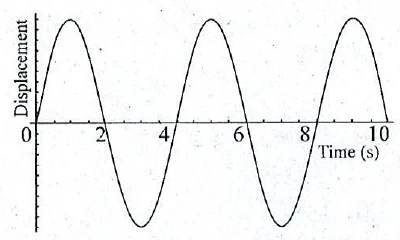
The following figure shows displacement versus time curve for a particle executing simple harmonic motion :

A graph of displacement (vertical axis, labelled Displacement, with no scale marked) against time (horizontal axis, labelled Time (s), ticks labelled 0, 2, 4, 6, 8, 10). The curve is a smooth sine-like wave that starts at zero displacement at t = 0 and rises to a first peak at about t = 1 s, falls through the time axis at about t = 2 s to a trough at about t = 3 s, rises back through the axis at about t = 4 s to a second peak at about t = 5 s, falls to a second trough at about t = 7 s, and rises to a third peak at about t = 9 s, reaching the axis again at about t = 10 s. The period is about 4 s.

Which one of the following statements is correct ?

Options
Show answer & solution

Option C

Phase of the oscillating particle is same at t = 3 s and t = 7 s

Why

Two instants have the same phase when they are a whole number of periods apart. The graph repeats every 4 s, so T = 4 s. Only t = 3 s and t = 7 s are exactly one period apart: both are troughs. NCERT Class 11 Physics, Ch. 14 (Oscillations).

Exam-hall approach

Same displacement is not enough; the motion must also be in the same direction. Peaks and troughs give the surest check: 3 s and 7 s are both troughs.

Proof

s; s (same phase); s ; s ; s

About the other options

Option A

s is a peak and s a trough: s apart, opposite in phase.

Option B

s : the particle passes zero moving one way at one instant and the other way at the other, so opposite in phase.

Option D

s : at s it crosses zero going up, at s going down, so opposite in phase.

Ideal time: about 51 s
85Physics • Light and Optics • Human Eye and Defects of Vision
Very easy

Match List I with List II and select the correct answer using the code given below the Lists :

List I (Disease)

A
Hypermetropia
B
Presbyopia
C
Myopia
D
Cataract

List II (Remedy)

1
Concave lens
2
Bifocal lens
3
Surgery
4
Convex lens
Options
ABCD
Show answer & solution

Option A

A4B2C1D3

Why

Hypermetropia (long sight): the image forms behind the retina, so a convex lens corrects it. Presbyopia: old age weakens focusing for both near and far, so a bifocal lens is used. Myopia (short sight): the image forms in front of the retina, so a concave lens corrects it. Cataract: the eye lens turns cloudy, and it is removed by surgery. NCERT Class 10 Science, Ch. 11 (The Human Eye and the Colourful World).

Exam-hall approach

Cataract needs surgery, so D–3. Only A and B have that. Myopia is corrected with a concave lens, so C–1, which gives A.

Proof

A–4, B–2, C–1, D–3

About the other options

Option B

Gives presbyopia a concave lens and myopia a bifocal. Myopia needs a concave lens; bifocals are for presbyopia.

Option C

Gives hypermetropia surgery and cataract a convex lens. A cloudy lens cannot be fixed with spectacles; it needs surgery.

Option D

Gets presbyopia and myopia right, but swaps hypermetropia and cataract: hypermetropia needs a convex lens, cataract needs surgery.

Ideal time: about 40 s
86Physics • Electricity • Resistance and Combination of Resistors
Easy

A circular coil of single turn has a resistance of 20 Ω. Which one of the following is the correct value for the resistance between the ends of any diameter of the coil ?

Options
Show answer & solution

Option A

5 Ω

Why

A diameter splits the ring into two halves of each. Between the ends of the diameter, these two halves are in parallel. NCERT Class 10 Science, Ch. 12 (Electricity), Resistors in Parallel.

Exam-hall approach

The answer between any two points of the ring cannot be more than the ring's , which strikes D. Two equal paths in parallel give half of one path, so less than .

Proof

About the other options

Option B

Takes only one half, , and forgets the other half in parallel.

Option C

The resistance of the whole ring, as if the current went all the way round.

Option D

Takes the two halves in series and doubles the ring: .

Ideal time: about 39 s
87Physics • Magnetism and Electromagnetism • Magnetic Effects of Electric Current
Easy

In a solenoid, the current flowing through the wire is I and number of turns per unit length is n. This gives a magnetic field B inside the solenoid. If number of turn per unit length is increased to 2n, what will be the value of magnetic field in the solenoid ?

Options
Show answer & solution

Option B

2B

Why

The field inside a long solenoid is . It is directly proportional to , so doubling doubles . NCERT Class 12 Physics, Ch. 4 (Moving Charges and Magnetism), The Solenoid.

Proof

About the other options

Option A

Takes the field as not depending on the turns per unit length; it does, directly.

Option C

Inverts the relation, as if more turns weakened the field.

Option D

Inverts and squares the relation; B is neither inversely proportional to n nor to its square.

Ideal time: about 41 s
88Physics • Light and Optics • Optical Instruments
Easy

Which one of the following statements is correct about the magnification of an optical microscope ?

Options
Show answer & solution

Option D

Magnification decreases with the increase in focal length of eyepiece

Why

The magnifying power of a compound microscope is . Both focal lengths are in the denominator, so a longer eyepiece focal length gives a smaller magnification. NCERT Class 12 Physics, Ch. 9 (Ray Optics and Optical Instruments), The Microscope.

Exam-hall approach

A stronger lens has a shorter focal length and magnifies more. So magnification falls as the eyepiece focal length rises.

Proof

, so

About the other options

Option A

The reverse: a longer eyepiece focal length lowers the magnification. Microscopes use short-focus eyepieces.

Option B

The objective's focal length is also in the denominator; a longer one lowers the magnification.

Option C

The eyepiece focal length does matter; it sets the eyepiece's own share of the magnification.

Ideal time: about 39 s
89Chemistry • States of Matter • Mixtures, Solutions and Colloids
Very easy

A homogeneous mixture contains two liquids. How are they separated ?

Options
Show answer & solution

Option C

By distillation

Why

Two liquids that mix completely are separated by distillation, using their different boiling points. When the boiling points are close (less than 25 K apart), fractional distillation is used. NCERT Class 9 Science, Ch. 2 (Is Matter Around Us Pure?).

Proof

NCERT Class 9 Science, Ch. 2 (Is Matter Around Us Pure?), How can we separate a mixture of two miscible liquids?

About the other options

Option A

Filtration: separates an insoluble solid from a liquid.

Option B

Evaporation: recovers a dissolved solid by driving off the liquid; it loses one of the two liquids.

Option D

Condensation: turning vapour back into liquid; it is only one step inside distillation.

Ideal time: about 12 s
90Chemistry • Carbon and its Compounds • Covalent Bonding and Properties of Carbon Compounds
Very easy

Which one of the following elements forms highest number of compounds ?

Options
Show answer & solution

Option D

Carbon

Why

Carbon forms millions of compounds because it links to itself in long chains, branches and rings (catenation) and has a valency of four. NCERT says carbon compounds outnumber those of all other elements put together. NCERT Class 10 Science, Ch. 4 (Carbon and its Compounds).

Proof

NCERT Class 10 Science, Ch. 4 (Carbon and its Compounds), Versatile Nature of Carbon

About the other options

Option A

Oxygen: forms many oxides and oxy-compounds, far fewer than carbon.

Option B

Hydrogen: is in most carbon compounds, so some count it as forming even more. The school answer, from NCERT, is carbon, whose catenation makes the variety possible.

Option C

Chlorine: forms chlorides and some organic compounds, far fewer than carbon.

Ideal time: about 10 s
91Chemistry • Chemical Reactions and Equations • Corrosion and Rancidity
Very easy

Which one of the following elements corrodes rapidly ?

Options
Show answer & solution

Option B

Iron

Why

Iron rusts quickly in moist air. The rust is loose and flaky, so fresh metal is always exposed and corrosion goes on. Aluminium and zinc form a thin, tight oxide layer that protects them. NCERT Class 10 Science, Ch. 3 (Metals and Non-metals), Corrosion.

Proof

NCERT Class 10 Science, Ch. 3 (Metals and Non-metals), Corrosion

About the other options

Option A

Aluminium: more reactive than iron, but a tight oxide layer stops further corrosion.

Option C

Zinc: also protected by its oxide layer; it is used to galvanise iron.

Option D

Silver: only tarnishes black slowly, with sulphur in the air.

Ideal time: about 11 s
92Chemistry • Some Basic Concepts of Chemistry • Concentration of Solutions
Easy

20 g of common salt is dissolved in 180 g of water. What is the mass percentage of the salt in the solution ?

Options
Show answer & solution

Option C

10%

Why

Mass percentage is the mass of the solute divided by the mass of the whole solution, times 100. The solution weighs g. NCERT Class 9 Science, Ch. 2 (Is Matter Around Us Pure?), Concentration of a solution.

Proof

About the other options

Option A

No usual slip gives 5%; it would need a solution twice as heavy.

Option B

Divides by g instead of g, adding the salt twice: .

Option D

No usual slip gives 15%. Dividing by the water alone, 20/180, gives about 11%, which is not an option either.

Ideal time: about 29 s
93Chemistry • Atomic Structure • Electronic Configuration and Valency
Very easy

The valency of an element depends upon the

Options
Show answer & solution

Option D

total number of electrons in the outer most shell of an atom

Why

Valency is the combining capacity of an atom. It depends on the electrons in the outermost shell (valence electrons): how many the atom loses, gains or shares to complete its octet. NCERT Class 9 Science, Ch. 4 (Structure of the Atom), Valency.

Proof

NCERT Class 9 Science, Ch. 4 (Structure of the Atom), Valency

About the other options

Option A

Total protons: the atomic number. It fixes the element, not its valency directly.

Option B

Mass number: protons plus neutrons; isotopes differ in it but have the same valency.

Option C

Neutrons: take no part in bonding.

Ideal time: about 18 s
94Chemistry • Periodic Classification of Elements • Noble Gases and their Uses
Easy

Match List I with List II and select the correct answer using the code given below the Lists :

List I (Noble gas)

A
Argon
B
Neon
C
Krypton
D
Xenon

List II (Use)

1
In lights for advertising display
2
Airport landing lights and in light houses
3
Light in photographer’s flash gun
4
In tungsten filament to last longer
Options
ABCD
Show answer & solution

Option D

A4B1C2D3

Why

Argon fills tungsten filament bulbs, since it is inert and slows the filament's evaporation. Neon gives the glowing red of advertising signs. Krypton is used in airport landing lights and lighthouses, as its light passes well through fog. Xenon is used in photographers' flash lamps. NCERT Class 12 Chemistry, Ch. 7 (The p-Block Elements), Group 18 Elements.

Exam-hall approach

Neon signs are well known, so B–1, which leaves A or D. Argon fills filament bulbs, so A–4, which gives D.

Proof

A–4, B–1, C–2, D–3

About the other options

Option A

Puts argon in flash guns. Argon fills light bulbs; the flash gas is xenon.

Option B

Puts argon in flash guns and neon in landing lights. Neon is the advertising-sign gas.

Option C

Gets argon and xenon right, but swaps neon and krypton: neon lights advertising signs, krypton lights runways.

Ideal time: about 46 s
95Physics • Light and Optics • Human Eye and Defects of Vision
Very easy

Colour vision in human eyes is the function of photoreceptor cells named

Options
Show answer & solution

Option B

Cones

Why

Cones in the retina respond to bright light and to colour. Rods respond to dim light but cannot tell colours apart. NCERT Class 11 Biology, Ch. 21 (Neural Control and Coordination), The Eye.

Proof

NCERT Class 11 Biology, Ch. 21 (Neural Control and Coordination), Parts of an Eye

About the other options

Option A

Rods: for vision in dim light, without colour.

Option C

Blind spot: where the optic nerve leaves the eye; it has no photoreceptor cells at all.

Option D

Fovea: a small pit in the retina, packed with cones, where vision is sharpest. It is a place, not a type of cell.

Ideal time: about 11 s
96Biology • Biomolecules and Enzymes • Chemical Composition of Living Organisms
Very easy

Which one of the following statements is NOT correct ?

Options
Show answer & solution

Option A

All proteins are enzymes

Why

Almost all enzymes are proteins, but most proteins are not enzymes. Collagen, keratin, haemoglobin and antibodies are proteins with other jobs. NCERT Class 11 Biology, Ch. 9 (Biomolecules).

Proof

NCERT Class 11 Biology, Ch. 9 (Biomolecules), Proteins and Enzymes

About the other options

Option B

Correct: nearly all enzymes are proteins; a few RNA molecules (ribozymes) also act as enzymes.

Option C

Correct: fats give about 9 kcal per gram, more than twice what carbohydrates or proteins give.

Option D

Correct: glucose is the most common simple sugar and the body's main fuel.

Ideal time: about 22 s
97Biology • Biomolecules and Enzymes • Carbohydrates
Very easy

Sugarcane is one of the important cash crops in India. It is grown to obtain

Options
Show answer & solution

Option D

Sucrose

Why

Sugarcane stores sucrose in its stem. Sucrose is table sugar, a disaccharide made of glucose and fructose. NCERT Class 11 Biology, Ch. 9 (Biomolecules).

Proof

NCERT Class 11 Biology, Ch. 9 (Biomolecules), Sugars

About the other options

Option A

Starch: the stored carbohydrate of potato, wheat and rice.

Option B

Glucose: one of the two units of sucrose; the main sugar of grapes and blood.

Option C

Fructose: the other unit of sucrose; the main sugar of fruit and honey.

Ideal time: about 11 s
98Biology • Morphology of Flowering Plants • The Flower
Moderate

The colourful part of the Sunflower or Marigold plant is

Options
Show answer & solution

Option B

Inflorescence

Why

The 'flower' of a sunflower or marigold is really a head (capitulum) of many tiny florets packed on one base. A group of flowers on one axis is an inflorescence. NCERT Class 11 Biology, Ch. 5 (Morphology of Flowering Plants), The Inflorescence.

Proof

NCERT Class 11 Biology, Ch. 5 (Morphology of Flowering Plants), The Inflorescence

About the other options

Option A

Flower: what the head looks like, but each coloured 'petal' is a separate ray floret.

Option C

Fruit: forms after fertilisation; in sunflower it is the dry 'seed' sold for eating.

Option D

Seed: inside the fruit; it is not coloured or showy.

Ideal time: about 12 s
99Geography • Minerals and Energy Resources of India • Distribution of Minerals in India
Easy

Match List I with List II and select the correct answer using the code given below the Lists :

List I (Mineral)

A
Manganese
B
Gypsum
C
Limestone
D
Magnesite

List II (Leading State)

1
Uttarakhand
2
Karnataka
3
Rajasthan
4
Odisha
Options
ABCD
Show answer & solution

Option D

A4B3C2D1

Why

Manganese: Odisha is the leading state. Gypsum: Rajasthan produces most of India's gypsum. Limestone: Karnataka has the largest share of limestone resources. Magnesite: Uttarakhand (Almora, Pithoragarh) is a leading state. Indian Bureau of Mines, Indian Minerals Yearbook.

Exam-hall approach

Odisha for manganese leaves C or D. Rajasthan for gypsum, a standard GK fact, gives D. The limestone and magnesite pairs then follow.

Proof

A–4, B–3, C–2, D–1

About the other options

Option A

Puts manganese in Uttarakhand and magnesite in Odisha. Odisha leads in manganese; Uttarakhand in magnesite.

Option B

Puts manganese in Uttarakhand and gypsum in Karnataka. Gypsum comes mainly from Rajasthan.

Option C

Gets manganese and magnesite right, but swaps gypsum and limestone. Rajasthan leads in gypsum, not Karnataka.

Ideal time: about 39 s
100Environment and Ecology • Protected Areas and Wildlife Conservation
Easy

Which one among the following is the correct order of tiger reserves situated from North to South in India ?

Options
Show answer & solution

Option C

Corbett – Sariska – Simlipal – Periyar

Why

Corbett is in Uttarakhand, Sariska in Rajasthan, Simlipal in Odisha and Periyar in Kerala. NCERT Class 10 Geography, Contemporary India II, Ch. 2 (Forest and Wildlife Resources).

Exam-hall approach

Corbett in Uttarakhand is the northernmost and Periyar in Kerala the southernmost, which strikes B and D. Rajasthan lies north of Odisha, which gives C.

Proof

Corbett (Uttarakhand, about 29.5°N) – Sariska (Rajasthan, about 27.3°N) – Simlipal (Odisha, about 21.8°N) – Periyar (Kerala, about 9.5°N)

About the other options

Option A

Puts Simlipal in Odisha north of Sariska in Rajasthan. Sariska, near Alwar, lies well to the north.

Option B

Runs south to north, the reverse of what is asked, with Simlipal and Sariska also swapped.

Option D

The exact reverse of the key: south to north.

Ideal time: about 41 s