Skip to content

General Knowledge 2023 (II)

Set A

Questions 1–20 of 120

1Physics • Light and Optics • Human Eye and Defects of Vision
Easy

A person can see near objects clearly through his eyes but cannot see distant objects clearly. The possible reason(s) for this defect could be :

1
Excessive curvature of the eye lens.
2
The eye-ball has become too small.
3
The focal length of the eye lens is too large.
4
Elongation of the eye-ball.

Select the correct answer using the code given below :

Options
Show answer & solution

Option C

1 and 4 only

Why

The defect is myopia (short-sightedness): the image of a far object forms in front of the retina. 1 — Correct. A lens that is too curved has too short a focal length, so it bends light too much. 2 — Wrong. A small eye-ball causes hypermetropia (long-sightedness), the opposite defect. 3 — Wrong. A focal length that is too large is also a cause of hypermetropia; myopia needs a focal length that is too short. 4 — Correct. An elongated eye-ball puts the retina too far behind the lens. Route: 'elongated eye-ball' is the best-known cause of myopia, which removes A and D; B pairs it with a hypermetropia cause.

About the other options

Option A

Leaves out statement 4: an elongated eye-ball is a cause of myopia.

Option B

Contains statement 2: a small eye-ball causes hypermetropia, not myopia.

Option D

Contains statement 3: too large a focal length causes hypermetropia.
Ideal time: about 1 min
2Physics • Motion, Force and Laws of Motion • Kinematics
Very easy

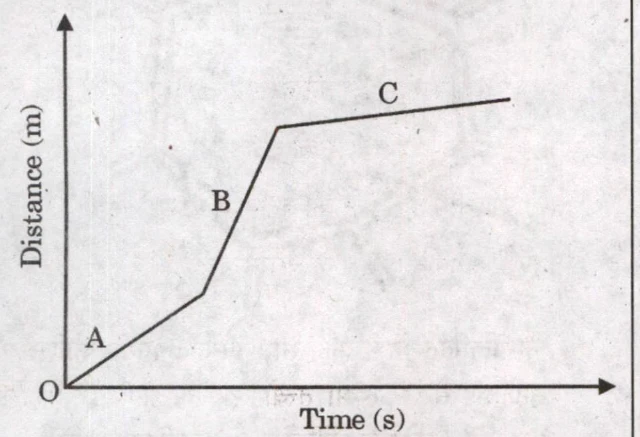
Consider a journey by a car represented by the graph given below in three parts A, B and C. The speed of the car in these parts is va, vb and vc, respectively :

A distance–time graph. The vertical axis is labelled "Distance (m)" and the horizontal axis "Time (s)"; the origin is marked O. No values are marked on either axis. The graph is a line of three straight segments joined end to end, starting at O: segment A rises from O with a moderate slope; segment B follows it and rises with the steepest slope of the three; segment C follows B and rises with the shallowest slope, nearly flat but still rising, to the end of the graph.

Which one of the following is correct in this case ?

Options
Show answer & solution

Option B

vb > va > vc

Why

On a distance–time graph the slope is the speed: the steeper the line, the faster the car. B is steepest, A is next, and C is almost flat, so vb > va > vc. Route: the steepest part is the fastest, so vb is the largest; only B puts vb first.

Proof

NCERT Class 9 Science, Motion (distance–time graphs)

About the other options

Option A

Reverses the order: C is the flattest part, so vc is the smallest, not the largest.

Option C

Equal speeds would give one straight line with a single slope; this graph bends twice.

Option D

B is steeper than A, so vb is greater than va, not less.

Ideal time: about 40 s
3Physics • Light and Optics • Reflection of Light and Mirrors
Easy

A concave mirror of radius of curvature 50 cm is used to form an image of an object kept at a distance of 25 cm from the mirror on its principal axis. What will be the position of the image from the mirror ?

Options
Show answer & solution

Option A

At infinity

Why

The focal length of a mirror is half its radius of curvature: cm. The object is at 25 cm, that is, exactly at the focus. Rays from the focus leave a concave mirror parallel, so the image is at infinity. Route: object at F always gives the image at infinity; object at C (50 cm) gives the image at C.

Proof

About the other options

Option B

50 cm is the centre of curvature. The image forms there only when the object is also at 50 cm.

Option C

25 cm is where the object is placed (the focus), not where the image forms.

Option D

75 cm would need the object between F and C; here the object is exactly at F.

Ideal time: about 45 s
4Physics • Gravitation • Universal Law of Gravitation
Very easy

If the Moon is brought closer to the Earth such that its distance from the Earth becomes half of the original distance, then the gravitational force of attraction between the Earth and the Moon would :

Options
Show answer & solution

Option D

increase to four times of its original value.

Why

By Newton's law of gravitation, the force varies as . Halving the distance makes the force times larger. Route: a closer Moon means a stronger pull, which removes A and C.

Proof

About the other options

Option A

The force grows when distance falls; it does not reduce.

Option B

Treats the force as varying with 1/r instead of 1/r².

Option C

The force depends on distance, so it cannot stay the same.

Ideal time: about 25 s
5Physics • Oscillations, Waves and Sound • Propagation of Sound
Very easy

Sonic boom is produced when a source of sound travels at a speed :

Options
Show answer & solution

Option A

greater than the speed of sound.

Why

A sonic boom is the loud bang from a shock wave. It forms when a source, such as a jet, moves faster than sound (supersonic speed), so the sound waves pile up behind it. Route: nothing with mass travels faster than light, which removes B.

Proof

NCERT Class 9 Science, Sound (supersonic speed and sonic boom)

About the other options

Option B

No object can travel faster than light.

Option C

Below the speed of sound the waves spread ahead of the source and do not pile up into a shock wave.

Option D

At exactly the speed of sound the waves bunch up at the 'sound barrier'; the boom comes from flight beyond it.

Ideal time: about 20 s
6Chemistry • Some Basic Concepts of Chemistry • Atoms, Molecules and Atomicity
Very easy

Which one among the following are the correct symbols for the elements gold, tin and lead, respectively ?

Options
Show answer & solution

Option C

Au, Sn, Pb

Why

Gold is Au (Latin aurum), tin is Sn (stannum) and lead is Pb (plumbum). Route: Au for gold is widely known, which removes A and B; Sn for tin then separates C from D.

Proof

NCERT Class 9 Science, Atoms and Molecules (symbols of elements)

About the other options

Option A

Ga is gallium and Sb is antimony.

Option B

At is astatine, and Le is not the symbol of any element.

Option D

Sb is antimony (stibium), not tin.

Ideal time: about 20 s
7Geography • Universe and Solar System • Planets of the Solar System
Moderate

How much percentage of carbon dioxide is present in the atmosphere of Venus and Mars ?

Options
Show answer & solution

Option D

95 – 97%

Why

Carbon dioxide makes up about 96% of the atmosphere of Venus and about 95% of that of Mars. Both atmospheres are almost entirely CO2, with nitrogen and argon making up most of the rest. Route: if you know these atmospheres are 'mostly CO2', only C and D remain, and 'mostly' means far above three-quarters.

Proof

NASA planetary fact sheets (atmospheric composition of Venus and Mars)

About the other options

Option A

Under half: CO2 is far more than half of both atmospheres.

Option B

Just over half: still far below the real share of about 95%.

Option C

Too low: nitrogen and argon together make up only about 3–5%, so CO2 cannot be as low as three-quarters.

Ideal time: about 20 s
8Chemistry • States of Matter • Elements and Compounds
Moderate

Which among the following methods is used to separate the constituents present in a compound ?

Options
Show answer & solution

Option A

Electrochemical method

Why

The constituents of a compound are joined by chemical bonds, so physical methods cannot separate them. They can be separated only by chemical or electrochemical reactions — for example, electrolysis splits water into hydrogen and oxygen. Route: fractional distillation is a method for mixtures, which removes C.

Proof

NCERT Class 9 Science, Is Matter Around Us Pure? (compounds and mixtures)

About the other options

Option B

Heating breaks down some compounds (heating mercury oxide gives mercury and oxygen), but it is not a general method. The NCERT line names only chemical or electrochemical reactions.

Option C

Fractional distillation separates miscible liquids in a mixture, such as acetone and water; it cannot break a compound.

Option D

Ion exchange removes ions from a solution, as in water softening; it is not a way to split a compound into its elements.

Ideal time: about 30 s
9Chemistry • Chemical Reactions and Equations • Writing and Balancing Chemical Equations
Very easy

During white-washing of walls, slaked lime reacts slowly with carbon dioxide in air to form a thin layer of calcium carbonate on the walls. Which of the following reactions represents this correctly ?

Options
Show answer & solution

Option D

Ca(OH)2 (aq) + CO2 (g) → CaCO3 (s) + H2O (l)

Why

Slaked lime is calcium hydroxide, Ca(OH)2, applied as a solution. It reacts with carbon dioxide gas from the air to form solid calcium carbonate and water. Route: slaked lime is Ca(OH)2, not CaO, which removes A and B; CO2 in air is a gas, which removes C.

Proof

NCERT Class 10 Science, Chemical Reactions and Equations (white-washing)

About the other options

Option A

CaO is quicklime, not slaked lime; quicklime reacts with water to make slaked lime.

Option B

Starts from CaO (quicklime), and calls it a liquid; it is a solid.

Option C

CO2 in air is a gas, not a liquid, and slaked lime is used as a solution (aq), not a liquid.

Ideal time: about 40 s
10Chemistry • Chemical Reactions and Equations • Writing and Balancing Chemical Equations
Very easy

Which one of the following equations is the balanced chemical equation for the given reaction ?

Fe + H2O → Fe3O4 + H2

Options
Show answer & solution

Option C

3Fe + 4H2O → Fe3O4 + 4H2

Why

Count atoms on each side. Fe3O4 needs 3 Fe and 4 O, so 3Fe and 4H2O. Then 4H2O gives 8 H, which is 4H2. Each side has 3 Fe, 8 H and 4 O. Route: only C has the same number of every atom on both sides.

Proof

NCERT Class 10 Science, Chemical Reactions and Equations (balancing an equation)

About the other options

Option A

Only 1 Fe on the left against 3 in Fe3O4, and 8 H on the left against 2 on the right.

Option B

Only 1 O on the left against 4 in Fe3O4.

Option D

8 H on the left against only 2 H on the right.

Ideal time: about 40 s
11Biology • Morphology of Flowering Plants • The Leaf
Easy

The term Phyllotaxy refers to the pattern of :

Options
Show answer & solution

Option A

arrangement of leaves.

Why

Phyllotaxy is the pattern in which leaves are arranged on the stem or branch: alternate, opposite or whorled. 'Phyllo' means leaf. Route: the root 'phyll' (leaf, as in chlorophyll) points to A.

Proof

NCERT Class 11 Biology, Morphology of Flowering Plants (the leaf)

About the other options

Option B

The branching of a stem is not a separate term here; phyllotaxy is about leaves only.

Option C

Flower formation on a branch is part of the inflorescence, not phyllotaxy.

Option D

The arrangement of flowers on the floral axis is called inflorescence.

Ideal time: about 20 s
12Biology • Cell Biology • Cell Organelles and their Functions
Very easy

Chromosomes are composed of DNA and :

Options
Show answer & solution

Option C

proteins

Why

Chromosomes are made of DNA and proteins. The DNA is wound round proteins called histones. Route: 'nucleoprotein' and 'histones' are the familiar words; neither lipids nor vitamins are structural parts of chromosomes.

Proof

NCERT Class 9 Science, The Fundamental Unit of Life (the nucleus)

About the other options

Option A

Lipids form cell membranes, not chromosomes.

Option B

Vitamins are nutrients that help enzymes work; they are not part of chromosomes.

Option D

Carbohydrates are an energy source and form the plant cell wall; the sugar in DNA is part of DNA itself, not a separate component.

Ideal time: about 15 s
13Biology • Cell Biology • Prokaryotic Cells
Easy

Bacteria have an undefined nuclear region which lacks a nuclear membrane and contains only DNA without proteins. Such a region is called :

Options
Show answer & solution

Option D

Nucleoid

Why

In prokaryotic cells such as bacteria, the poorly defined nuclear region without a nuclear membrane is called the nucleoid. Route: a 'nucleus' must have a nuclear membrane, which removes B; '-oid' means 'like a nucleus'.

Proof

NCERT Class 9 Science, The Fundamental Unit of Life (prokaryotic cells)

About the other options

Option A

A nucleosome is a unit of DNA wound round histone proteins in eukaryotic chromosomes.

Option B

A true nucleus is enclosed by a nuclear membrane, which bacteria lack.

Option C

Nucleoprotein is a substance — DNA joined with protein — not a region of the cell.

Ideal time: about 20 s
14Biology • Cell Biology • Cell Organelles and their Functions
Easy

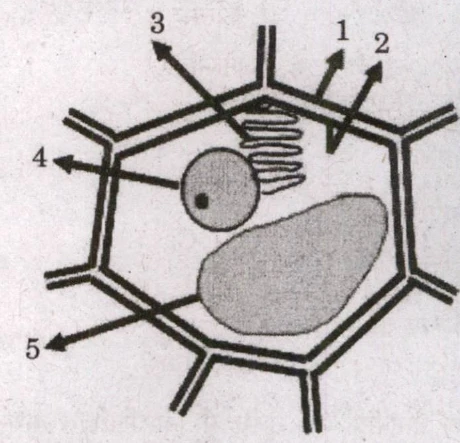
In the following simplified diagram of a plant cell, five parts/organelles are marked from 1 to 5 :

A simplified drawing of a plant cell, roughly seven-sided. Its boundary is drawn as two concentric outlines: an outer thick double line, with short double-line stubs projecting outward from each corner (as if joining neighbouring cells), and just inside it a second, thinner outline. Five arrows are labelled. Arrow 1 (top right) starts on the outer thick double-line outline and points outward. Arrow 2 (top right, beside 1) starts just inside the inner outline and points outward. Arrow 3 (top left) starts at a stack of wavy, folded parallel membranes near the top centre of the cell. Arrow 4 (left) starts at a small round body with a dark dot inside it, sitting just below the folded membranes. Arrow 5 (lower left) starts at a large irregular oval body shaded grey, filling much of the lower half of the cell.

Which one of the following correctly represents the above parts/organelles ?

Options
Show answer & solution

Option C

1 – cell wall; 2 – cell membrane; 3 – endoplasmic reticulum; 4 – nucleus; 5 – vacuole

Why

1 is the outermost thick layer: the cell wall. 2 is the thin layer just inside it: the cell membrane. 3 is the stack of folded membranes: the endoplasmic reticulum. 4 is the round body with a dark dot (the nucleolus): the nucleus. 5 is the large body filling much of the cell: the vacuole, which is very large in plant cells. Route: the cell wall lies outside the membrane in a plant cell, which removes A; the large central body in a plant cell is the vacuole, which leaves only C.

Proof

NCERT Class 9 Science, The Fundamental Unit of Life (plant cell diagram)

About the other options

Option A

Swaps wall and membrane: in a plant cell the wall is outside the membrane. It also swaps the vacuole and the nucleus.

Option B

Calls the small round body with a nucleolus the vacuole; that is the nucleus. The large body is the vacuole.

Option D

Calls the folded membranes the vacuole and the small nucleus the endoplasmic reticulum.

Ideal time: about 1 min
15Art and Culture • Literature • Medieval Regional Literature
Easy

Which one of the following is the language of the famous political treatise Amuktmalyada ?

Options
Show answer & solution

Option D

Telugu

Why

Amuktamalyada was written in Telugu by Krishnadeva Raya, the Vijayanagara ruler. Besides a poem, it contains his advice on statecraft. Route: Krishnadeva Raya is famed as a patron of Telugu literature (the Ashtadiggajas at his court).

Proof

NCERT Class 12, Themes in Indian History Part II, An Imperial Capital: Vijayanagara

About the other options

Option A

Krishnadeva Raya did write in Sanskrit (Jambavati Kalyanam), but Amuktamalyada is in Telugu.

Option B

Tamil was the language of the Sangam works and of the Chola court, not of this text.

Option C

Kannada was spoken in much of Vijayanagara, but Krishnadeva Raya's court poetry was in Telugu.

Ideal time: about 20 s
16History • Buddhism, Jainism and Other Sects • Jainism
Moderate

Which one of the following statements about the Shvetambara Sect of Jainism is not correct ?

Options
Show answer & solution

Option B

It refers to monks, who migrated to the south of Vindhyas in 4th century BCE.

Why

When a famine struck Magadha in the 4th century BCE, Bhadrabahu led a group of monks south. Those who went south became the Digambaras (sky-clad). Those who stayed in the north under Sthulabhadra became the Shvetambaras. So B describes the Digambaras. Route: 'Shvetambara' means white-clad, which makes A true; the south-migration story belongs to the other sect.

Proof

Upinder Singh, A History of Ancient and Early Medieval India (Jainism)

About the other options

Option A

True: Shvetambara means 'white-clad', after the white robes of its monks.

Option C

True: the Shvetambaras accept a canon of Angas, compiled at the Valabhi council; 12 Angas are named, though the 12th is lost.

Option D

True: the Shvetambaras hold that women can attain liberation; the Digambaras deny it.

Ideal time: about 30 s
17Art and Culture • Painting • Prehistoric Rock Art
Hard

Where is the Vikramkhol Cave located ?

Options
Show answer & solution

Option A

Odisha

Why

Vikramkhol is a rock shelter in Jharsuguda district, Odisha. It carries ancient engraved signs on the rock face. Route: no common fact narrows this; it has to be known.

Proof

Standard references on Indian rock shelters and inscriptions (Vikramkhol, Jharsuguda)

About the other options

Option B

Bihar's famous caves are the Barabar and Nagarjuni caves, cut in the Mauryan period.

Option C

Telangana is not the site; it has no well-known Vikramkhol.

Option D

West Bengal is not the site; Vikramkhol is in western Odisha.

Ideal time: about 15 s
18History • Prehistoric Period • Palaeolithic, Mesolithic and Neolithic Cultures
Moderate

Consider the following statements regarding the ‘Levallois Technique’ :

1
It refers to making perforated Harappa pottery.
2
It refers to making prehistoric flake tools.

Which of the statements given above is/are correct ?

Options
Show answer & solution

Option B

2 only

Why

1 — Wrong. The Levallois technique has nothing to do with pottery; Harappan perforated jars are a different subject. 2 — Correct. It is a prehistoric stone-tool method: a core is shaped first, then a flake of a planned shape is struck off it. It is typical of the Middle Palaeolithic. Route: 'technique' named after a French site points to prehistoric stone tools, not Harappan pottery.

Proof

Upinder Singh, A History of Ancient and Early Medieval India (Palaeolithic tool technology)

About the other options

Option A

Contains statement 1: Levallois is a stone-tool method, not a pottery method.

Option C

Contains statement 1, which is false.

Option D

Leaves out statement 2, which is true: Levallois is a flake-tool technique.

Ideal time: about 30 s
19Art and Culture • Science and Technology in Ancient and Medieval India • Sciences in Ancient India: Medicine, Mathematics and Astronomy
Hard

Which of the following statements is/are correct ?

1
The Bakshali Manuscript written in the Gatha language (a refined version of old Prakrit) using the Sharada script deals with topics such as fractions, square roots, arithmetic and geometric progressions.
2
In the field of geometry, Aryabhatta described the various properties of a circle giving a very accurate value for pi (π) correct to four decimal places at 3·1416.
3
Sharangadhara Samhita is an important text on political system of ancient India.

Select the correct answer using the code given below :

Options
Show answer & solution

Option C

1 and 2 only

Why

1 — Correct. The Bakhshali manuscript, on birch bark in the Sharada script and in the Gatha language, deals with fractions, square roots and progressions. 2 — Correct. Aryabhata gave the value of pi as 3.1416, correct to four decimal places. 3 — Wrong. The Sharangadhara Samhita is an Ayurvedic text on medicines and how to prepare them, not on politics. Route: Aryabhata's 3.1416 is well known, which removes B; 'Samhita' with a medical author's name rules out a political text, which removes A.

About the other options

Option A

Contains statement 3: the Sharangadhara Samhita is about medicine.

Option B

Leaves out statement 2, which is true, and contains statement 3, which is false.

Option D

Leaves out statement 1: the Bakhshali manuscript is a mathematics text in the Sharada script.

Ideal time: about 1 min
20History • National Movement, 1919–1947 • Transfer of Power and Partition, 1945–47
Moderate

Which one of the following is not correct about the Indian Independence Act, 1947 ?

Options
Show answer & solution

Option B

Act of 1947 laid down the basic framework of the Indian Constitution.

Why

The Indian Independence Act, 1947 ended British rule and created two dominions. It did not lay down a framework for the Constitution; that came from the Government of India Act, 1935, much of which the Constitution borrowed. Route: the 1935 Act is the well-known 'blueprint' of the Constitution, which marks B as the false one.

Proof

M. Laxmikanth, Indian Polity, Historical Background (Indian Independence Act of 1947)

About the other options

Option A

True: the Bill was introduced on 4 July 1947 and received Royal Assent on 18 July 1947.

Option C

True: the Act created the two independent dominions of India and Pakistan from 15 August 1947.

Option D

True: it gave each Constituent Assembly power to frame and adopt any constitution, and even to repeal Acts of the British Parliament.

Ideal time: about 45 s