Skip to content

General Knowledge 2017 (II)

Set A

Questions 81–100 of 120

81Geography • World Economic Geography • Major Industrial Regions of the World
Moderate

Match List–I with List–II and select the correct answer using the code given below the Lists :

List–I (Industrial Region)

A
Leipzig
B
Detroit
C
Lorraine
D
Cumberland

List–II (Country)

1
USA
2
UK
3
France
4
Germany
Options
ABCD
Show answer & solution

Option C

A4B1C3D2

Why

Leipzig is an industrial city of Saxony in Germany. Detroit, the motor-car city, is in the USA. Lorraine, with its iron ore, is the steel region of north-eastern France. Cumberland, with its coal and iron, is in north-west England, UK. Route: Detroit–USA is the pair everyone knows; it leaves only A and C. Leipzig is German, which rules out A.

Proof

A–4, B–1, C–3, D–2

About the other options

Option A

Swaps Leipzig and Cumberland: Leipzig is German, Cumberland is English.

Option B

Puts Detroit in France; Detroit is the motor-car centre of the USA.

Option D

Puts Detroit in France and Lorraine in the USA; Lorraine is French.
Ideal time: about 1 min
82Geography • Physiography of India • Peninsular Plateau and its Ranges
Easy

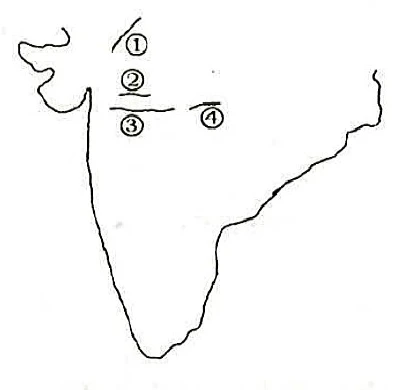
Match List–I with List–II and select the correct answer using the code given below the Lists :

List–I (Mountain Range)

A
Satpura
B
Vindhya
C
Aravalli
D
Mahadeo

List–II (Location in Map)

1
①
2
②
3
③
4
④
Outline map of peninsular India: the west coast from the Gujarat coast (Kathiawar and the Gulf of Khambhat at top left) down to the southern tip, and the east coast up to the Bengal side at top right; no internal boundaries or names. Four short line segments mark mountain ranges in the north-central part of the peninsula, each with a circled numeral. (1) is a short line running diagonally from south-west to north-east, at the top, north of the Gulf of Khambhat and furthest north of the four. (2) is a short horizontal line just below (1), with the numeral above it. Just below (2) is a longer horizontal line running east–west with (3) printed below it. (4) is a short horizontal line to the east of the (2)/(3) lines, at about the same latitude as (3)'s line, with the numeral beside it.
Options
ABCD
Show answer & solution

Option C

A3B2C1D4

Why

The Aravalli runs from south-west to north-east, north of the Gulf of Khambhat, so it is ①. South of it the Vindhya (②) and then the longer Satpura (③) run east–west, with the Narmada between them. The Mahadeo hills (④) are the eastern part of the Satpura system, east of the main range. Route: the diagonal line is the Aravalli; that leaves A and C. Satpura is the long range south of the Vindhya, so it is ③.

Proof

A–3, B–2, C–1, D–4

About the other options

Option A

Swaps Satpura and Mahadeo: the long east–west line is the Satpura; Mahadeo is the short line to its east.

Option B

Swaps Vindhya and Aravalli: the Aravalli is the diagonal range furthest north, not ②.

Option D

Puts the Aravalli at ②; the Aravalli is the only range running south-west to north-east.

Ideal time: about 1.5 min
83Geography • Physiography of India • Peninsular Plateau and its Ranges
Moderate

Which of the following statements in respect to the Indian Peninsular Plateau are correct?

1
The Deccan Plateau gradually rises from North to South.
2
The Malwa Plateau dominates the Vindhyan scarps, forming the Eastern flank of the plateau.
3
The Western Satpuras separate the Narmada and Tapi rivers.
4
The Chota Nagpur Plateau is composed of Archaean granite and gneiss rocks.

Select the correct answer using the code given below.

Options
Show answer & solution

Option B

1, 3 and 4 only

Why

1 — Correct. The Deccan Plateau rises southward: the Maharashtra plateau is lower than the Karnataka plateau, and the highest land (Nilgiris, Anaimalai) is in the south. 2 — Wrong. The Malwa Plateau lies on the western side of the Central Highlands; the eastern flank is formed by Bundelkhand, Baghelkhand and Chota Nagpur. 3 — Correct. The Satpura range stands between the Narmada (to its north) and the Tapi (to its south). 4 — Correct. The Chota Nagpur Plateau is made of very old Archaean granite and gneiss. Route: once statement 2 is out, A and C go. Statement 4 is the only difference between B and D.

About the other options

Option A

Includes statement 2; Malwa is on the western, not eastern, side of the Central Highlands.

Option C

Includes statement 2, which is false, and leaves out statements 1 and 3, which are true.

Option D

Leaves out statement 4; Chota Nagpur is indeed Archaean granite and gneiss.

Ideal time: about 1 min
84Indian Polity • Constitutional Bodies • Finance Commission
Moderate

Which one of the following criteria got the highest weight for determination of shares of States in the formula given by the 14th Finance Commission?

Options
Show answer & solution

Option B

Income distance

Why

The 14th Finance Commission (report submitted in December 2014, accepted in February 2015) gave income distance the largest weight, 50%, in sharing taxes among States. The others were population of 1971 (17.5%), demographic change of 2011 (10%), area (15%) and forest cover (7.5%). Income distance means how far a State's per-capita income is below that of the richest State; poorer States get more.

Proof

Report of the Fourteenth Finance Commission (2015–20), chapter on horizontal devolution

About the other options

Option A

Population: 17.5% (1971 population) plus 10% for demographic change — large, but less than income distance.

Option C

Area: 15% weight.

Option D

Tax effort: used by the 13th Finance Commission, dropped by the 14th.

Ideal time: about 20 s
85Indian Polity • Parliament • Legislative Procedure in Parliament
Very easy

A Money Bill passed by the Lok Sabha can be held up by the Rajya Sabha for how many weeks?

Options
Show answer & solution

Option A

Two

Why

The Rajya Sabha must return a Money Bill within 14 days, that is, two weeks. After that it is deemed passed by both Houses in the form the Lok Sabha passed it (Article 109).

Proof

Constitution of India, Article 109(2) and (5)

About the other options

Option B

Three weeks: no such limit in Article 109; the limit is 14 days.

Option C

Four weeks: not a limit for Money Bills.

Option D

Five weeks: not a limit for Money Bills.

Ideal time: about 20 s
86Indian Polity • Public Administration • Civil Services and their Constitutional Safeguards
Easy

Constitutional safeguards available to Civil Servants are ensured by

Options
Show answer & solution

Option B

Article 311

Why

Article 311 protects civil servants: no one can be dismissed or removed by an authority lower than the one that appointed them, and no one can be dismissed, removed or reduced in rank without an inquiry and a fair chance to be heard.

Proof

Constitution of India, Article 311

About the other options

Option A

Article 310: the 'doctrine of pleasure' — civil servants hold office during the pleasure of the President or Governor. Article 311 limits it.

Option C

Article 312: power of Parliament to create All India Services.

Option D

Article 317: removal and suspension of members of a Public Service Commission.

Ideal time: about 20 s
87Indian Polity • Fundamental Rights • Right to Constitutional Remedies and Writs
Very easy

A writ issued to secure the release of a person found to be detained illegally is

Options
Show answer & solution

Option B

Habeas corpus

Why

Habeas corpus ('you may have the body') orders the person holding someone to produce them before the court, which frees them if the detention is illegal. The Supreme Court issues it under Article 32, High Courts under Article 226.

Proof

Constitution of India, Articles 32 and 226

About the other options

Option A

Mandamus ('we command'): orders a public official or body to do a duty it has failed to do.

Option C

Certiorari: a higher court quashes an order already passed by a lower court or tribunal.

Option D

Prohibition: a higher court stops a lower court from going beyond its jurisdiction in a pending case.

Ideal time: about 15 s
88Indian Polity • Parliament • Legislative Procedure in Parliament
Easy

Which one of the following cannot be introduced first in the Rajya Sabha?

Options
Show answer & solution

Option C

Annual Financial Statement

Why

The Annual Financial Statement (the Budget, Article 112) is presented first in the Lok Sabha and only then laid before the Rajya Sabha, because money matters belong to the Lok Sabha; the Appropriation and Finance Bills that follow from it are Money Bills, which can be introduced only in the Lok Sabha (Article 109). Route: the other three are documents or bills that either House can take up first.

Proof

Constitution of India, Articles 109 and 112

About the other options

Option A

A Constitutional Amendment Bill can be introduced in either House (Article 368).

Option B

The CAG report is laid before both Houses (Article 151); it is not tied to the Lok Sabha.

Option D

A Bill to alter State boundaries (Article 3) can be introduced in either House on the President's recommendation.

Ideal time: about 20 s
89Indian Polity • Statutory and Non-Constitutional Bodies • Statutory National Commissions
Easy

The National Commission for Women was created by

Options
Show answer & solution

Option C

an Act passed by the Parliament

Why

The National Commission for Women is a statutory body, set up in January 1992 under the National Commission for Women Act, 1990, passed by Parliament.

Proof

National Commission for Women Act, 1990

About the other options

Option A

Not constitutional: commissions for SCs (Article 338) and STs (Article 338A) are constitutional, the NCW is not.

Option B

A Cabinet decision creates an executive body (like the old Planning Commission); the NCW has a law behind it.

Option D

No presidential order created the NCW; the President appoints Finance Commissions, not this body.

Ideal time: about 20 s
90Indian Polity • Judiciary • Judicial Activism and Public Interest Litigation
Easy

Who among the following was the Chief Justice of India when Public Interest Litigation (PIL) was introduced in the Indian Judicial System?

Options
Show answer & solution

No option is correct

Why

Public Interest Litigation (PIL) began in the Supreme Court in the late 1970s and early 1980s, in cases such as Hussainara Khatoon (1979) and S. P. Gupta (1981). It let anyone, even by a letter, approach the Court for people who could not do so themselves. Y. V. Chandrachud was Chief Justice of India then (1978–85). He is not among the options, so none of the four is right. Justice P. N. Bhagwati, with Justice V. R. Krishna Iyer, built PIL, and Bhagwati is called the father of PIL in India. But when PIL began he was an ordinary judge of the Court; he became Chief Justice only in 1985. The examiner probably meant Bhagwati, as the judge linked to PIL.

Proof

Standard polity references (Laxmikanth, chapter on Public Interest Litigation)

About the other options

Option A

M. Hidayatullah: CJI 1968–70, before PIL began.

Option B

A. S. Anand: CJI 1998–2001; PIL was well established by then.

Option C

A. M. Ahmadi: CJI 1994–97; PIL was well established by then.

Option D

P. N. Bhagwati: the judge who shaped PIL and is called its father, but when it began he was not Chief Justice; he held that post only in 1985–86.

Ideal time: about 20 s
91Art and Culture • Literature • Classical Sanskrit Literature
Hard

Which twelfth century Sanskrit scholar was first responsible for the compilation of ‘Nibandhas’ or digests of epic and Puranic texts?

Options
Show answer & solution

Option C

Lakshmidhara

Why

Lakshmidhara, minister of the Gahadavala king Govindachandra of Kanauj in the twelfth century, compiled the Krityakalpataru, the first great nibandha (digest) that collected rules from the epics, Puranas and Smritis by subject. Route: Harsha (7th century) and Kalidasa (Gupta age, about 5th century) are not twelfth-century; that leaves Govindachandra and his minister.

Proof

Standard ancient-history references on the Gahadavalas and the Krityakalpataru

About the other options

Option A

Harsha: 7th-century king of Kanauj, author of the plays Nagananda, Ratnavali and Priyadarshika — not a digest compiler.

Option B

Govindachandra: the Gahadavala king Lakshmidhara served; the patron, not the compiler.

Option D

Kalidasa: poet of the Gupta age (Abhijnanashakuntalam, Meghaduta), centuries earlier.

Ideal time: about 20 s
92Economy • Basic Concepts and National Income • Theories of Development and Underdevelopment
Very hard

Who among the following scholars argued that “capital created underdevelopment not because it exploited the underdeveloped world, but because it did not exploit it enough”?

Options
Show answer & solution

Option C

Geoffrey Kay

Why

Geoffrey Kay wrote this in 'Development and Underdevelopment: A Marxist Analysis' (1975): merchant capital held back the underdeveloped world because it did not transform its production, that is, did not exploit it enough.

Proof

Geoffrey Kay, Development and Underdevelopment: A Marxist Analysis (1975)

About the other options

Option A

Bill Warren: argued in 'Imperialism: Pioneer of Capitalism' that imperialism spread capitalism and development.

Option B

Paul Baran: 'The Political Economy of Growth' — underdevelopment from the drain of surplus, i.e. too much exploitation, the opposite view.

Option D

Lenin: 'Imperialism, the Highest Stage of Capitalism' — capital export and exploitation of colonies.

Ideal time: about 20 s
93Art and Culture • Literature • Sangam and Classical Tamil Literature
Easy

Which river is praised in the fifth century Tamil epic, Silappadikaram?

Options
Show answer & solution

Option A

Cauvery

Why

The Silappadikaram, the Tamil epic of Kovalan and Kannagi, is set in Puhar at the mouth of the Kaveri, and its songs (the 'Kanal vari' and others) praise the Kaveri (Cauvery) as the life of the Chola land. Route: a Tamil epic praises a Tamil river; the Cauvery is the main river of Tamil Nadu.

Proof

Silappadikaram (Ilango Adigal); NCERT Class 12, Themes in Indian History Part I, on the Tamil epics

About the other options

Option B

Godavari: river of Maharashtra and Andhra, outside the Tamil country.

Option C

Saraswati: the river praised in the Rig Veda.

Option D

Ganges: the sacred river of the north, central to Sanskrit, not Tamil, literature.

Ideal time: about 20 s
94History • Harappan Civilisation
Very easy

Which one of the following statements about the Harappan Culture is not correct?

Options
Show answer & solution

Option C

It marks the earliest known use of iron as a medium for the art of sculpting.

Why

The Harappan culture was a Bronze Age culture; it did not know iron. Iron came into use in India much later, about 1000 BCE onwards. So the statement about iron sculpture is not correct. The other three are true: Harappa had the first cities of the subcontinent, the first script (read right to left), and the first stone sculpture, such as the steatite 'priest-king'.

Proof

NCERT Class 12, Themes in Indian History Part I, chapter 1 (Bricks, Beads and Bones)

About the other options

Option A

True: Harappa, Mohenjo-daro and others were the subcontinent's first cities.

Option B

True: the Harappan script is the earliest in the subcontinent and is thought to be written right to left.

Option D

True: stone figures such as the steatite 'priest-king' of Mohenjo-daro are the earliest stone sculpture here.

Ideal time: about 30 s
95History • Early Medieval North India • Harshavardhana and his Age
Easy

Harshacharita has references to various presents sent by a ruler named Bhaskara to Harshavardhana. Bhaskara belonged to

Options
Show answer & solution

Option B

Varman Dynasty of Assam

Why

Bhaskaravarman, king of Kamarupa (Assam) of the Varman dynasty, was Harsha's ally against Shashanka of Gauda; Banabhatta's Harshacharita describes the gifts his envoy brought to Harsha. Route: the Haryanka and Nanda dynasties ruled Magadha over a thousand years before Harsha (7th century).

Proof

Banabhatta, Harshacharita; standard ancient-history references on Harsha

About the other options

Option A

Haryanka dynasty: Bimbisara and Ajatashatru of Magadha, 6th–5th century BCE.

Option C

Nanda dynasty: Magadha in the 4th century BCE, before the Mauryas.

Option D

Not needed: Bhaskara is the Varman king of Kamarupa.

Ideal time: about 20 s
96Geography • Rivers and Drainage of India • Lakes of India
Moderate

Which of the following lakes is/are situated in Ladakh?

1
Tso Kar
2
Pangong Tso
3
Tsomgo
4
Tso Moriri

Select the correct answer using the code given below.

Options
Show answer & solution

Option C

1, 2 and 4

Why

1 — Correct. Tso Kar is a salt lake in the Rupshu plateau of Ladakh. 2 — Correct. Pangong Tso lies across the Ladakh–Tibet border. 3 — Wrong. Tsomgo (Changu) Lake is in East Sikkim, on the road to Nathu La. 4 — Correct. Tso Moriri is in the Changthang area of Ladakh. (In 2017 Ladakh was part of Jammu and Kashmir; it became a Union Territory in 2019.) Route: Pangong Tso removes A, and Tsomgo in Sikkim removes B; Tso Kar decides between C and D.

About the other options

Option A

Leaves out Pangong Tso and Tso Moriri, both in Ladakh.

Option B

Includes Tsomgo, which is in Sikkim.

Option D

Leaves out Tso Kar, a Ladakh salt lake.

Ideal time: about 45 s
97Environment and Ecology • Climate Change • Sea-Level Rise
Very easy

‘Tuvalu’ has become a point of discussion recently. Why?

Options
Show answer & solution

Option D

A country under threat of submergence due to ice melting and sea level rise

Why

Tuvalu is a small island nation in the Pacific Ocean whose highest point is only about 4.6 m above sea level. Rising seas from global warming threaten to submerge it, which keeps it in climate-change discussions.

Proof

Standard environment references on climate change and small island states

About the other options

Option A

No such potato: Tuvalu is a country, not a crop variety.

Option B

Snow near the equator in Africa is on Kilimanjaro (Tanzania), not Tuvalu.

Option C

Tuvalu is a country, not a technology; it is a victim of global warming.

Ideal time: about 20 s
98Geography • Earth's Motions, Latitudes, Longitudes and Time • Latitudes and Longitudes
Easy

Which of the following statements related to latitude are true?

1
Rainfall, temperature and vegetation vary with latitude.
2
The difference between the longest day and the shortest day increases with latitude.
3
Indira Point is located approximately at 6°45′ N latitude.

Select the correct answer using the code given below.

Options
Show answer & solution

Option D

1, 2 and 3

Why

1 — Correct. Latitude decides how much sun a place gets, so temperature, rainfall and natural vegetation change with it. 2 — Correct. At the equator day and night are about 12 hours all year; towards the poles the longest day grows longer and the shortest shorter, up to 24 hours at the poles. 3 — Correct. Indira Point, the southern tip of Great Nicobar and of India, is at about 6°45′ N (NCERT Class 9, India — Size and Location). Route: 1 and 2 are basic; the only question is whether 6°45′ N is right. Do not confuse it with 8°4′ N, the southern limit of the mainland.

About the other options

Option A

Leaves out statement 3; Indira Point is at about 6°45′ N.

Option B

Leaves out statement 2; the gap between the longest and shortest day does widen with latitude.

Option C

Leaves out statement 1; climate and vegetation do vary with latitude.

Ideal time: about 45 s
99Geography • Rivers and Drainage of India • Lakes of India
Moderate

Match List–I with List–II and select the correct answer using the code given below the Lists :

List–I (Lake)

A
Bhimtal
B
Ashtamudi
C
Gohna
D
Lonar

List–II (Type of Lake)

1
Lagoon
2
Landslide
3
Tectonic
4
Crater
Options
ABCD
Show answer & solution

Option A

A3B1C2D4

Why

Bhimtal (Uttarakhand) lies in a basin formed by faulting — a tectonic lake. Ashtamudi (Kerala) is a backwater, a lagoon cut off from the sea. Gohna Tal (Garhwal) formed when a landslide blocked the Birahi Ganga in 1893. Lonar (Maharashtra) fills a meteorite crater in basalt. Route: Lonar as a crater lake is the pair everyone knows; it leaves A and B. Ashtamudi is one of Kerala's backwaters, so it is a lagoon.

Proof

A–3, B–1, C–2, D–4

About the other options

Option B

Swaps Ashtamudi and Gohna: Ashtamudi is a Kerala backwater (lagoon); Gohna is the landslide lake.

Option C

Makes Lonar tectonic and Bhimtal a crater; Lonar is the meteorite crater.

Option D

Makes Lonar tectonic; Lonar is the crater lake of Buldhana, Maharashtra.

Ideal time: about 1.5 min
100Geography • Rivers and Drainage of India
Moderate

Which of the following statements is/are correct?

1
Himalayan rivers have their origin in the snow-covered areas, hence are dry in winter season.
2
Rivers of the Peninsular Plateau have reached maturity.
3
Himalayan rivers depict all the three stages of normal cycle of erosion.

Select the correct answer using the code given below.

Options
Show answer & solution

Option C

2 and 3 only

Why

1 — Wrong. Himalayan rivers are fed by both melting snow and rain, so they flow all year (perennial); they are not dry in winter. 2 — Correct. Peninsular rivers are old, with graded profiles and shallow valleys; they have almost reached their base level (NCERT Class 11, India Physical Environment, Drainage System). 3 — Correct. A Himalayan river is youthful in the mountains (deep gorges), mature in the foothills and old in the plains (meanders, ox-bow lakes, deltas), so its course shows all three stages of the cycle of erosion. Route: knowing that Himalayan rivers are perennial removes B and D.

About the other options

Option A

Leaves out statement 3. NCERT calls Himalayan rivers 'young', but along their course they do show youthful, mature and old stages.

Option B

Includes statement 1; Himalayan rivers are perennial, not dry in winter.

Option D

Includes statement 1, which is false.

Ideal time: about 1 min